IT was 42 degrees C in St. Louis, Missouri, last weekend, about the same as in Saudi Arabia. Along the US Atlantic coast, it was cooler, but not much: 41°C in Washington DC, just short of the city’s all-time record. And 46 Americans were already dead from the heat wave.
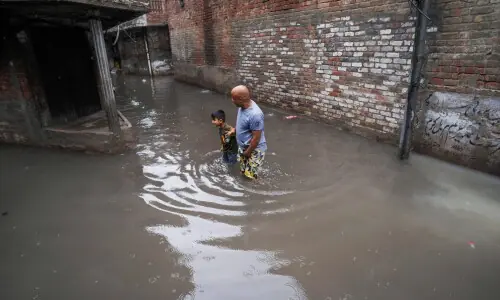
In Britain, it was incredibly wet. Almost six centimetres of rain fell on Saturday in parts of southern England, and there were over 20 flood warnings and 100 flood alerts in effect. The wettest April ever was followed by the wettest June (more than double average rainfall), and July has started the same way.
Russia had its hottest summer ever in 2010, with peat wildfires raging out of control — over 5,000 excess deaths in Moscow in July alone — but this summer it’s wet in Russia too. Very recently, an astonishing 28 cm of rain fell overnight in the Krasnodar region in southern Russia, and flash floods killed 155 people. Krasnodar governor Alexander Tkachev said: “No one can remember such floods in our history. There was nothing of the kind for the last 70 years.”
There are very unusual events happening in winter too: last January only 14.7 per cent of the United States was covered by snow, compared to 61.7 per cent at the same time in 2011. At least 300 people died in a cold wave in northern India in the previous January.
One could go on, enumerating comparably extreme weather events in the southern hemisphere in the past couple of years. But that would just be more impressionistic evidence, and no more convincing statistically. The events are too few, and the time period is too
short. But it does feel like something is going on, doesn’t it?
The most recent opinion polls indicate that a majority even of Americans now accept that climate change is happening (although, being American, many of them still cling to the belief that it is a purely ‘natural’ event that has nothing to do with human greenhouse gas emissions). Can we really say that something serious is happening, and that it is evidence that the climate is changing now?
No, we can’t. It’s a statistical long-shot, but it is possible that this is just a random collection of extreme events signifying nothing in particular. Occasionally a tossed coin comes up heads six times in a row. But usually it doesn’t.
The best way to approach the question is to ask what we would actually see if global warming had crossed some threshold and triggered big changes in weather patterns. The actual change in the average global temperature would be almost imperceptible: only 1°C or 2°C, or the difference in an average day’s temperature between 9 am and 10.30. What we would notice is that the weather is getting wild.
We never really experience the climate; what we feel is the daily weather that it produces. A climate that is changing will produce unfamiliar weather — and if it is getting warmer, it will be more energetic weather. Wilder weather, if you like.