0
0

Private educational institutions in the province have been violating the last year’s judgment of Peshawar High Court concerning fee concession to two or more brothers or sisters studying in the same school. Following the judgment, parents have been approaching management of different schools for claiming fee concession to their children, but in vain.
A leading chain of educational institutions in Peshawar has been conveying to its students that they had challenged the PHC orders in the Supreme Court and as such they would not implement the verdict. Management of another school, which claims to be an international chain, told parents of students that the verdict was not applicable to them.
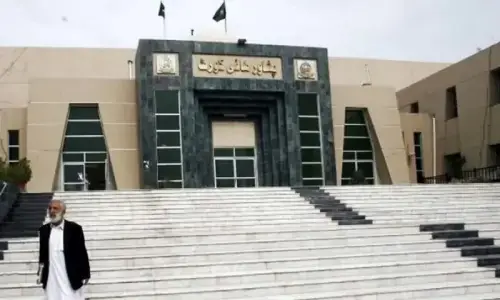
In this regard a contempt of court petition was filed by one of the aggrieved parents before the high court a few weeks ago, stating that while the Supreme Court had not granted any stay order to the educational institutions, they should follow the PHC verdict. During initial hearing of the contempt petition the high court had directed the secretary of elementary and secondary education and director of Educational Regulatory Authority to convey the policy and orders of the high court to all private educational institutions and that anyone violating the verdict would be dealt with for committing contempt of court.
The judgment was delivered by a two-member PHC bench on Feb 1, 2011. The bench had dismissed writ petitions filed by leading private schools and declared as legal the notifications asking them to extend fee concession to siblings studying in the same school.
The bench had declared the Education Code, 1935, under which an impugned notification was issued by the government to schools, a valid legal instrument.
Article 102 (ii) of the Education Code states: “when two or more real brothers and sisters attend the same school or different schools in the province, only the brother or sister in the highest class of a school shall be required to pay the full rate of fee.
The fee payable by the other brothers and sisters shall not exceed one half of ordinary fee.”
“These private educational institutions have turned into money minting machines and charging heavy fee from students, but are reluctant to provide any relief to students even if law provides it,” said advocate Shahnawaz Khan, who was counsel in some of those petitions. He said that the private schools had been violating the court verdict.
In its detailed judgment the high court observed: “Yes, education has become an industry and an enterprise but it should not be shorn of humanistic and philanthropist considerations, otherwise the very purpose of education, which could be none else but character-building and something more than memorizing a few useful lessons, shall stand defeated.”
About legality of the Education Code 1935 the court observed: “The private sector of education cannot be taken away from the umbrella of the Code so as to allow it to grow into a wild forest of money yielding trees.”
The court observed that almost all the business of educational institutions whether public or private was regulated by this Code, therefore, its efficacy or enforceability could not be disputed simply because it tended to deal with the brothers and sisters studying in the same or different schools in the province with an element of equity or benevolence.
Another important judgment was delivered by the high court on June 9, 2011 through which the provincial education department was asked to frame appropriate rules under the Khyber Pakhtunkhwa Registration and Functioning of Private Educational Institutions Ordinance, 2001. The law was published in the official gazette on Oct 15, 2001, but still the provincial government had not framed the rules for its implementation. Even now over a year has passed after the court’s judgment, but the rules are yet to be framed.
While the parents of students continue to complain against the private institutions, especially excessive fee structures, the regulatory authorities remain unmoved.
The petitioner’s counsel had pointed out that Section 26 of the Ordinance provided that the government may make rules for carrying out the purpose of this Ordinance and the regulatory authority may make regulations, subject to approval of the government, for conduct of its business. He requested the court to direct the government for making the rules.
The court had issued directives to the provincial education department to make the relevant rules.
One aggrieved father said that the court should take strict action against institutions not implementing its orders. He claimed that one of the leading educational institutions had started with a single school in 1979, but now its management was running around a dozen institutions in Peshawar, which proved that it had been making huge profits.