0
0

The following excerpt is taken from the chapter, “The beginning (Aghaz) of Biti Kahani”
Now only the women were left in the palaces. Frist, we despaired for the life of our brother and that fright almost dried our blood. Once God had saved him from this calamity, another fiend fell upon us. A couplet:
Ek afat se to marmar ke hua tha jina Par ga’i aur yeh kaisi mere Allah na’i (Though almost dying, yet survived through one calamity, What new disaster has come upon us, Oh Allah?)
The qil’ah looked desolate. All was deserted. We were stunned. We wondered, Oh God, what would happen next? Staying there didn’t look good, but how could we get vehicles to move out. All workshops and offices were deserted. Almost half the night was spent in this anxiety. At last, my Amma jan told Nargis, a maidservant, “Look here, go to the carriage-house and look for Sandal, the rathban (coachman). If he is there, do your best to get the rath readied.”
Nargis hastened away. She saw Sandal running hither and thither in great agitation. She got the rath ready with Sandal and brought them to the palace. In the meantime, Dadi Amma’s rath was also readied. Moti Mahall, too, ordered her rath. There were, thus, only three carriages and women numbering two hundred. Oh Almighty! What should we do now? Who should we leave behind and who should we take with us? At last, with no option left, as many swarian as could be possible were packed into the carriages.
The rest of the women, including the maid-servants, nurses, women-in-waiting and respectable women (bibian) as well, started on foot with children under their arms, and clutching bags and bundles in their hands.
Worried and confused, with no male escort, this leaderless caravan was now on its way towards Jhajjar. On top of it, we had left behind our homes with no guard or caretaker. But at this moment who would worry either about a house or wealth and possessions?
The one and only concern was to march ahead and to reach Jhajjar quickly.
Those on foot were in a miserable and helpless condition. With blisters on their feet, lamentations on their lips, eyes crying and tears flowing, while someone would keep on walking, some would be exhausted; another would sit to rest for a while and another would get up again. Someone’s loose trousers would get caught in thorns; another’s dupattah would get entangled in the hedges of the field. Imagine, how could they walk now when never before had they done so, and particularly now when there was dread of the rebels? In addition there was fear of bandits too.
With great difficulty and misery we covered about a mile or a mile and a half from Pataudi. The night was dark; the sky was overcast with dense black clouds. All of a sudden lightning flashed and there we saw right in front of us five or six horse riders.
Death was now sure. These must be the horse riders of the rebels. They will plunder and murder us. How sad! Death had to overpower us in this jungle! With no coffin and no grave, alas, we would be the repast of the crow and the kite! In the meantime, one of the horse riders shouted. We grew frightened. Everyone got confused. Sandal, the rathban, however, recognised the voice and said, “This is the voice of Qadir Bakhsh, the sawar.” Coming close to the riders he found out that those were indeed our horse riders. Hastily he came to inform us of this. Everyone relaxed.
Sandal then went near them and described our condition and inquired where they were going. They said they were going to Jhajjar to join the Master, i.e. my father, but now they would stay with us. Once the horsemen rode with us we felt a little comforted. We moved ahead and arrived at a village by the name of Khandyola. Seeing our caravan, the landholders of this village with cudgels on their shoulders and choppers in their hands came upon us to plunder us. Noticing that we had horse riders with us, they hesitated and did not dare to harm us. Well, we escaped from these tyrants too and proceeded further. After a little while we saw another village. We halted there. All of us were thirsty and so we drank water, rested a while and marched again till noon. In the afternoon we arrived at a village called Swari and alighted at Faqir ka takya. We were in truly bad shape.
Even the brave and fine persons were in miserable conditions; acute thirst had parched our throats. In addition, children were bitterly crying because of hunger. Well, we had some water but we wondered how to get some bread. At last Dadi Amma gave some money to the faqir pleading, ‘Sa’in bake some bread for our children.’ That beggar, who begged for morsels of food, may he be dead, got ten or fifteen thick, coarse loaves made of barley flour for us.
As soon as we put a morsel in our mouth it got stuck like a bullet in our throats. Some wept while the others laughed at this state.
In short, we managed to swallow two or three morsels with gulps of water. Once we had gulped down the meal we wished to have pan. Lo! Except the pipal leaves was no trace of a pan leaf there.
Of course, there were a few women who left behind everything else but brought with them the load of their pandans. From these women some got pans while others got betelnuts. Whatever one could get they ate.
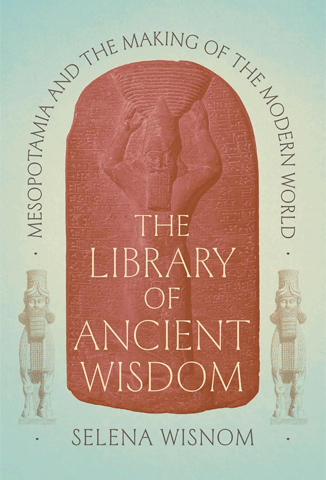
A story of Days Gone By Translation of Biti Kahani (AUTOBIOGRAPHY) Translated by Tahera Aftab Oxford University Press, Karachi ISBN 9780199060122 268pp. Rs825