



 6
6

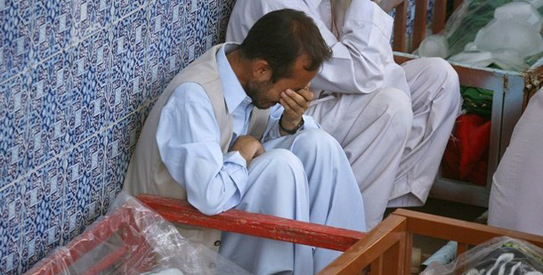
“The smell of charred human flesh is quite sickening and remains with you for days,” says Hasan Abdallah, a reporter in DawnNews, who has seen many a “headless body, or body parts” after a suicide attack.
“However, one gets desensitised to such sights after a while,” adds the young reporter, with a ring of pain mixed with regret in his voice.
Abdallah says he has often witnessed “non-sensitive paramedics” joking around and about corpses.
He is not sure whether it is the “sadistic” streak in these medical corps that sees too much of death, gore and blood or whether “they are trying to shield against the emotional pain” that stems comes from that.
These are indeed no ordinary times, not for Pakistanis at least and not for the media either. Take the suicide attack of September 19 when a car laden with 300 kilograms of explosives flattened the house of Chaudhry Aslam, a senior CID police officer.
Eight ordinary people were killed, yet there was nothing ordinary about their killing.
Or the way 26 Shia pilgrims, going to Iran from Quetta, were intercepted in Mastung and forced off from the bus, lined up on the roadside and gunned down.
Even days after every tragedy the front pages and the television screens are hogged by stories of how their lives were cut short, of grieving relatives and friends and of those who miraculously survived the event.
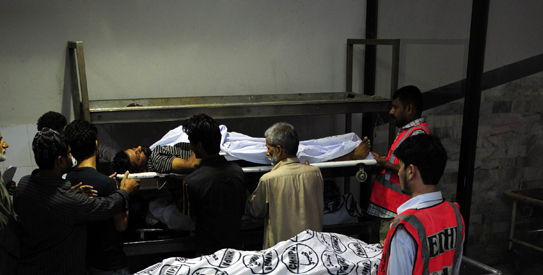
“I open the newspaper with much trepidation, as I anticipate nothing but bad news,” says Zamurad Hussain, a businessman. This has become a common refrain although many have already seen and heard it through the television. So the first shock has already been absorbed.
In the aftermath of the 2009 earthquake, or the 2010 AirBlue Crash, or even the suicide attacks many journalists were shown distraught and emotional. Many choked up or even cried on air.
As these incidents become frequent, reporters try and give a human face to these tragedies. They lead us through the details in the life of each person struck down by the attack and help us understand the grief and anger of the loved ones they left behind. They help us understand the world we live in.
And yet, they are as much affected by the tragedy since they are the first to arrive at the scene.
Many including Abdallah find the most difficult is to go up to victim’s families and asking them “to share their feelings”.
And so despite finding it extremely unsettling and distasteful shoving the microphone in front of people, prying and barging in on their sorrow, asking sobbing families of victims of violence how they are braving the tragedy and how, in their opinion, violence be handled, the job has to be done.
But there are few reporters who can muster the courage to ask the difficult questions.
In the process, it affects them personally, taking a toll on their emotions. What’s more, they were never forewarned of how taxing this work is on their nerves.
Faiza Ilyas, working in an English daily, finds it the most difficult part of her job. “It leaves a person emotionally drained,” she says. “At times people are unwilling to talk and you have to be really careful how you start and steer the conversation and how not to tread on their sensibilities,” she says.
According to Ilyas, it’s important that while gathering information the reporter empathises with the grieving family.
“As a reporter one has to feel the pain people are going through, yet, keep your emotions at bay,” Ilyas says.
Abdallah disagrees saying: “You don’t really share their grief, it’s utter nonsense.”
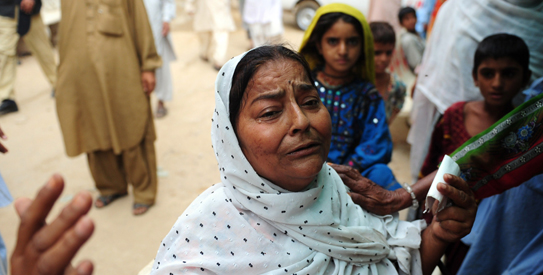
Riaz Ahmed, a reporter in a private TV channel, agrees with Abdallah saying: “A reporter goes there with a purpose -- to get a story and a few news bites, nothing more.” He says media bosses are fixated with adding the element of tragedy in their stories, “and we shamelessly go and ask painful questions to those freshly grieving relatives”.
“I hated it and would often get into heated arguments with my editors for asking me to do this,” says Abdallah who believes such stories are only done to boost ratings. “At the back of your mind you know why you’re there,” he acknowledges.
“Psychologically I have suffered,” Abdallah has no qualms about acknowledging. He has even broken down and cried.
“Men don’t look good crying, I was told,” said Abdallah, after one such incident, and it had to be re-shot.
Sophia Jamal, a TV anchor who has been covering the recent violence that erupted in Karachi in July and August, said she often “choked up” and “cried on air while interviewing relatives”.
“I’d come home devastated, after talking to mothers who have lost their sons to that senseless wave of violence,” says Jamal, mother of one.
Abdallah is sure this kind of sensitive reporting requires certain rules of engagement and careful training which most of the media (not just reporters) in Pakistan are not equipped with.
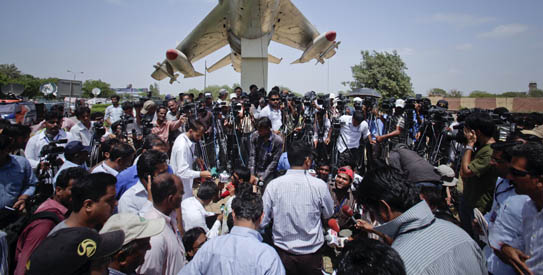
Little wonder then people like Ahmed have “picked up the head of a suicide bomber” after an attack and TV channels shown body parts, even dead corpses, or the hundreds of times of the footage of how a man is shot by law enforcing agencies who begs for his life, thereby playing their part in brutalising society.
So when Ahmed says it is the media which lures and persuades the viewers what they should like, he is not entirely incorrect in his assessment.
Jamal, on the other hand, feels that in the rat race that the media is caught in to be the first to break the news, one has to be astute enough to “read between the lines and the chalking on the wall”. Striking a balance is what one reporter should aim for. “Be clever and discerning as it is easy to be swayed by emotions and just give a one-sided story.”
For his part Abdallah follows his own rules, specially while reporting about how a victim’s family is coping with their loss. “If I’m talking to the victim’s widow, mother or child, I try to imagine myself in their shoes,” he says. And while he believes ethics in journalism are to be observed, he regrets it is a tool that has been chiseled by those “who put economic interest before human grief.”
So why is it important to ask painful questions from victim’s families?
Ilyas explains: “Somebody has to tell their story also,” but adds, “It’s how a reporter/writer shapes the questions that can lessen their pain” which is equally important.
But it is also about adhering to a rigorous pursuit of accuracy and truth based on explanations before coming up with an analysis. What a journalist needs is to be sensitive not emotional.
And if they continually lived in fear of asking painful questions, many stories would never get shown. It’s a risk they have knowingly decided to take.
Zofeen T. Ebrahim is a freelance journalist.


























