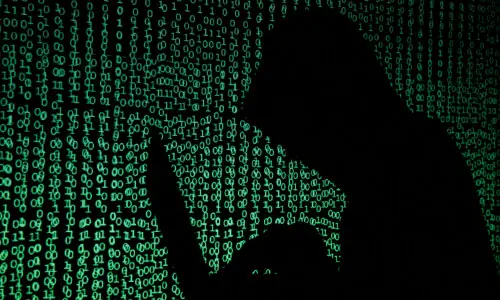
THE spectre of crashing power grids, stalled air control towers, hospitals brought to a standstill and defences left wide open was raised at the first cyber-security world summit that ended on Wednesday, when politicians, officials, military leaders and industrialists warned that the US and other countries were failing to protect computer networks and were vulnerable to attacks of catastrophic proportions.
Harry Raduege, former director at the Pentagon agency responsible for the computer network, said cyber attacks were growing in intensity and sophistication. “We have experienced a number of attacks against the financial sector, on the power grid and against our defence capability,” he told the meeting in Dallas.
Raduege, chairman of the Deloitte Centre for Cyber Innovation, added “What we are concerned about most is the vulnerability of the system and that potential attackers are gaining more skills. So it never ends. It demands constant attention.”Patrick Pailloux, director-general of the French network and information security agency, said he had nightmares about attacks on the electricity system, transport, water supplies, the financial sector and hospitals, which are dependent on computers. “My biggest nightmare is not having enough time to prepare,” he said.
The EastWest Institute summit was attended by 400 representatives of 30 countries, including the US and Estonia, which claim to have been victims of cyber attacks, and the countries they blame for perpetrating them, China and Russia.
Hundreds of thousands of attacks are launched round the world daily, with attackers including student hackers and criminal gangs, and these cost billions of dollars. But attacks launched by countries against other countries are causing the greatest concern. The biggest so far appears to have been on Estonia in 2007, when attacks on its computers brought parts of the country to a standstill, and Georgia in 2008. Both blamed Russia, which denies the charge.
There was a cyber attack on the US last July 4, which Washington suspects North Korea was behind and which it claims was aimed at closing down federal agencies. The US has also accused China of launching attacks, mainly aimed at espionage.
A Republican congressman, Michael McCaul, who helped guide a bill through the US House of Representatives in February to improve the security of US networks against cyber attacks, said “When you mention cyber security to most members of Congress, their eyes glaze over and yet it is one of the most serious threats of this century. We are good at offensive capability but we are not good on defence.”
— The Guardian, London