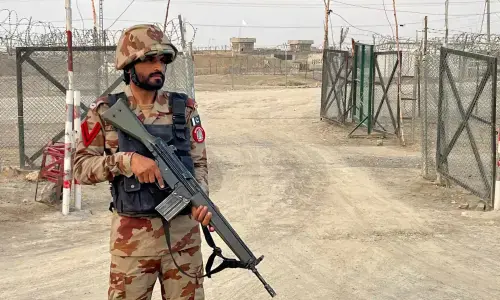
FOR Pakistan, 2009 proved the deadliest year since the fight against Islamic militancy began eight years ago. Although the Pakistani military — for the first time — made some significant gains against the Pakistani Taliban in Malakand and the tribal regions, the fallout saw Islamic militants targeting not just the country's security establishment but also civilians.
A series of never-ending suicide attacks and bomb blasts by the Taliban targeted everything from GHQ and ISI substations to mosques, markets and educational institutions. It was clearly a new and more ferocious phase in the militants' war against Pakistani society.
Still it was the restoration of the country's illegally dismissed chief justice and his 'brother judges', and a new wave of judicial activism, particularly the striking down of the controversial National Reconciliation Ordinance (NRO) and the revival of corruption cases against incumbent ministers and others, that made 2009 the year of the judiciary. This despite the fact that even some of the ardent supporters of the pro-judiciary movement raised objections to certain judgments of the superior courts. Questions were raised about the limits of judicial activism.
Nevertheless, the triumphant manner in which Chief Justice Iftikhar Chaudhry returned to the Supreme Court in March, bringing back with him all those superior court judges who had been illegally removed by Gen Musharraf in November 2007, was, in the eyes of their admirers, nothing short of a judicial coup. Many had thought it was a lost cause especially after President Asif Zardari went back on his promise to his one-time ally Nawaz Sharif to restore the judiciary. Mr Sharif felt compelled to come out openly in support of the lawyers' movement and his entering the arena of street protests changed the entire dynamics of the movement.
The timing of the campaign was also right as the term of the Musharraf-appointed chief justice, Abdul Hamid Dogar, was also coming to an end and it appeared that the security establishment would not intervene. Mr Sharif's calculated move to support the lawyers' 'long march' to the capital made all the difference. The high drama that started on the morning of March 16 in Lahore with the PML-N leader joining the lawyers' protest and crowds swelling to tens of thousands, was enough to make the electronic media go berserk.
By the time the procession reached Gujranwala, with the police mysteriously agreeing to remove all the barricades and the paramilitary troops disappearing quietly, it was obvious that the 'revolution' had the much-needed support of the security establishment.
Until 10 pm on March 16 the president, completely oblivious to the gathering storm, was enjoying a private dinner at the fully barricaded Aiwan-i-Sadr. He had, in fact, been briefed by his overconfident interior adviser that things were well under control. Rehman Malik's assessment was that even if the procession was allowed to enter Rawalpindi it would not consist of more than 10,000 to 15,000 people and could easily be dispersed. Had it not been for the efforts of the then Intelligence Bureau chief, Shoaib Suddle, a few hours' delay in taking the crucial decision to restore the chief justice could have brought down the entire government.
In the end it was a real and well-deserved victory for those campaigning for the restoration of the rule of law and justice in the country. It was a humiliation for the government as its top brass, after taking an unreasonable and arrogant stand, had to eat humble pie.
Chief Justice Iftikhar Chaudhry's return to the Supreme Court revived the hopes of many victims of injustice. The brand of judicial activism he had introduced by taking up public interest litigations in their hundreds had made him one of the most popular judges in the country's history. The judges did not act in haste and took their time before taking up the most crucial issue to decide the constitutionality of Musharraf's Nov 3, 2007 actions.
A larger bench of the Supreme Court ruled that not only was Gen Musharraf's order to impose emergency rule unconstitutional, the judges who took oath under his Provisional Constitution Order (PCO) in defiance of the ruling of a five-member bench, too, would cease to be judges. In fact, the court ruled that Justice Dogar was never a constitutional chief justice. So, in one go the superior courts were cleansed of all the so-called PCO judges.
The case that drew the most attention and stirred up a new debate was focused on the NRO. The controversial ordinance issued by Gen Musharraf was always a sore point, mainly because it allowed top PPP leaders, particularly President Zardari, to have all cases of corruption — instituted by the Nawaz Sharif government in the 1990s — against them withdrawn. Once the government's attempt to get the NRO bill passed by parliament was thwarted by the opposition parties, the Supreme Court became alive to the matter.
Several months-old petitions were placed before the biggest-ever bench of 17 judges. Headed by the chief justice, the bench decided to look not just into the legal aspects of the NRO, but all aspects of the corruption cases. Even the cases that were once pursued in the Swiss courts against Benazir Bhutto and Asif Zardari were discussed in detail as the court wanted to find out which politicians had remained untouched and why issues of morality, incorporated in the constitution by Gen Ziaul Haq, were not being applied in selecting those deemed fit to govern the country.
With the government decision not to defend the NRO, the verdict became predictable. But while striking down the controversial law, the Supreme Court also decided to ensure a new system where it was to monitor the progress of revived cases of corruption against politicians and bureaucrats, most of them loyal to the present government.
However, even while most praised the striking down of a bad law that had tried to legitimise corrupt practices, a new debate started on whether the Supreme Court was overstepping its jurisdiction and interfering with the functions of the executive. Questions were raised about its monitoring authority and reliance on controversial articles of the constitution to turn it into a morality issue. The loudest criticism came from people like lawyers Asma Jehangir and Ali Ahmed Kurd, who had been in the forefront of the lawyers' movement.
But such criticism did not discourage the apex court from pursuing cases it deemed to be in the public interest. So as the year came to a close, another Supreme Court bench took up the issue of loans that were written off.
Many politicians were among the beneficiaries of the write-offs. The new year is to see the court further pursuing this and many other cases, with its stated aim of cleaning the system of corruption and bad practices. Hence, further debate on the division of powers between the executive, parliament and the judiciary is likely.
Celebrations linked to the judiciary's remarkable comeback remained largely an urban phenomenon. However, terrorism was different. The way it spread its tentacles shook everyone. The year 2009 saw a clearer delineation of the battle lines. Almost all militant groups, including various factions of the so-called Punjabi Taliban, decided to join hands with the Tehrik-i-Taliban Pakistan (TTP). After initial blunders and setbacks, the Pakistani military went for a decisive battle against the Islamic militants. Their success, at least in the Malakand region, was largely due to the near-unanimous support it got from the country's mainstream political parties, most importantly Nawaz Sharif's PML-N.
Initially the Taliban movement in Swat and the rest of Malakand had shocked the country, especially when the militants moved into Buner pretending to implement the peace agreement or the so-called Nizam-i-Adl. Their motives soon became obvious. Once Mr Sharif decided to back the government to use force against them, the army took them on in May, leading to a fierce conflict of several weeks in which Mullah Fazlullah's men were either killed or driven out. Army men died in their hundreds, and the collateral damage was enormous. The resultant human displacement of more than three million people drew the attention of the international community.
Earlier in the Bajaur tribal agency an equally successful operation had forced the militants into the mountains along the border with Afghanistan. Here the army came up with a controversial policy to encourage rival tribal groups to raise lashkars or militias to fight the Taliban. The biggest, the Salazar lashkar, remains active in the area.
The TTP's main leadership under Baitullah Mehsud decided to hit back. The new wave of suicide attacks left the army with no choice but to go for the kill in South Waziristan. The biggest success came in the form of an American drone strike in September that killed Baitullah. But the TTP soon chose his successor and retaliated with more bombers. By the year's end the army had managed to take control of large parts of the Mehsud territory claiming the destruction of major terrorist sanctuaries. But the main militant leadership, although on the run, remained intact.
This period saw the TTP use terror assets it had already deployed in the major cities of the NWFP and Punjab. Newer tactics were used with the help of the Punjabi Taliban. Now suicide bombers were joined by what is known in the militants' parlance as the 'fidayeen'. The military was not the only target anymore. Every method was used to terrorise society as we saw in the Meena Bazaar, Peshawar, explosion that killed over 100 people, most of them women and children.
As if a series of other attacks in marketplaces in Peshawar, Lahore, Rawalpindi and even Dera Ghazi Khan were not enough, a double suicide attack at the Islamic University in Islamabad, where women were the main target, gave a new dimension to the conflict. The ensuing panic caused schools to shut down for some time.
The month of March saw the most audacious, though abortive, attempt to take the visiting Sri Lankan cricket team hostage. The incident isolated Pakistan further, with most countries refusing to send their sports teams to play here.
Islamic militants also stepped up their attacks against targets linked to the security forces. A number of intelligence and police installations in the NWFP and Punjab were hit. But perhaps the most organised of all such attacks was the two-pronged strike on GHQ, and the most dastardly one on the Friday prayer congregation at a Rawalpindi mosque frequented by army men and their families.
The GHQ attack literally shook the army establishment. Militants took over 40 people, including many senior army officers, hostage. The episode lasted several hours and resulted in several deaths. It was then that the realisation dawned that a large number of Punjabi Taliban, who had once been involved in the Kashmir militant movement, were leading the fidayeen attacks against the security forces. Names of hitherto unknown groups and their factions, including Ilyas Kashmiri, the Hafsa Brigade and the Ghazi force started to emerge. These were linked to the main TTP in South Waziristan.
As the year came to a close, another factor further caused confusion. If the constant use of drones by the Americans was not enough to make this fight controversial, the revelations that a large number of defence contractors, of the Blackwater/Xe and Dyncorp variety, were being used in the war in Pakistan and Afghanistan created a storm. The issue was rightly exploited by many groups and parties in the country, with some like the Jamaat-i-Islami blaming such American groups for terrorism in the country.
Such statements, though devoid of reality, demonstrated that in the absence of a clear-cut policy by the government and army, the people were not sure who their real enemy was. On the other hand, it was evident that the war against militancy was far from over, and that in the coming years the Islamic militants, and others interested in destabilising Pakistan, would continue to strike.
Still, the year 2009 was not all about judicial activism or terrorism. Although the government received flak for inefficiency, some goals were achieved, the most significant being a consensus on the National Finance Commission award, where all the provinces agreed for the first time on a new formula for the distribution of federal resources. The package giving an identity to the Northern Areas by renaming it Gilgit-Baltistan and holding elections was taken as the first major step towards giving the people of the area their fundamental rights.
On the foreign policy front, Prime Minister Yusuf Raza Gilani's meeting with his Indian counterpart in the Egyptian city of Sharm el Sheikh, was not only an ice-breaker after the Mumbai carnage, it resulted in a joint statement aimed at reviving bilateral talks, although there was little progress on the peace front after that and bickering between the two countries continued.
The growing sense of insecurity among the people due to increased terror attacks, US pressure for a bigger offensive, revived judicial activism, etc, has put the government in a vulnerable spot. Unless the PPP-led government comes up with revolutionary ideas, it will have a tough time in the year ahead.