AS the PML-N responds to the arbitrary dismissal of its government in the Punjab, following disqualification of the Sharif brothers by a Supreme Court bench from holding public office, by taking to the streets and throwing itself into the lawyers` movement, the failure of Pakistan`s political leadership is once again manifest.
During the previous experiment with democratic rule (1988-99) it took eleven years for the politicians to exhaust their credibility and empower Musharraf to seize control in a bloodless (counter-)coup. Musharraf`s arbitrary treatment of the superior judiciary in 2007 gave Pakistan`s disgraced politicians-in-exile an opening. Riding on the backs of the lawyers and exploiting the vocal media that mushroomed under Musharraf`s rule, the émigrés were able to worm their way back into the national mainstream.
It was hoped that this time around Pakistan`s “seasoned”, “experienced” and “mature” political leadership would be able to work together and learn from their past failures. Instead, in just thirteen months the politicians are once again at each others` throat and ready to plunge the country into chaos for personal political gain. For this situation both the PPP-led government at the centre and the PML-N are to blame.
The central government is chaotic and whimsical. Even after a year in office, it seems unable to decide on basic appointments and the distribution of spoils. Rumours abound of rifts between the Presidency and the Prime Minister`s office; of arbitrary shuffles and reshuffles of the bureaucratic deck, and of delay, inconsistencies and kleptocracy.
The furious denials issued by the powers that be only serve to confirm, in the cynical world of Pakistani politics, the veracity of the claims being made. The government does not seem particularly interested in governing. Serious problems including administrative reform, the power crisis, law and order, etc., continue to fester. The illusory and transient consolidation of power through monopolisation of patronage appears to be the principal game in town.
The central government also appears to have repudiated its solemn commitment to the Charter of Democracy. Hence, the powers of the president are unlikely to be clipped though they may be “revisited” and eventually trimmed, nor is the `non-functional` Chief Justice Iftikhar Chaudhry going to be restored. The indemnification of the November 3, 2007 emergency also may not be reversed; the National Reconciliation Ordinance is here to stay. The centre would not tolerate any meaningful provincial autonomy though it may let the NWFP change its name as a sop to local sentiment. It is easy to see how in the emerging narrative the PPP is likely to be cast as the villain.
The PML-N, however, isn`t exactly a league of angels sent to save Pakistan from the Pakistanis. Its leaders are notoriously patrimonial in their approach towards running the affairs of the state. In Pakistan`s history no party (or military strongman) except for the PML-N has ever physically stormed the Supreme Court and openly fomented a judicial insurrection. That Nawaz Sharif fancied himself as Pakistan`s amir-ul-momineen and would have turned the country into a dynastic theocracy if it weren`t for Musharraf`s coup speaks volumes about the PML-N`s inherent intellectual and moral bankruptcy.
Many who ought to know better have placed their faith in the PML-N`s conversion to the rule of law, institutional autonomy and religious moderation. It would, however, be rather imprudent if not naïve to forgive and forget the PML-N`s long list of original and not-so-original sins.
To its credit the PML-N has sacrificed participation in the central government and its government in the Punjab at the altar of judicial autonomy. Given the extent to which Pakistani politics are invested in the official patronage that flows from participation in government, the PML-N`s sacrifice is worth noting. This sacrifice does lend credence to its claims of being genuinely committed to the principles it now espouses. There is also merit in the argument that the rule of law is worth struggling for and a necessity if Pakistan is to be rehabilitated and re-energised along modernist lines.
To its critics the PML-N`s maximal position on the judiciary is a ploy to destabilise the centre and force early elections. After all, many of the judges that were arbitrarily dismissed have been reappointed, if not restored. There is also merit in the argument that Iftikhar Chaudhry is now a political figure and as such cannot be restored to the position of Chief Justice of the Supreme Court. That the PML-N would engage in this level of brinkmanship at a time of war, insurgency and economic crisis can be cited as lack of pragmatism and disregard for the greater interests of the state.
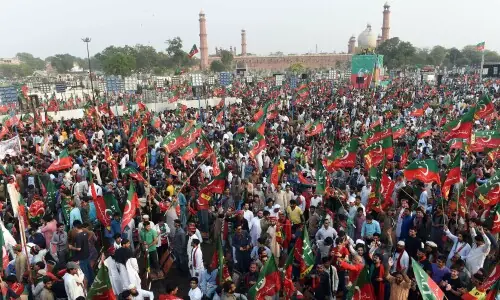
While Pakistan`s politics degenerates into open conflict between the bad and the worse the question of the future of democracy in the country appears set to be settled sooner rather than later. The PML-N`s agitation in Punjab could of course peter out after a few weeks. It could also, however, coalesce with the lawyers` movement, gather steam and make it impossible for the province to return to normalcy.
The point that ought to be understood is that if the agitation takes an ugly turn the result is not likely to be the strengthening of democracy but its termination. Successful campaigns of civil disobedience and agitation in Punjab have traditionally terminated in martial laws and coups.
In 1952-53, the anti-Ahmedi agitation led to the imposition of martial law in Lahore. The martial law remained in place for two months and gave the military its first taste of civil power and public approval. Khwaja Nazimuddin`s government was dismissed in April 1953 by Governor General Ghulam Mohammad and his military/bureaucratic cronies. This ushered in a period of indirect rule by the army and bureaucracy that lasted from 1953 to 1958.
The 1967-68 anti-Ayub Khan agitation in Punjab paved the way for Yahya Khan`s brief but disastrous military rule. It was only after the military defeat in East Pakistan undermined support for the regime within the armed forces that power was transferred to Zulfikar Ali Bhutto and the PPP.
The 1976-77 anti-Bhutto agitation launched by the PNA after the controversy over the rigging of the 1977 elections enabled the army chief General Zia-ul Haq to seize power. He held on to it for eleven years after promising to hold elections in 90 days. Democracy was restored only after Zia and many of his senior officers were killed in a mysterious air crash.
These historical antecedents ought to caution the PML-N and its supporters as they charge headlong into a struggle for “true” democracy and complete judicial restoration. If the agitation spreads and attains a critical mass that the government cannot control the consequences are not likely to be those the PML-N has in mind.
The writer is a faculty member of the Quaid-i-Azam University, Department of History, Islamabad.
niazone80@gmail.com