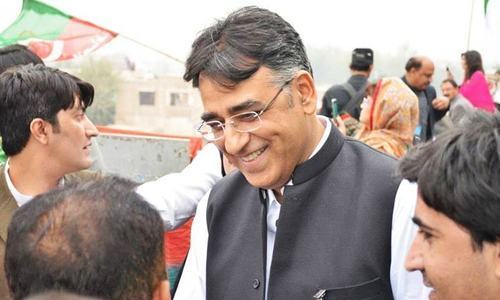
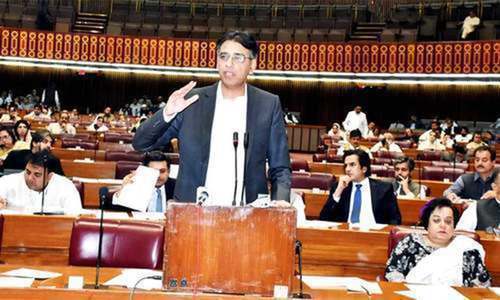
THE reasons Finance Minister Asad Umar announced a supplementary budget for the current year, according to his speech in the National Assembly, were the previous government’s ‘unrealistic budget’ and the inevitable corrective measures required to avoid a severe crisis.
Yet the budget appears to be a political statement rather than a serious economic effort.
The minister commenced his speech by mentioning three unrealistic areas of the original budget 2018-19: a Rs350 billion overstatement of revenue flows, a Rs250bn understatement of expenditures and a Rs286bn expectation of cash surplus from provinces.
While acknowledging that it is unrealistic to expect a Rs286bn surplus from provinces that together posted a Rs18bn deficit last fiscal year, this head should have been either abolished or a more realistic figure put forth after appropriate consultation with provincial governments. The target, however, remains unchanged in the revised budget.
The net impact of the revenue adjustment made in the budget is no more than a negligible Rs48bn: the total tax revenue target has been brought down to Rs4.72 trillion in the revised budget from Rs4.89tr — a reduction of Rs169bn; and non-tax revenue is now projected to be Rs893bn instead of Rs772 in the original budget — an increase of Rs121bn.
The budget appears to be a political statement rather than a serious economic effort
Therefore, at the end of the day, total resources will be higher by just Rs63bn — Rs5.31tr under the revised scheme against Rs5.25tr in the original budget — since external receipts are now anticipated to be around Rs32bn greater than the Rs342bn visualised in the April 27 budget.
Apparently because of a devaluation of around 18 per cent from April 27 to date, interest payments are now forecast to be Rs222bn higher — Rs1.842tr instead Rs1.62tr. Defence expenditures, subsidies and day to day government expenditures will mostly remain unchanged at Rs1.1tr, Rs175bn and Rs460bn, respectively.
In fact, a Rs44bn subsidy claimed to have been provided to the five Punjab-based zero-rated export sectors — textiles, leather, sports, carpets and surgical goods — in the shape of a fixed gas sale rate of $6.5 per unit is yet to be made part of the balance sheet.
Likewise, some other subsidy items like the Rs6-7bn provided to the fertiliser industry still remain outside the budget even though both measures were announced before the supplementary budget.
The federal public-sector programme will drop by Rs225bn to Rs575bn instead of the original Rs800bn. With this, there will be no more room for manoeuvring under this head in the case of further slippages on the revenue side.
Also suggested is a Rs100bn cut in projections for the petroleum levy which had been kept in the original budget as a cushion to provide relief in times of a fluctuation in international oil prices. The PTI will now need to make any future adjustments in the sales tax rate which will transfer the majority (almost 60pc) of the collection to the provinces.
There was hardly any need to remove this cushion from the budget when it could just as easily have been avoided by not increasing the POL prices. All these measures hardly make up for the 2.1pc (Rs810bn) of GDP fiscal adjustment claimed by the Finance Minister. The actual adjustment is no more than Rs300bn, even less than 1pc of GDP.
Secondly, the country faces a rather serious challenge on the external front yet the solutions brought forward are focused more on local adjustments that will result in inflationary pressures while doing little to address the current account deficit.
A high inflation-low growth combination is one the country can scarce afford at a time when economic growth was just taking off after a decade of sluggishness. We can be prepared once again for squeezed individual budgets, reduced job creation and an exportable surplus leading to stagflation.
Electricity, gas, fuel and transportation, devaluation and an increase in policy rate can have a substantial impact on inflation given that just four of these items – electricity, gas, transport and housing – have a weightage of almost 37pc in the consumer price index.
Of the Rs183bn additional revenue, about half is expected through administrative measures and use of modern technology.
The reversal of the PML-N’s admittedly drastic measure barring non-tax filers from purchasing properties and certain vehicles gives silent assent to the black economy.
Building on ex-finance minister Miftah Ismail’s strategy, Mr Umar continued to impose and increase duties on about 600 items in an attempt to curb imports. Such steps have a lag effect and start yielding results in around two to three months.
While the trade deficit has already shown signs of slowing down, as exports start to grow much faster (5pc) than imports (1pc) in the first two months of the current fiscal, there was hardly a word from the finance minister on how he planned the near-term challenge of sliding foreign exchange reserves that he conceded were not enough to finance more than six to seven weeks of imports.
Published in Dawn, The Business and Finance Weekly, September 24th, 2018