0
0
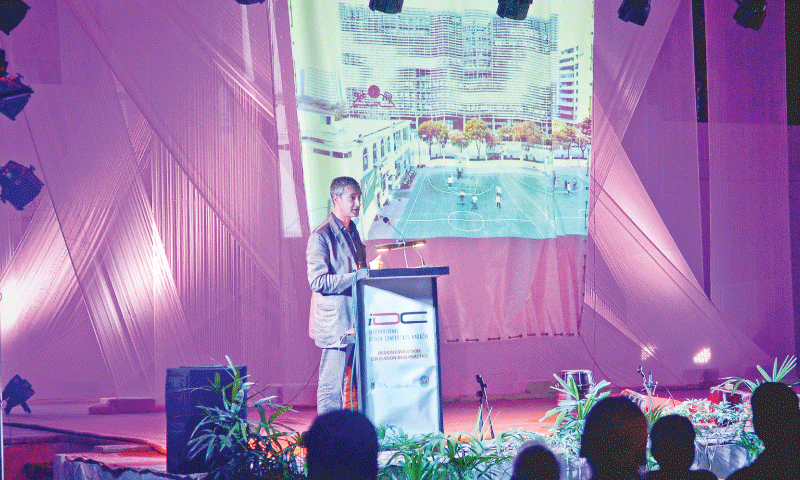

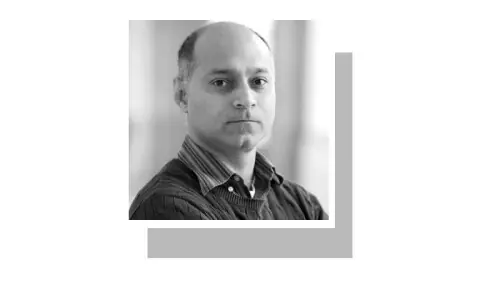
KARACHI: “The work of architect has gone from cutting stone to just tracing lines on paper,” said Prof Mehrdad Hadighi of the Pennsylvania State University during his keynote lecture at the opening ceremony of the International Design Conference Karachi on Monday.
The three-day conference on the theme of ‘Design, evolution, education and practice’ is being held at the Indus Valley School of Art and Architecture.
Prof Hadighi’s highly technical academic talk traced the relationship of theory and philosophy of architectural design. He used Darwin’s assertion about design without the designer to explain that the scientist of evolution believed that favourable variations in natural design such as the beaks of birds even are preserved and that those variations that are “neither useful nor injurious” are not affected by natural selection, and would be left either in a state of flux, or “would ultimately become fixed, owing to the nature of the organisms and the nature of the conditions”.
Three-day International Design Conference Karachi opens at IVS
Over the years, the techniques for cutting stone have had to be altered according to the terrain, he said, adding that the tools, too, had been evolved.
“Design has had to work out itself through idealisation. Poets use the written word to communicate ideas but editing distances is further from pure thought. Design is a bridge between art and science but the designer has now been distanced from his ideas by getting someone else to materialise it,” he explained.
What he meant was that the architect who at one time both designed and built structures is no longer doing so. “Design and construction were separated from each other. The architect was given the intellectual or ‘noble’ work while the builder was responsible for the physical labour,” he said.
The separation of design and construction is like “a divorce between thinking and working,” he further explained, while showing through various examples that the bifurcation of ideas and materialisation was not particularly that good an idea.
For instance, he said, there were people who altered a building according to their needs by replacing and changing materials such as paint, metal, wood, glass, cement, etc. Columns, beams and prefabricated parts also came into play as the space between ideas and material, between drawings and buildings, became places to explore and innovate. How making adjustments to old designs and living areas according to the need of individuals gave way to something remarkable such as creating different units within one structure, he observed.
“This is how you come up with practical design to make an environment-friendly place to live in,” he said while sharing the pictures of buildings with holes drilled through for ventilation and lights, all done due to necessity as the designer and constructor become one and the same.
Co-chair of the conference Farah Mahbub, IVS dean of academics Dr Jawaid Haider and Anthony Dean of the US State Department’s Cultural Affairs also spoke.
Published in Dawn, February 21st, 2017