0
0

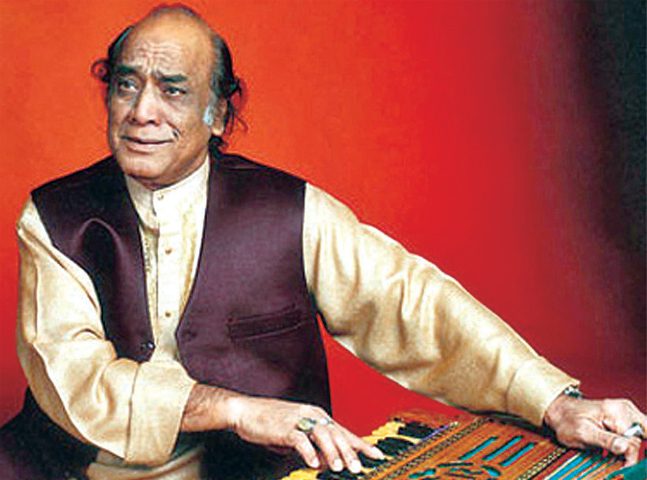
With the demise of Mehdi Hasan four years ago on June 13 ended a golden era of ghazal singing. Undoubtedly, he founded his own style of singing in this genre and no ghazal singer after him could surpass him.
Before the early 1950s, ghazal used to be sung as a thumri albeit with a slight difference. Begum Akhtar, Inayat Bai Dheroowali, K.L. Saigal and many others ventured into this genre by singing the first line of the couplet without rhythm followed by the second line with rhythm in a relatively faster tempo. Similarly, the choice of theka or taal, the rhythm pattern, was also limited as hardly a pattern other than keherwa (four beats) and dadra (six) beats was used.
Musical genius hidden in Mehdi Hasan studied the flaws and loopholes in this style and, with sheer hard work, came up with a new one that was purely his own, and dominated the horizon of ghazal singing for a little less than half a century.
He would start his recital with a small alap giving an outline of the raga in which the composition had been set. Then one by one came couplets, but both lines were set in a definite and suitable rhythm pattern ensuring at the same time that the same fell on the most appropriate word of each line of the couplet. He also broadened the range of rhythm patterns by introducing taal patterns such as rupak (seven beats) in addition to employing varieties in keherwa and dadra.
This new style combining richness of classical music and delicacies of light music came as a breath of fresh air in the realm of music, not only in sub-continent but in whole of the Urdu world taking Hasan to the zenith of popularity. The whole affair started with radio programmes and very soon he was requested to lend his voice to films where he sang both film songs and ghazals, which remained his forte.
Initially trained as a classical vocalist by his father Azeem Khan and uncle Ismail Khan -- court musicians of Jaipur state before Partition – Hasan had an in-depth knowledge of sub-continental classical music and would prefer to self-compose the ghazal he would choose to sing.
He was decorated with the most coveted awards and state and private honours both in Pakistan and abroad for his unparalleled musical genius. But the best one, perhaps, is the compliment bestowed by his Indian contemporary, the legendary Lata Mangeshkar, who said: “His is the voice of gods.”
One of the contributing factors to Hasan’s immortal popularity was quality of the text. In those days, Radio Pakistan employed renowned literati who would select ghazals from collections of classical Urdu poets such as Mir, Ghalib, Aatish to name a few. The producer and station director or some other senior official, who were competent themselves, would further shortlist the selection before handing over the text to a composer.
As luck would have it, Mehdi Hasan got the best of ghazals early in his career on radio. Later, he developed an intimate friendship with poets such as Faiz, Faraz and many others and was requested by a host of them to sing their poetry. In fact, there was a time when every poet of some caliber on both sides of the divide believed it was Hasan’s magical voice that could take their verses to the listeners.
Immense practice -- riyaz -- was surely one of the keys to the success of this great singer. Ustad Badaruz Zaman and Ustad Qamaruz Zaman once told this writer that Hasan invited them to a dinner at his house when they visited Karachi in the mid-70s. As per tradition, there had to be singing before dinner.
“We reached his house shortly after sunset. No sooner had we finished exchanging pleasantries that he requested us to sing. We sang a khayal and a thumri or kaafi which took us a little less than two hours and then requested him to sing,” Ustad Qamar reminisces.
“I would like to share with you my new composition,” said Hasan and started off with a ghazal. “It was no less than three to four hours that he sang just one ghazal offering as many variations and improvisations as possible. We were so absorbed that everybody forgot dinner, which was served after midnight,” concluded Ustad Badar.
Hasan’s tryst with film world has a specialty of its own. A film song is a time-limited presentation and singers can hardly take much liberty and are also being watched by the music director. Being a true genius, Hasan did justice to both time-bound and free singing styles. He would satisfy a film music director by recording a composition in the required time, but would sing the same song in concerts candidly.
Apart from being a legendary ghazal singer, Mehdi Hasan shall also be remembered as a benefactor to Urdu language. He never compromised on wrong pronunciation and thus took forward the cause of the language more than many scholars and researchers in the sub-continent.
Published in Dawn, June 19th, 2016