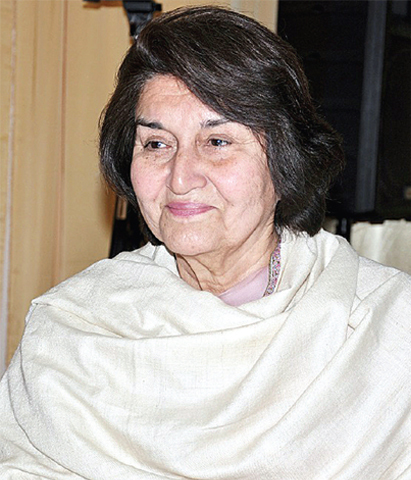
Given that Pakistan has already had women in key public positions, such as prime minister and speaker of the National Assembly, the absence of women judges from the benches of the Supreme Court appears to be a grave oversight. Dawn spoke to retired Justice Nasira Iqbal – one of Pakistan’s most respected women judges – and asked her how this situation came about and what could be done to rectify it.
Q: What is the situation like for women judges in the superior courts?
A: Until 1994, not a single woman judge had been appointed to any superior court in the country. It happened for the first time during Benazir Bhutto’s tenure, when five judges were appointed; three in the Lahore High Court, one in Sindh and one in Khyber Pakhtunkhwa.
But even as their seniority increased, the government never made them chief justice. No woman has been made the chief justice of any superior court or a judge of the Supreme Court, even though a lot of women were eligible.
Read: New bill seeks women judges in Supreme Court
Particularly Khalida Rashid from Peshawar, who has been sent to the international criminal tribunal… and when she said it was her turn to be chief justice, the law department told her “You can’t be chief justice, so you can join the International Crimes Tribunal or you can retire as an ordinary judge”.
But after 1994, there weren’t any women appointed to the bench until 2010. A woman was made a judge in Balochistan, and a [few others]. Right now, there are a total of three women on the Lahore and Peshawar high courts, and one in the Federal Shariat Court.
Q: Why hasn’t a woman judge been appointed to the Supreme Court?
A: It’s male chauvinism. They don’t want to appoint women, they want them to be at a lower standing. It’s a ‘glass ceiling’ situation, that women judges weren’t appointed to the superior courts until Benazir’s tenure.
There are women who are eligible to be appointed to the Supreme Court. There is a woman judge in Lahore who has apparently been at the high court for five years, and there are also women judges at the Balochistan High Court.
But it’s a government of men. No one obeys what Article 25 says, or heeds our international commitments. Maybe their mindset will change as time goes on, but there needs to be some kind of movement in this regard. Women have this right – when a woman appears in court, it’s important that there is a woman there in front of her.
Q: Why is it important for women judges to be appointed to the Supreme Court?
A: Despite popular belief, it’s not true that more than half of the population is women. In the last census, women made up 48pc of the population, and that may have decreased – but we’ll only know for sure once there’s another census.
But whatever it is, they make up around half of the population. And like Mao Zedong said, ‘Women hold up half the sky.’ If women let their half go, the sky would fall. According to Article 25 of the Constitution, our principles of policy – it’s necessary that women be given these opportunities.
It’s a law that in the family courts that there should be at least two women judges in every district, because women understand the problems of other women.
Published in Dawn, April 23rd, 2016