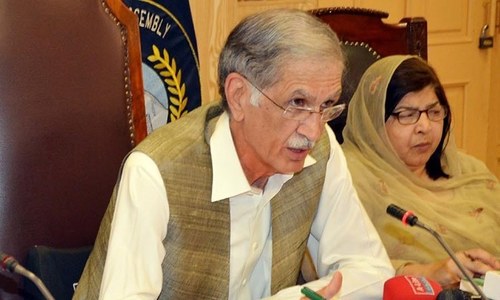
ISLAMABAD: Khyber Pakhtunkhwa Chief Minister Pervez Khattak has said that changes have been made in the provincial Ehtesab commission law to check misuse of authority and ensure more transparency.
Addressing a press conference here on Saturday, he said: “We have not curtailed powers of the commission.”
He said an amendment had been introduced in the Khyber Pakhtunkhwa Ehtesab Commission Act to reduce discretionary powers of the director general of the commission.
Now a five-member committee, he said, would decide with majority whether or not to proceed with a case. This power had earlier rested with the director general, he added.
The chief minister said the committee, not the director general alone, would take all decisions to ensure transparency. He expressed displeasure over politicisation of the issue.
Mr Khattak said in case of the arrest of a parliamentarian on corruption charges it would be mandatory for the commission to inform the chairman of the Senate or speaker of the National Assembly or the provincial assembly.
In case of a bureaucrat’s arrest, he said, intimation to the chief secretary would be mandatory. “It will be just intimation, not a prior approval.”
He said no arrest would be made without a warrant of arrest approved by the commission. The duration of remand was reduced to 15 days from 45 days.
In reply to a question, the chief minister said it was a prerogative of the provincial government to decide whether or not a law should be amended.
He said no inquiry would be initiated on an anonymous complaint. The complainant should have sufficient evidence which could become a proof for investigation into the case.
He said if an accused was cleared by the commission without establishment of charges he/she would be paid Rs2 million as compensation.
The chief minister said the Ehtesab commission law had to be amended because working of the commission had been affecting the working of government officers. He said the commission had been bound to submit its performance report to the provincial assembly before the end of a calendar year.
The record whether it was ceased by the commission or provided to it would have to be returned to the person or department concerned within 15 days, he said, adding that a reference would have to be made within seven days.
Mr Khattak said an enquiry would be completed in 90 days, while an investigation would be carried out within 30 days and after that the commission would decide whether or not to take the reference to court. He said the commission was empowered to constitute a scrutiny committee to revisit the status of employees of the commission appointed earlier.
The amendments had elaborated procedures for the appointment of the director general and members of the commission and their powers.
Published in Dawn, February 14th, 2016