The courtroom, where Mughal emperors used to make judgments on issues related to disputes at the vanished Fort Feroza in Mansehra’s Gulli Bagh area, is in imminent danger of collapse.
As the name suggests, Gulli Bagh, which was around 20km from Mansehra, was famous for flowers, including exotic ones, when it was the capital of the ‘Pakhli Sarkar’ state in 1500AD.
Another portion of the courtroom, where Raja Dewan Baba, a saint of that era known for miracles, was pulled down recently. Ironically, it is being reconstructed instead of being preserved.
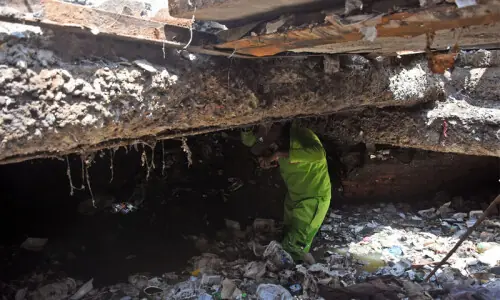
The neglect of the relevant authorities is also reducing other historical pieces of the area to rubble. The bricks of the courtroom are broken to the extent that the entire building could collapse anytime.
Currently, the abandoned structure is a safe haven for addicts. The remains of burnt wood could be seen scattered all over the place.
Seeing the relevant authorities to be unconcerned about the maintenance of the historical asset, the local residents stepped in and plastered the broken portion of the structure with mud. The move however didn’t help the courtroom stand on its foundation or check degradation.
There are calls for the preservation of this structure of Mughal history along scientific lines for the generations to come.
In 15th century, Babar Mirza, a grandson of Amir Taimur and cousin of Zaheeruddin Babar, founder of Mughal dynasty in South Asia, advanced to the area then known as Pakhli Sarkar in the vicinity of Mansehra.
Babar Mirza had built a fortified Fort Feroza in Gulli Bagh, capital of Pakhli Sarkar, where besides other buildings, there was also a courtroom used by Babar Mirza and his successors to issue decrees in matters related to justice.
Sultan Mehmood Khurd was the last Mughal emperor, who ruled Pakhli Sarkar until 1700AD. He was killed in the battlefield.
Thereafter, the local rebel groups captured the governing role in the area.
The history and circumstantial evidence reveal Sultan Mehmood Khurd had made a white stone coffin for his burial during his lifetime but it was stolen.
The Shinkiari police recovered it from robbers few years ago and handed it over to Hazara University for its museum.
“Rains, sunlight and wind have damaged these artifacts but a considerable damage was caused to them by the Oct 8, 2005 earthquake. Cracks emerged during the disaster are still evident on walls,” said Mohammad Safdar, chairman of the Hazara University archeology department. He said the courtroom’s walls were badly damaged, while at some places, the masonry was considerably fractured.
“The locals are still finding antique pieces of Mughal era during excavations and ploughing. Most such historical pieces are displayed at the Hazara University museum along with the white stone coffin of Emperor Sultan Khurd,” he said.
Safdar said ironically, a portion of the courtroom or resting abode of contemporary saint Dewan Raja Baba was demolished by locals and that it was being constructed instead being preserved.
“A great ancient part of the courtroom, where Dewan Raja Baba is buried, has been destroyed by locals. It is now being constructed along modern way. However, its historical charm is no more there for generations to come,” he said.
Safdar said the government should take steps to preserve the ancient structure before its devastation, which, if happened, would do away with a great chapter of Pakistan’s history.
He said the archaeological investigation in Gulli Bagh was important to unearth hidden facts about the portions of the courtroom, which had survived destruction.
The archeologist said comprehensive conservation needed to be carried out in Gulli Bagh to protect it from further decay as conservation of that historical piece would also pave the way for the conservation of the cultural heritage in the area and would bring economic prosperity in the region through tourism. He said encroachments, desiccation, loss of building material, deposition of environmental pollutants and growth of microbial films were major reasons for the dilapidated condition of the Mughal era courtroom.
Sarfaraz, the custodian of Dewan Raja Baba’s shrine, said as the shrine’s dilapidated building could collapse anytime, its demolition was the only option.
An elderly woman, Zaibun Nisa, stated to be the descendent of Dewan Raja Baba, said devotees came to the shrine in large numbers to offer prayers.
“My forefathers used to take care of the affairs of the shrine and adjoining ancient building, which was demolished recently over fears that it could collapse anytime. The devotees later began constructing it on their own,” she said.
Local resident Mohammad Yousuf said the courtroom where Sultan Mehmood Khurd used to issue decrees was in highly dilapidated condition and if the government didn’t step in without day for its preservation, the structure would ruin.
Published in Dawn, December 13th, 2015