60
60

WASHINGTON: Unidentified elements in Pakistan and Afghanistan are major sources of terrorist financing, says a report by the US Treasury Department.
“There is evidence that recently some funding via donations has been diverted from Afghanistan and Pakistan to terrorist groups operating in Syria,” claims a similar report by the British government.
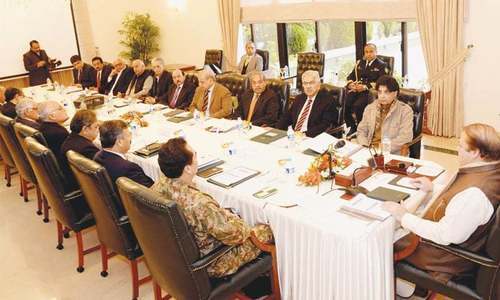
Terrorist financing was the focus of discussions at a White House meeting last week between US security officials and Pakistani defence team headed by Army Chief Gen Raheel Sharif.
Take a look: Hot pursuit of terror funds
The report — “Terrorist Financing Risk Assessment, 2015, — notes that the Haqqani Network generates funds by a wide range of sources including businesses and proceeds derived from criminal activities such as smuggling, extortion, and kidnapping for ransom in Afghanistan and Pakistan
The report claims that Lashkar-e-Taiba receives the majority of its funds from within Pakistan, including by using its charitable front organisations, Jamaat-ud-Dawa (JUD) and Falah-i-Insaniyat Foundation (FIF), to solicit donations.
LeT generates additional funds from private donations and commercial ventures. The report notes that the group’s two largest financial hauls come from private donations during Ramazan and profits associated with the collection and sale of animal hides during the Eid-ul-Azha, each of which nets the group millions of dollars.
The report also points out that Faisal Shahzad, who tried to blow New York’s Times Square on May 1, 2010, received about $4,900 in cash from a TTP supporter in Pakistan in February 2010. He picked the money from a gas station attendant, Aftab Ali Khan, in Massachusetts.
The report identifies Khan as an unlicensed money transmitter. Six weeks later, Shahzad received another $7,000 in cash, sent by the same source in Pakistan, in Ronkonkoma, New York, from a Pakistani businessman named Mohammed Younis who was also acting as an unlicensed money transmitter.
The report names another Pakistani national, Saifullah Anjum Ranjha, who pleaded guilty to laundering money and to concealing terrorist financing. He ran an unlicensed money remitter business in the District of Columbia.
Over the course of four years, a cooperating witness gave Ranjha and his associates a total of $2,208,000 to transfer abroad, explaining that the funds were the proceeds of, and related to, his involvement in international drug trafficking, international smuggling of counterfeit cigarettes and weapons.
Ranjha conducted 21 transactions in amounts ranging from $13,000 to $300,000. He arranged with his associates for the equivalent amount of money, minus commissions, to be delivered to the cooperating witness, his third party designee, or a specified bank account in Canada, England, Spain, Pakistan, Japan and Australia.
Another defendant, not named in the report, is accused of manufacturing heroin in clandestine laboratories along the Afghan border and of leading one of the largest heroin trafficking organisations in the world. The defendant sent the drug to more than 20 countries, including the United States. “Proceeds from his heroin trafficking were then used to support high-level members of the Taliban in furtherance of their insurgency in Afghanistan,” the report claims.
Published in Dawn, November 24th, 2015