27
27

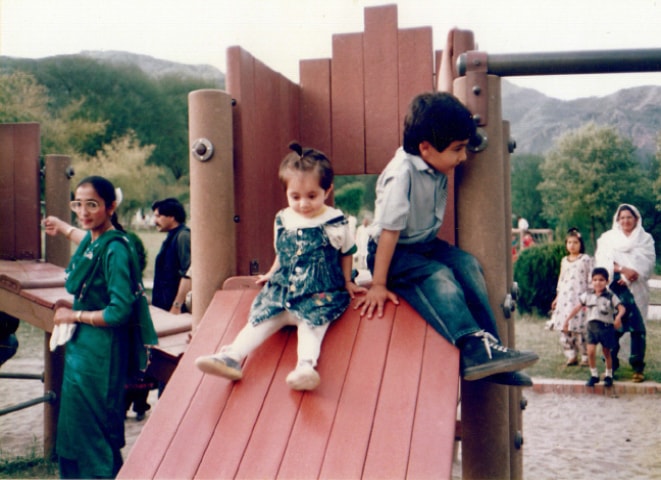 |
| THIS photo (L) from the late 1980s shows the park’s slide in its original state, which is a far cry from its current state of disrepair. — Photos by the writer |
“Children’s plays are their most serious actions,” reads the inscription that greets visitors at the entrance of the Children’s Playland, commonly known as Japanese Park, in Islamabad.
It is a quote from Montaigne, the French philosopher who enjoined upon parents to not take their children’s sporting habits and outdoor pursuits lightly. It is also a fitting dedication to this picturesque park, set against the green Margalla Hills.
Developed in 1985 by the Japanese government as a gift of friendship from the children of Japan to the children of Pakistan, the park remained a favourite destination for children from the twin cities for over two decades.
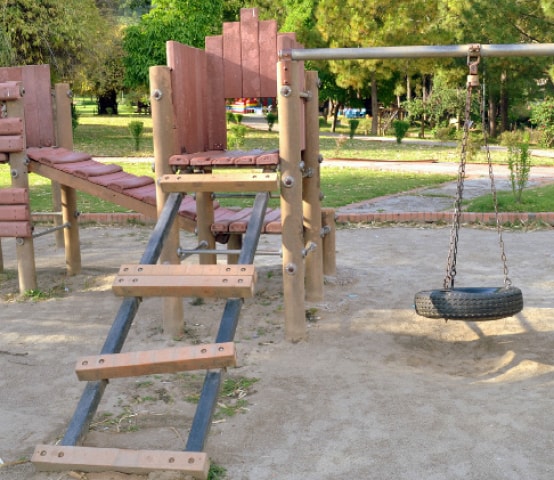
But today, the condition of the park is appalling. Dozens of Japanese play structures, slides and jungle gyms that once drew children here by the hordes are now in a state of disrepair. Hooks and nails dangerously protrude where once ropes were tied for climbing.
Extremely popular amongst children who grew up in the 80s and 90s, Japanese Park is now a shell of its former self
Not a single slide remains usable and broken chains and meaningless half-destroyed structures are scattered over the grounds.
To make up for the lack of swings and other facilities, new Chinese-made trampolines, bouncy castles and electric rides with bright colours have been installed, which offer a stark contrast with the original, sandstone-coloured installations.
The original play structures here were made of a special fibre-based material, not available locally.
 |
Each was given a different name and was designed to stimulate children’s imaginations as well as offering a physical challenge.
One was modeled after a mosque, another like a pirate ship complete with cannon balls. Signs next to each play structure helped children and their parents understand what the challenge was about and which muscles of the body would be exercised while playing on it.
Each installation also had soft sand on the ground underneath to prevent children from getting hurt if they fell down.
Many residents of the capital fondly recall their childhood days spent at the Japanese Park.
Mavra Bari, 25, told Dawn: “The Japanese Park is special to anyone who grew up in Islamabad. As a kid, it seemed so expansive, almost an enchanted place. I recently went back there, and couldn’t believe my eyes. The park seemed so bare and small.”
Zainab Kemal, 28, says that while growing up, the Japanese Park used to be her favourite spot in Islamabad.
“It was unlike any other playground I had been to. I loved the zip-line, which had a pulley suspended from a cable. We would hang from it and whiz to the other end, pretending we were Indiana Jones,” she said, with a chuckle.
“The sun would go down before we were done climbing and sliding off everything. The days never seemed to be long enough,” Danyal Kamal, 28, recalled.
Today, parents complain that the park is just like any other in the city.
“I’ve been coming to this park since I was a child. The only nice thing about it anymore are the trees and flowers, otherwise, there is barely anything for children to do here,” said Sameena Hamayun, a visitor to the park.
However, Saeed Mustafain Kazmi of the Capital Development Authority (CDA) – which manages the park – claimed that it would be restored to its original shape soon.
“We are in touch with the Japanese government for the commencement of repairs because we don’t want to use substandard local or Chinese material and restore the park’s original look.
“The Japanese have graciously agreed to provide the materials and the process for the awarding of the contract took the Japanese about six months,” he explained.
Mr Kazmi said the restoration project, worth 80 million Japanese Yen, would soon be executed.
“Many of the swings and other equipment have reached Karachi port and we will hopefully be able to complete the restoration work within a month,” he said.
Published in Dawn, June 14th, 2015
On a mobile phone? Get the Dawn Mobile App: Apple Store | Google Play