ISLAMABAD: The Supreme Court Bar Association filed a petition on Wednesday through its secretary Chaudhry Muhammad Maqsood Ahmed in the apex court challenging the operations of military courts established in the country in the wake of the deadly attack on Peshawar's Army Public School.
The petition comes nearly two weeks after the newly-established courts sentenced six alleged Tehreek-i-Taliban Pakistan (TTP) militants to death under the Pakistan Army (Amendment) Act, 2015.
The petition, filed against the Federation of Pakistan, alleges that the rights of the accused were not protected in the process as would have been the case in case of what it called a fair trial.
It also states that established principles guaranteed under Article 10-A of the Constitution were not being observed in military courts. Moreover, the petitioner was unable to find provisions on whether Articles 12, 13 and 14 of the Constitution were applied during the trial process in military courts to safeguard the prisoners' fundamental rights.
 |
| A copy of the petition, page 1. - Photo by reporter |
 |
| A copy of the petition, page 2. - Photo by reporter |
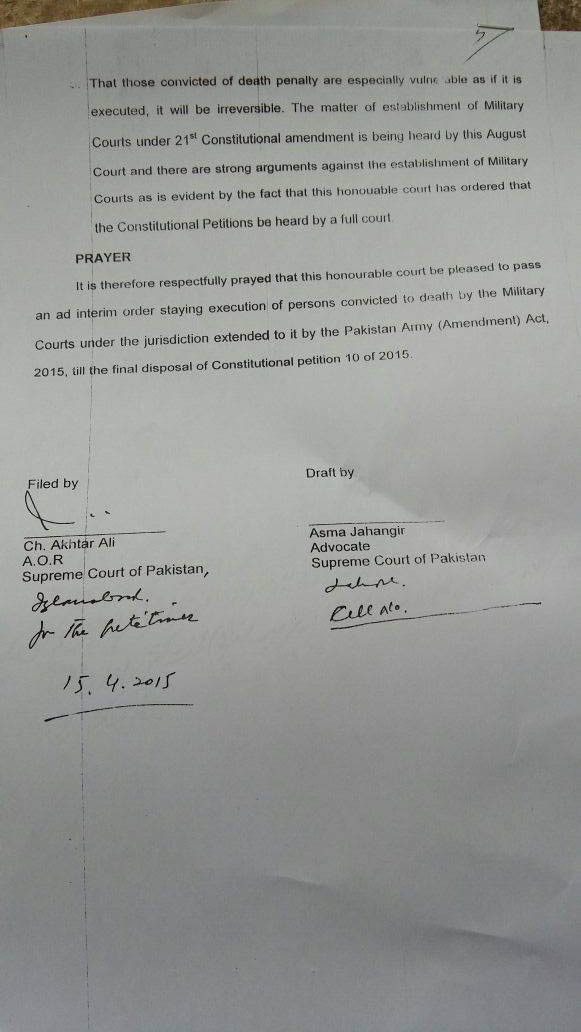 |
| A copy of the petition, page 3. - Photo by reporter |
The application also questioned: "Were the persons arrested enemy aliens? If they were not enemy aliens, were the accused informed of the grounds for such arrests? Were the accused given the right to consult and be defended by a legal practitioner of his choice? Were the accused produced before a Magistrate within a period of twenty-four hours?"
The petition also questions whether the accused were tortured in order to extract evidence or were compelled to be a witness against themselves, stating that these factors were significant to consider when it came to protecting individuals against "arbitrary trials".
The application concluded: "The recent trials of the Military Courts are neither public nor transparent and Military Trials do not ordinarily observe principles of due process, thus the apprehensions of the petitioner are genuine and have merit."
Also read: Military ‘justice’
Political parties had unanimously agreed over the issue of setting up military courts for tackling terrorism cases in the country following the gruesome attack on APS Peshawar on Dec 16.
President Mamnoon Hussain had promulgated an ordinance further revising the amended Army Act to ostensibly aid the functioning of military courts by allowing for trials in camera, i.e. without the presence of the public or the media, and over video link if necessary.
The establishment of military courts has been mooted as a narrow and limited solution to a very serious problem of what he often been called a flawed criminal-justice system.