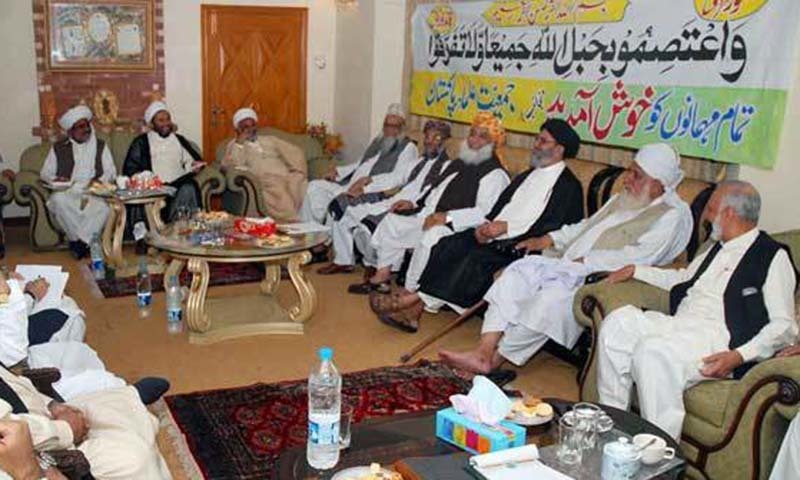
ISLAMABAD : In the aftermath of the 21st constitutional amendment, the country’s main religio-political parties are faced with an existential crisis, but the nature of the crisis differs for each party.
However, acknowledging the gravity of the problem facing them, the Jamaat-i-Islami (JI), Jamiat Ulema-i-Islam-Fazl (JUI-F) and the Wafaqul Madaris Al Arbia – the umbrella body that looks after the affairs of Deoband madressahs across the country – have convened separate meetings on Thursday.
While the Milli Yekjehti Council (MYC) extended a conditional approval to the 21st amendment on Wednesday, the leadership of Jamaat, JUI-F, and Wafaq ul Madaris are expected to oppose the move completely.
The MYC’s objections over the amendment revolved around the use of the words “religious and sect-based terrorism” in the text of the amendment.
Read: Parliament passes 21st Constitutional Amendment, Army Act Amendment
Even those on the other end of the spectrum, Sahibzada Abulkhair of Jamiat Ulema-i-Pakistan (JUP) and Allama Amin Shaheedi of the Majlis Wahdat Muslimeen – also members of the MYC – said that the council agreed that, “Terrorism was terrorism”.
“What will the authorities do if an act of terror is committed by a nationalist or ethnic group,” Sahibzada Abulkhair asked, rhetorically.
However, the MYC did extend its support to the establishment of military courts. Amin Shaheedi summed it up thus: “It was inevitable because the existing courts have failed to provide justice and the system was nearing collapse. What can we expect from courts, where judges such as Iftikhar Chaudhry eagerly release known terrorists,” he mused.
Jamaat’s skeletons
The Jamaat leadership is already in Lahore where a high-level meeting will discuss the implications of the 21st amendment. “We oppose the establishment of the military courts because we are a democratic party and we respect and follow the constitution,” Mian Aslam, JI Naib Emir, told Dawn over the phone from Mansoora. It would be unjust to bracket all Islamic parties and madressahs with terrorism, he said.
But many hawk-eyed observers aren’t convinced by this rationale. They maintain that JI members had been quite active in the Afghan and Kashmiri jihad in the past, but today there are still those among their cadre who flout party discipline by continuing to fight.
“It is a deeper problem than we think. Even the party does not know what some of their workers or mid-level office bearers are doing,” said activist and intellectual Haris Khalique. “Since there are a large number of former or recent jihadis within its ranks, the JI would never like to see them persecuted.”
Also read: Fazl mobilising religious parties to protest against military courts law
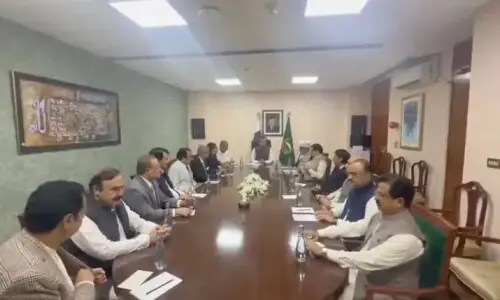
JUI-F chief Maulana Fazlur Rehman has also summoned a consultative meeting of major religious political parties at his residence on Thursday. Those called to the meeting include leaders of the Jamiat Ahle Hadith, Jamiat Ulema-i-Pakistan and the lesser-known Tanzeem-e-Islami.
So severe is teh nature of the threat that JUI-F perceives, that it has also invited arch rival and leader of his own faction of the JUI, Maulana Samiul Haq, to attend the meeting too.
In a statement expressing apprehensions over the new legislation, the cleric from DI Khan claimed that the law was biased against only one sect and could be used to target religious seminaries and institutions.
A party leader, speaking on condition of anonymity, conceded that JUI-F leaders were under pressure from the extremists to speak for them. Many in the party, including the party chief himself, have been attacked by militant groups operating in KP and Balochistan.
“Some of those whom we call the terrorists or the extremists are part of the JUI-F constituency,” explains Amir Rana, director of the Pakistan Institute of Peace Studies.
Singling out a sect
The Deobandi Wafaqul Madaris Al Arbia is holding its own meeting on Thursday to discuss the outcome of the new constitutional amendments and the National Action Plan.
In a statement, the board expressed the fear that this move only targeted one sect. But both Wafaq and JUI-F officials acknowledged that they were referring to the seminaries of Deobandi sect.
Published in Dawn, January 8th, 2015
On a mobile phone? Get the Dawn Mobile App: Apple Store | Google Play