8
8


KABUL: The US and Nato closed their combat command in Afghanistan on Monday, more than 13 years after invading the country in the wake of the Sept. 11 terror attacks to target al-Qaida and Osama bin Laden.
Though quickly routing the Taliban-led government that sheltered the militants, the US-led coalition soon found itself spending billions of dollars rebuilding a country devastated by almost 30 years of war while an insurgency grew as the invasion and occupation of Iraq quickly took America's attention.
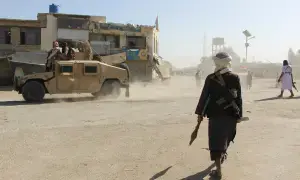
As Nato's International Security Assistance Force's Joint Command, which was in charge of combat operations, lowered its flag Monday and formally ended its deployment, resurgent Taliban militants launched yet another bloody attack in the country.
And with President Barack Obama allowing American troops to go after both al-Qaida and Taliban militants in the country into the next year, the fighting likely won't be over anytime soon.
“I don't think the war will slow or stop during the winter, as attacks on cities are not contingent on the weather,” Afghan political analyst Wahid Muzhdah said.
“I believe attacks in the cities will increase, they attract media attention."
Monday's ceremony saw the Nato flag of the command folded and put away amid the foreign troop withdrawal. From Jan. 1, the coalition will maintain a force of 13,000 troops in Afghanistan, down from a peak around 140,000 in 2011.
As of Dec. 1, there were some 13, 300 Nato troops in the country. US Gen. John F. Campbell, commander of Nato and US forces, said foreign troops now will focus on training and supporting local Afghan forces, which have led the fight against the Taliban insurgents since mid-2013.
“The Afghan security forces are capable,” Campbell told The Associated Press.
“They have to make some changes in the leadership which they're doing, and they have to hold people accountable.“
But as local troops stepped up, they now face record-high casualty figures that have risen 6.5 per cent this year, to 4,634 killed in action, compared to 4,350 in 2013.
By comparison, some 3,500 foreign forces, including at least 2,210 American soldiers, have been killed since the war began in 2001.
Obama recently allowed American forces to launch operations against both Taliban and al-Qaida militants, broadening the mission of the US forces that will remain in the country.
They also will be permitted to provide combat and air support as necessary, while Afghan President Ashraf Ghani also considers resuming controversial night raids that could see Americans take part. Up to 10,800 US troops will remain in Afghanistan for the first three months of next year, 1,000 more than previously planned, said a Nato official who spoke on condition of anonymity to discuss troop deployments.
As a result, there will be little, if any, net drop in US troop numbers between now and Dec. 31, when the international combat mission formally ends. By the end of 2015, however, American officials say the US troop total will shrink to 5,500, and to near zero by the end of 2016. Ghani, who replaced President Hamid Karzai, has embarked on a top-to-bottom overhaul of Afghanistan's military and the security apparatus.
He has begun replacing provincial governors in volatile areas and his office said military leaders will be replaced. His National Security Council also is working on a manual that will set down for the first time in the post-Taliban era rules of engagement and battlefield practices for Afghan security forces. Yet Obama's decision to allow American forces to remain behind in a more active role suggests the U. remains concerned about the Afghan government's ability to fight.
Chances of Ghani restarting peace talks with the Taliban also appear slim as he signed agreements with Nato and the US to allow the foreign troops to remain behind, a red line for the militants.