ISLAMABAD: The government admitted on Thursday that some arrests had been made in connection with the graffiti appearing in the country about the Islamic State (IS) militant outfit.
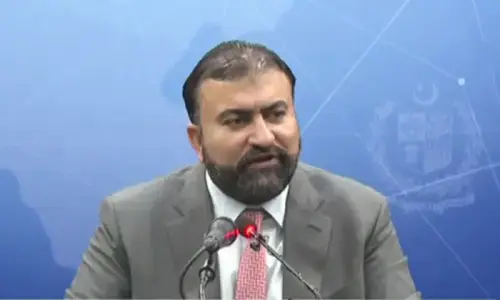
“The police have made arrests in connection with the (IS related) wall-chalking,” Foreign Office spokesperson Tasneem Aslam said at her weekly media briefing.
She did not share details about who were detained, but said that the motive behind the graffiti was being investigated.
“The investigations are under way about the motives and other aspects,” Ms Aslam said.
This is the first time that the government has officially accepted having made a few arrests linked to IS, also known by its Arabic acronym Daesh. Previously, there were reports of some arrests, but these mostly came through unofficial or unidentified sources.
Interior Minister Chaudhry Nisar had denied last month the presence of Daesh in Pakistan.
The sudden emergence of pro-Daesh graffiti in major cities, distribution of the terror group’s literature and more importantly raising of its flags near defence installations of the country are believed to have unnerved the security establishment.
“Pakistan is taking comprehensive action against all terrorists. The determination to root out all terrorists has been clear at all levels,” the spokesperson said.
A group of six Tehreek-i-Taliban Pakistan commanders had joined IS in October after swearing allegiance to Daesh leader Abubakr al-Baghdadi.
Former Interior Minister Rehman Malik in a twitter posting welcomed the arrests.
“The arrests of ISIS operators have supported my claim of ISIS presence in Pakistan. We need to be more vigilant to counter this new alarming challenge (sic).”
HUNTING LICENCES: The spokesperson denied that the Foreign Office had decided the allocation of hunting areas to members of royal families of Gulf countries.
The government this year issued at least 29 permits to members of royal families from Gulf countries for hunting of internationally protected houbara bustard. The controversial move was challenged in high courts of Balochistan and Sindh.
The Balochistan High Court has ordered cancellation of allotment of hunting areas, while the Sindh High Court has directed the Foreign Office to submit documents concerning special permission for hunting endangered birds.
While denying the FO role, Ms Aslam said: “The decision to allocate areas for hunting is not taken by the Ministry of Foreign Affairs. There is a committee, constituted by the prime minister, headed by the finance minister, which takes decisions and allocate areas.”
The Foreign Office, she said, only communicated decisions about allocation of hunting areas to those who had requested for it.
“Whatever directions the court gives we will comply with them,” she added.
Published in Dawn, December 5th, 2014