2
2
MUSCAT: Iran and world powers sought on Tuesday to avoid a nuclear deal falling apart on Nov 24, with a top Russian official expressing optimism and urging key countries to “build bridges”.
After 24 hours in which the chances of a deal seemed to nosedive after senior officials from the United States and Iran failed to make progress, the other parties to the nuclear talks met in Oman.
The one-day meeting between Iran’s nuclear negotiating team and officials from the P5+1 — the United States, France, Britain, Russia and China, plus Germany — was held behind closed doors.
But Russia’s chief negotiator, Sergei Ryabkov, said Iran and participants in the talks should “not kill the chances” of a comprehensive deal by Nov 24, warning that “in the absence of creativity and responsibility” failure was possible.
“We are not working on plan B, that’s for sure,” he told reporters in Muscat, though he did not rule out an extension to an interim deal that expires later this month.
“If by whatever reason, by whatever development, we are not there, I think we will have time on the evening of the 23rd to develop an alternative,” said Ryabkov, Russia’s deputy foreign minister.
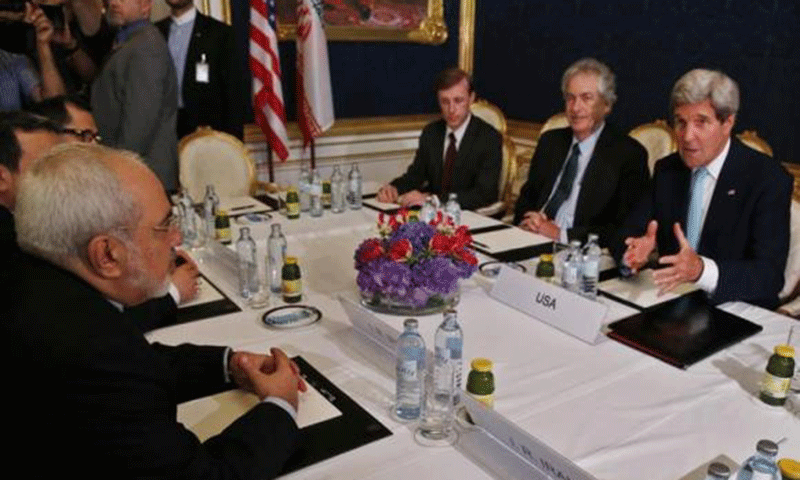
Asked why the talks appeared to be in stalemate, Ryabkov cited the “inability of parties to build bridges over still deep gaps on issues like enrichment, like sanctions. “His comments came after lengthy discussions between US Secretary of State John Kerry and Iran’s Foreign Minister Mohammad Javad Zarif broke off in the Gulf sultanate late Monday with no signs of progress.
Tuesday’s talks, chaired by former EU foreign policy chief Catherine Ashton, were scheduled to brief the P5+1 members on Kerry and Zarif’s talks.
The West still appears unconvinced of Iran’s assurances that it has not sought and will not attempt to develop an atomic bomb, while Tehran wants clearer undertakings on when sanctions will be lifted, as well as fewer curbs on its nuclear activities. The US State Department said Kerry and Zarif’s head-to-head meetings — more than 10 hours across Sunday and Monday — proved “tough, direct and serious”, adding that “there is still time” for progress.
Iran’s deputy foreign minister Abbas Araqchi, quoted by state media, was more candid.
Published in Dawn, November 12th, 2014