143
143


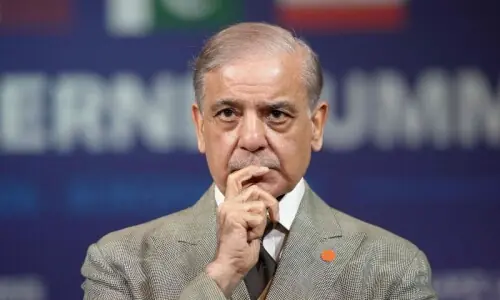
BEIJING: Pakistan will help China with its fight against extremists that Beijing says are active in its unruly far western region of Xinjiang, Prime Minister Nawaz Sharif said on Saturday during a meeting with Chinese President Xi Jinping.
China blames the East Turkestan Islamic Movement for carrying out attacks in Xinjiang, home to the Muslim Uighur people, though many foreign experts doubt the group's existence in a cohesive group.
China, a major Pakistan ally in the region, has long urged Islamabad to weed out what it says are militants from Xinjiang, who are holed up in a lawless tribal belt, home to a lethal mix of militant groups which include the Taliban and Al-Qaeda.
Hundreds have died in unrest in Xinjiang in the last two years or so. Exiles and activists say that Chinese control on the religion and culture of the Uighur people is more a cause of the violence than well-organised militant groups.
Prime Minister Nawaz Sharif told Xi that his country would “continue to resolutely fight the East Turkestan Islamic Movement terrorist forces,” China's foreign ministry said in a statement following the meeting in Beijing.
Pakistan will increase its coordination with China on Afghanistan as well, so as to “jointly maintain regional peace and stability,” Sharif said.
Pakistan will also do all it can to guarantee the safety of Chinese companies and workers in the country, he added, who have in the past been attacked by militants.
China and Pakistan call each other “all-weather friends” and their close ties have been underpinned by long-standing wariness of their common neighbour, India, and a desire to hedge against U.S. influence across the region.
Pakistan, China sign MoUs
China's foreign ministry said the two countries had signed more than 20 agreements on Sharif's trip, including nuclear power and on the deepwater port of Gwadar, which China is developing.
Read: Pakistan, China ink 19 agreements on energy, basic infrastructure
Punjab Chief Minister Shahbaz Sharif, Federal Ministers Khawaja Muhammad Asif, Shahid Khaqan Abbasi and Ahsan Iqbal, and Special Assistant to the PM on Foreign Affairs Tariq Fatemi were also present on the occasion.
The Chinese premier was assisted by Vice Chairman of National Development and Reforms Commission and other officials.
The agreements signed between the two countries include solar power production at Quaid-e Azam Solar Park, easy loan for laying optic fibre between the two countries, mining of 65,00,000 metric tons of coal in Thar Block-2, 870 MW Sukhi Kinari hydropower project, 1320 MW Sahiwal power project and MoU for 100 MW Jhimpir wind power project.
An agreement was also signed to establish an Industrial Park in Faisalabad.
The two countries also inked an agreement for economic and technical cooperation.
China to establish $40bn Silk Road infrastructure fund
The Chinese president also announced today that his country will contribute $40 billion to set up a Silk Road infrastructure fund to boost connectivity across Asia – the latest Chinese project to spread the largesse of its own economic growth.
China has dangled financial and trade incentives before, mostly to Central Asia but also to countries in South Asia, backing efforts to resurrect the old Silk Road trading route that once carried treasures between China and the Mediterranean.
The goal of the fund is to “break the connectivity bottleneck” in Asia, state media quoted Xi as saying during a meeting in Beijing with leaders from Pakistan, Bangladesh, Cambodia, Laos, Mongolia, Myanmar and Tajikistan.
The Silk Road Fund will be “open” and welcome investors from Asia and beyond to “actively” take part in the project, Xi was cited as saying, ahead of a separate summit of the Asia Pacific Economic Cooperation (APEC) grouping, also being held in the Chinese capital.
Last month, Xi unveiled the $50 billion China-backed Asian Infrastructure Investment Bank, seen as a challenge to the World Bank and Asian Development Bank, both multilateral lenders that count Washington and its allies as their biggest financial backers.