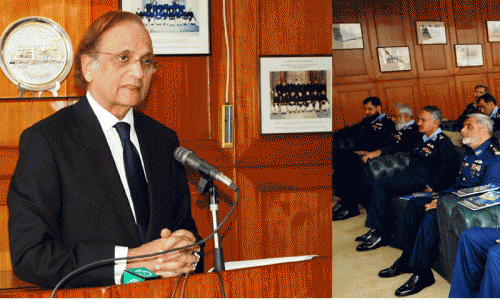
ISLAMABAD: Chief Justice Tassaduq Hussain Jillani said on Friday that the Supreme Court had learned in the post-2007 era how to exert its constitutional authority to bolster and sustain democracy.
This helped not only in guarding against subversion of constitutional values but also prevented a breakdown and unseemly clashes between institutions, he said in his address to a two-day international judicial conference at the Supreme Court.
“The authority of the Supreme Court, especially under its judicial review jurisdiction, may be usefully extended to a number of areas from which it had historically maintained a distance.”
The conference is being attended by the chief justice of Sri Lanka and judges of the superior courts of the United Kingdom, United States, India, Turkey, Afghanistan, Nigeria, Libya and Nepal.
Although the chief justice did not elaborate on the “friction between institutions” and “preventing constitutional breakdowns”, he pointed out that Pakistan, like other transitional democracies, had had its share of societal conflicts which reflect sectarian, racial, ethnic and political differences.
Citing a number of cases which the court had taken up in exercise of its suo motu jurisdiction, like the law and order situation in Karachi and Quetta, the Peshawar church blast and Taliban threats to Kalash people, he said the judiciary had a role to play through effective enforcement of law because only the law liberated an individual, a society or a nation. The judiciary through its verdicts can also promote trust and tolerance. It can also protect minorities and the weaker sections of society, he added.
The chief justice said lack of governance on part of the executive burdened the judiciary and threw up new challenges like ‘judicialisation’ of political issues. And because of erosion or malfunction of other institutions, the courts increasingly have been called upon to decide issues which do not fall in their domain.
Besides, there had been a tendency for a parliamentary majority to bring in legislation which might violate fundamental rights guaranteed under the constitution, the chief justice emphasised, also highlighting gaps between the law and socio-economic demands as well as perception of role of courts in the advancement of constitutional goals. “The law may not keep pace with social dynamics. As a result the courts fill the gap,” he said.
Justice Jillani also touched upon the emotive issue of missing persons, but said that although the judiciary was fully cognisant of, and sympathetic to, the plight of families of the missing persons, it must resist the urge to step beyond its constitutional limits.
“I commend this restraint because it is my conviction that even in the direst of human rights cases, the Supreme Court must remain conscious that its actions are not limited to a single time and space but become a source of jurisprudence for years to come.
“Even a seemingly small move outside the bounds of law has the potential of opening up wide cracks in the edifice of certainty and reliability of justice, which in turn may be detrimental to the very foundations of rule of law in coming years,” he said.
The chief justice said that although it was imperative that the Supreme Court exercised suo motu power to reach out to those who might feel handicapped in reaching out to it, “we are also cognisant that this power has to be exercised fairly, equitably and judiciously so that the integrity of the mainstream system is not compromised”.
Justice Jillani also shed light on the role of judiciary in promoting a culture of tolerance and said the protection of minorities was not only amongst the principles of policy expressed in the constitution but also an integral pillar of Islam.
Besides judges of superior courts, US Ambassador Richard Olson, rights activist Asma Jehangir, Amina Masood Janjua, who is campaigning for the cause of missing persons, and a representative of transvestites, Almas Boby, attended the function.