2
2

Sitting on his haunches outside a small confectionery store on a bright February morning, young Saboor Khan stood up jerkily when I requested his attention.
The bearded Khan, in his late 20s and with a mobile phone in hand, bent and gently replied in the negative when my associate asked him about the presence of Maqbali Khan.
In 2009, the latter was a leading spirit behind the Aman Lashkar (peace force) of Badhbair Baalu Khel, a dusty village in Peshawar’s outskirts boasting brick houses and narrow roads with open drains.
This constitutes part of the Sheikh Muhammadi rural area of Badhbair where, according to the residents, an unpredictable peace and a deepening fear compete.
Many stay inside their homes once dusk has fallen. The situation in the adjoining Mashu Khel, Matani, and Baazid Khel rural areas is even worse. Other than the main roads, the police cannot conduct patrols without elaborate security measures.
The police guard the squares during the day and militants at night, is the common saying these days.
“No, he just left,” said the bearded Khan, straightening up. “I don’t know,” was his laconic reply when asked about Maqbali’s return.
As it eventually proved, Maqbali was not to be met despite a scheduled news interview. He deferred the meeting twice, after two-hour lapses, in as many telephonic contacts.
Maqbali was instrumental in setting up a peace force after militants blew up, with improvised explosive devices, the building of Badhbair’s lone higher secondary school for girls in August 2008.
“No one wants to draw their [the militants’] deadly attention,” said Wahid Afridi, an acquaintance who arranged the interview.
He was referring to the Feb 12 attack in the nearby Mashu Khel village, when militants killed nine members of the same family while targeting Pir Israr, a former head of a peace force.
Israr’s elder brother Pir Zafar, a community police member, was killed in an attack a few months ago.
“They have been targeting the active ones from among the Aman Lashkar members,” said Baseer Khan, a former peace force member from Tootee Khel village, Badhbair.
He said one of his acquaintances, Najeem, was killed six months ago outside his residence at Salman Khel village.
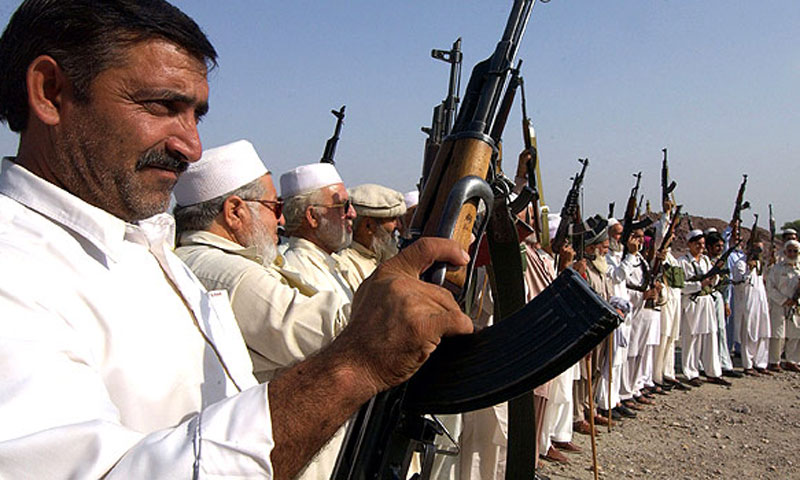
At the prime of Aman Lashkars’ existence in 2009-2010, armed members of the Badhbair, Matani, Mashu Khel, Adaizai, and Baazid Khel peace forces in Peshawar’s outskirts used to conduct night patrols in villages in aid of the police.
But things have changed.
The heads of the Baazid Khel and Matani rural areas, adjacent to Fata, met violent ends earlier. Fahim Khan, of the Baazid Khel peace force, was killed under mysterious circumstances on June 27, 2012, while Haji Abdul Maalik, the commander of the Matani area’s force, was killed in a suicide bomb attack in November 2009.
A similar trend has also been reported from Buner district where peace force activist Adalat Khan was gunned down on Feb 22.
Many hold the creation of Aman Lashkars by the earlier government a violation of the Constitution’s Article 256 that says: “No private organisation capable of functioning as a military organisation shall be formed, and any such organisation shall be illegal.”
Nevertheless, the policy had many takers. It served multiple stakeholders in the short run: anti-social elements got weapons and money from the government’s secret fund, the police force got aides to serve as the first defence line, thousands of jobless youths got temporary jobs against a Rs10,000 salary, and the army set its eyes on four broad objectives.
These included identifying friends and foes, identifying geographical routes in remote districts (the policy was implemented in Tank, Hangu, Dera Ismail Khan, Mingora, Dir Upper, Dir Lower, and Buner district in addition to Peshawar), engaging with communities, and recruiting them as interpreters.
Khushdil Khan, an ANP leader and former deputy speaker of the Khyber Pakhtunkhwa assembly who patrolled in the Badhbair area with a 200-strong contingent back in 2009, blames the provincial government for the recent surge in targeted killings. “The government has abandoned the peace force members, leaving them at the TTP’s mercy,” he said.
However, senior minister Sirajul Haq, the Naib Amir of the Jamaat-i-Islami, told the provincial assembly last week that the government had no intention of making citizens fight against each other, meaning civilians vs the TTP.
In the majority of areas, the peace forces melted into obscurity long ago. The last of the existing Aman Lashkars, in the Upper and Lower Dir districts, are on their way out. According to a senior official, the provincial government has decided not to finance them any further.