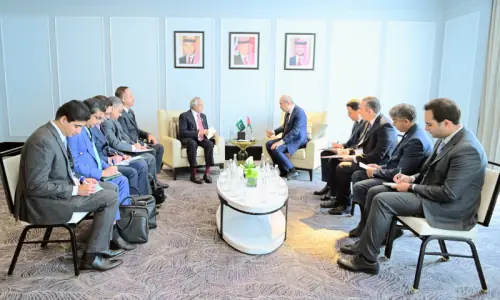
THERE are sound geopolitical reasons why Saudi Arabia would like to know where Pakistan stands, Iranian President Hassan Rouhani’s tour de force being only one of them. As the outcome of the Saudi foreign minister’s visit to Islamabad shows, the two sides have renewed their commitment to deepen their defence cooperation and, in the words of Prince Saud Al-Faisal, “stand by each other”. For Prime Minister Nawaz Sharif, the first visit in six years by a Saudi personage marked the beginning of a new era, while Sartaj Aziz felt satisfied that the two countries stood together “on the many challenges” they faced. Contrary to reports that the visit was Musharraf-oriented, the Saudi prince said the focus of the negotiations was on regional and international affairs. This means Iran, Syria and Afghanistan must have occupied centre stage in the talks, given the changes in the offing.
The Saudi foreign minister’s visit comes in the wake of the Nov 24 Geneva nuclear deal, which has served to lower tensions in the Middle East, reduced the risk of an Israeli military strike and opened the way for greater Iranian interaction with the West. Saudi Arabia and other Gulf monarchies would obviously like to adjust their responses when Iran attempts to integrate itself with the world economy if sanctions, especially those on oil, are eased. Normalisation of Iran’s ties with the West helps Pakistan in many ways, even if the gas pipeline issue remains dormant. At the same time, Islamabad has to maintain and consolidate relations with Saudi Arabia, without compromising its traditionally friendly relations with a neighbour with which it shares the only stretch of borders that relatively speaking is not volatile.
As for Afghanistan, both Islamabad and Riyadh are obviously concerned about the shape of things to come. The US-led International Security Assistance Force is scheduled to leave by the end of the year after more than a decade of war in which America never showed clarity of aim. Having relied on Hamid Karzai and his corrupt cronies all along, America is now discovering it backed a leader who never had his feet on the ground. Pakistan, like Saudi Arabia, fears a renewal of civil war, whose consequences will first and foremost be borne by the Pakistani state and society. Will Islamabad once again soil its hands and fight a proxy war in Afghanistan? It should know that the fighters it backed in the wake of the Soviet withdrawal some 20 years ago are now a different breed and will have no reason to pull Pakistan’s chestnuts out of the fire. It is only by staying away from the new bout of bloodletting that Pakistan — and Saudi Arabia — can help stabilise the regional situation. The same applies to Syria, where Riyadh can have a salutary effect on the situation by reining in non-Syrian militants.