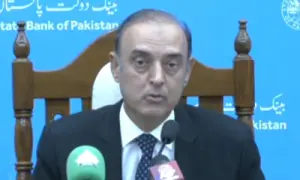
ISLAMABAD: The country was being run without any concrete plan, and the situation has worsened so much that banks refuse to offer even $50,000 business loan without a viable five-year business plan, said Minister for Planning, Development and Reforms Senator Ahsan Iqbal on Thursday.
Speaking at the annual general meeting of Pakistan Institute of Development Economics, Mr Iqbal said that until 1990s, Pakistan was progressing with an average growth rate of 5.5 per cent whereas India was reeling with a growth rate of 2 to 3 per cent which was termed as ‘Hindu growth rate’ in the economic literature of that time.
“Today, we have been relegated to the Hindu growth rate of 2 to 3pc, whereas India has jumped into our footsteps with 6 to 7pc growth rate. Unfortunately, the country was being run in the last one and a half decade without integrated and sound economic planning,” he said.
The planning minister said that the present government was in the process of finalising mid-term and long-term planning — five-year plan and Vision 2025 — to put the country on a sustainable economic path.
Pakistan is faced with eleven deficits which are hampering the economic growth, and energy deficit is on the top of the list. Other deficit areas are: fiscal, saving and investment, current account, infrastructure, housing, human and social development, productivity, competitiveness, governance, and confidence, he added.
To make up the energy deficit, he said, we have to reconfigure the energy mix, with 70pc in favour of thermal generation as compared to 30pc in the past.
He opined that the energy mix has contributed a great deal to our economic woes because with the rising oil prices in international market the cost of generating electricity also multiplied significantly, making it unaffordable for the people, he said.
In the medium to long steps, the government is aggressively pursuing hydro power projects like Dasu dam, Diamer-Bhasha dam and Bunji dam which would drastically change the energy mix of the country.
In addition, the government has also started work on Karachi coastal nuclear power plant to produce 2100MW cheap energy.
In the short to medium term initiatives, the government has focused on installing coal-fired electricity generation projects, and the 6600MW Gadani power park is a major step in this direction.