Two languages, two scripts, two literatures
 It is quite surprising that a strong reaction against Dr Gian Chand Jain’s controversial book ‘Aik Bhasha: Do Likhawat, Do Adab’ is being generated mainly in India, and Pakistani intellectuals, to a large extent, have kept mum on the issue. Though some of our countrymen have replied to the book that has largely been described as ‘communal, biased, sarcastic, acrid, malicious, anti-Urdu and anti-Muslim’, these have been half-hearted attempts to react on an issue that challenged not only our ideological but also our linguistic and literary notions. Even some of our intellectual friends have sided with Dr Jain. For example, in an article published in the fifth issue of ‘Niqaat’, a literary journal published from Faisalabad, an intellectual has lashed out at our countrymen for missing out on a wonderful opportunity offered to us for self-criticism and self-evaluation in the shape of Dr Jain’s book.
Personally I believe in the freedom of thought and expression. I simply reserve my right to differ and do beg to differ, but it is strange that Pakistani critics, researchers and intellectuals -- supporting either side of the argument -- have not been able to write even a full-length objective article on the issue, let alone a book, though the issue concerns them in equal measure.
On the contrary, the reaction in India has been quick, crisp and detailed. In addition to a large number of articles and columns, at least two books have been written on the issue. As I have expressed my views on Dr Jain’s book in an article of mine published in Dawn (Books & Authors, June 24, 2007), I would rather restrict myself to a brief introduction of the two books here.
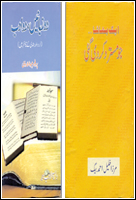 The first one, titled ‘Aik Bhasha … Jo Mustarad Kar Di Gai’ is written by Prof Dr Mirza Khalil Ahmed Beg, former chairman of the Department of Linguistics, Aligarh Muslim University. Written in an objective manner and based on historical and linguistic facts, Dr Beg’s book has totally rejected Dr Jain’s book on the basis of linguistic theories. He says, for instance, that Dr Jain objects to the point of view held by many Muslim scholars that khari boli Hindi was a new language, cooked by the British at Fort William College. Dr Beg has not only proved this notion correct but has quoted Hindu and western scholars who have supported this theory. Similarly he has contested Dr Jain’s point of view that Urdu does not have a chronological precedence over Hindi and has proved, with citations from Hindu scholars (as Dr Jain believed that Muslim scholars were biased against Hindus and Hindi), that Urdu is senior to Hindi not only as a spoken language but also as a literary language.
In the light of Dr Beg’s arguments, it is easy to conclude that in the beginning there was only one language, written in one script (Perso-Arabic), shared by both Hindus and Muslims and known as Hindi, Hindvi, Rekhta, Urdu or whatever, as it had different names in different parts of India. Later on, thanks to the colonial designs, we had one language written in two scripts -- Urdu and Nagari. Now it is two languages with two scripts and two literatures. And this bifurcation took place mainly due to Hindu revivalist and nationalist movements who saw Hindi written in Nagari as their cultural and religious icon.
Dr Beg’s style is unemotional and he views the Hindi-Urdu controversy in historical and cultural perspective. Dr Beg has successfully unmasked Dr Jains’ biased approach and his communal mindset.
The other book ‘Do Zabanen, Do Adab’, has been written by Prof Dr Abdus Sattar Dalvi, former head of the Urdu department, University of Bombay. Dr Dalvi believes that though both Urdu and Hindi are daughters of the same mother, Sanskrit, Urdu is older by centuries. Both share the same grammar and lexicon but have their separate identities. Arabic and Persian have played a vital role in shaping Urdu’s vocabulary. According to Dr Dalvi, orientalists such as John Gilchrist, Duncan Forbes, Fallon, Grierson and even Tara Chand have held the view that Urdu is the original and older language. Prof S. K. Chatterji disagreed with these orientalists and called Urdu ‘Muslim Hindi’. It was a misleading theory and the fact is that after 1850 an artificial language was nurtured by Hindus to keep the Hindu identity intact. According to Dr Dalvi, Chatterji should have rather labelled Hindi as ‘Hindu Urdu’. But in 1973, Prof Chatterji admitted in his lectures that he gave in Bombay that Urdu was the original language and accepted its seniority.
Dr Dalvi says that Hindi was developed in fact in the later half of the 19th century and behind its rise stood communal thinking and British and Hindu politics. Gandhi was of the opinion that neither Urdu nor Hindi but ‘Hindustani’ should be India’s national language. After 1947, Hindi was declared India’s and Urdu Pakistan’s national language and Gandhi’s unnatural theory died a natural death.
Though Dr Dalvi has got it right, I personally disagree with him where he has favoured Gandhi’s theory of a common language for India named Hindustani. The question is: What is or was Hindustani? A new and carefully planned artificial and unnatural language laden with strange Sanskrit words or the same old, common language spoken by the common people of India, both Hindu and Muslim, for centuries and written in one script?
In fact the Indian movies, popularly known as Hindi movies, are Urdu movies. If you want to have a confirmation, try singing a few lines from any ‘Urdu’ Indian movie and you will know it. Why do the producers and songwriters prefer this language which is not pure Hindi, contrary to the language of Door Darshan and All India Radio’s language of the news bulletins? Simply because people do not understand the Sanskritized artificial language and the language spoken and preferred by the man in the street in India is Urdu, the natural, the older and the real language.
Link between literature and politics
“It seems that everyone is a poet in this part of the world,” opined a foreign journalist, who came to Pakistan to cover political developments and lawyers’ movement in the country, when she was told that Amin Fahim and Aitzaz Ahsan both were poets. The journalist was wondering that how these politicians found time and suitable environment for creative writings. Perhaps she was unaware of the link between politics and literature.
The link is vivid from sloganeering with a poetic rhythm and recitation of emotional verses on stage during public meetings of the political parties. Some politicians happened to be good writers and poets in NWFP but politics dominated this aspect of their life and they remained only politicians in the eyes of people. On the other hand, some writers and poets were capable of getting a room at top for them in politics but they preferred to remain busy with pens and books instead of active politics.
Writers should take part in active politics or confine themselves to their domain of literature? It is a question which has been repeatedly discussed in literary circles.
“Writers and poets should mind their own business,” once said renowned poet Mohammad Sadiq Pasarlay during a chat with this scribe. He was of the view that writers possessed a specific type of leniency and aesthetic sense which the politicians lacked. “Politics causes grouping and rift among the poets, so they should keep themselves at an arm’s length from active politics,” the aging poet said.
Opposing his views, Abdul Rahim Mandookhel, senior vice chairman of Pakhunkhwa Milli Awami Party and author of several books, said: “Politics leads society and literature defines society so they can’t be pitted against each other.” He termed political ideology must for every writer to serve the society in a befitting manner.
When general secretary of PMAP, Sher Ali Bacha, passed away few years ago, the trend-setting writer and promoter of modern criticism in Pashto literature Qalandar Momand (late) had said: “People know Sher Ali Bacha Anwar as leader of peasant movement and nationalist politician but most of them don’t know that he was a good writer and stylish poet. There is dire need to explore this aspect of his life.”
Interestingly, Qalandar Momand himself was an active political activist and bore the hardships imprisonment for about six years. But in the latter period of his life he devoted himself completely to literature. Though he used to observe the discipline of Awami National Party throughout his life, Qalandar Momand left active politics and continued his research.
Same was the case of Ghani Khan who possessed more political capabilities as compared to many famous politicians but he preferred to divert his attention to literature and art from politics.
Kausar Ghoriakhel (late), Hamesh Khalil and Aasi Hashnaghrai (late) all played leading role in politics and were jailed but now they are know as literary figures and a sizeable numbers of political activists don’t know about their contribution in this regard. Abdul Akbar Khan Akbar (late) and Mohammad Akbar Khadem (late) can be also placed in the same category.
But the case of Babu Fazle Khaliq was different. He was known for political activism and even his friends came to know about his literary services after his death. Ajmal Khattak, the closest among his all friends, wrote in the foreword of his book that he didn’t know that Babu was a writer or poet.
Though Babu was not a very good poet and most of his poems lack the basic requirements of poetry, yet he nurtured many young writers and guided them to become good writers. Ajmal Khattak himself remained successful in proving his mettle in both literature and politics. Besides publishing more than two dozens books, Ajmal Khattak served ANP as its central president twice. Even common people know him as a poet as well as a politician. Keeping balance between literature and politics amounts to walking on a tight rope. “Everyone has a political ideology. Being a sensitive citizen and intellectual a writer cannot remain indifferent to his surrounding. But after obtaining the membership card of a political party a writer cannot criticise the flawed policies of that party openly,” opined Shah Saud, a poet and a writer.
Perhaps Tagore was also pointing towards the everlasting but gradual impact created by literature as compared to politics when he said: “People will forget that I have presented some philosophical ideas but they will always remember that I have sung songs for them.”