The Big-5 decision
IRAN’S nuclear issue is now all set to go to the Security Council. Evidently, Russia and China managed to avert an immediate referral to the UN’s executive arm when the Big-5 met in London on Tuesday to take up the issue. Barring some unforeseen development, the Iran-Europe dialogue, which had kept the issue from going to the world body, now seems to be off. Now it is the International Atomic Energy Agency which will first report to the Security Council some time in March. It now remains to be seen whether Tehran will end its cooperation with the IAEA and deny it the right to monitor its nuclear programme and undertake snap inspections. Were this to happen, the situation could get out of hand, especially because this will provide Israel with a pretext for attacking Iran’s nuclear installations.
The basic issue is the reconciliation between Iran’s desire for acquiring nuclear energy for peaceful purposes and western fears that Tehran could use it for making weapons. Iran must realize its limitations. At the IAEA board of governors’ meeting today, the move to take the issue to the UN council is certain to be approved. Only Venezuela is likely to support Iran, while India, keen to oblige the US and secure its own nuclear cooperation accord with Washington, is expected to abstain. The move will thus be passed by a simple majority. The issue will then go to the UN next month and in all probability the US will press for sanctions. In such an eventuality Iran will unnecessarily face sanctions which could have been avoided. Sanctions, as Iraq’s experience shows, can hurt. They do not destroy a country, or even bring a regime down, but they do incalculable harm to infrastructure, hurt the economy and even kill people. We all know that the US-led sanctions that denied vital pharmaceutical raw material to Baghdad led to the death of half a million Iraqi children.
The options Iran could exercise are unlikely to help in a solution of the problem. There are reports that Tehran could stop the IAEA from monitoring its nuclear facilities and that it could also cut crude production. That the two moves will help Iran looks doubtful. A better course for Iran would be to suspend uranium conversion, as it did in the past but resumed it. It could also accept Russia’s offer to enrich uranium. A suspension will have a positive impact on the situation and force the EU-3 to resume negotiations. The aim should be to satisfy Iran’s justified quest for the use of nuclear energy for peaceful purposes. At the same time, the US should show some restraint. Repeated talk of attacking Iran’s nuclear installations only hardens Tehran’s attitude and serves to highlight the double standards the US and the European Union are practising by overlooking Israel’s huge stockpile of nuclear weapons. President Mahmoud Ahmedinejad should also tone down his rhetoric. The stakes for Iran are high, and it would be a pity if the US and/or Israel were to use his “wipe out Israel” statement to use force to destroy Iran’s nuclear installations. A peaceful and transparent nuclear programme will help Iran in the longer run rather than a hard-line policy that destroys what Iran has so far been able to achieve by way of acquiring nuclear technology.
Speeding up reform
NOT for the first time, the World Bank has asked the government to speed up the pace of economic reform. The bank has asked the government, among various measures, to make amendments to the existing labour laws and take measures to increase the level of competition in the economy. The irony is that these are all things that we should be initiating on our own without having to wait for prodding from the World Bank or the IMF. As far as amendments to labour laws is concerned, the situation is not so straightforward since the bank’s policy worldwide is to enable companies, especially in the private sector, to hire and fire employees with relative ease. In our context, there is considerable dead wood in the public sector and such laws may be needed, especially if such entities are to be privatized. However, it will have to be ensured that certain basic safeguards provided currently to workers, especially against arbitrary removal, are not abandoned.
As for the issue of increasing the level of market competition in the economy, this needs to be taken up with some seriousness because of the far-reaching public impact of this issue. The Monopoly Control Authority (MCA) is proposed to be abolished and replaced with a ‘National Competition Commission’ whose task will be to oversee the performance of various regulatory authorities set up to monitor key sectors which include telecommunications, oil and gas, electricity, banking, financial markets and the electronic media. In its current form, the MCA has become a toothless agency with little or no authority to prevent cartels from emerging in the economy, as reflected in its losing fight against cement manufacturers. Part of the reason for its failure to carry out its task has been that it is not sufficiently empowered in terms of being able to impose stiff penalties in dealing with the corporate behemoths it is supposed to monitor. As for regulatory authorities like Pemra, Nepra, PTA and Ogra, they too, by and large, have shown by their actions to be partial towards the corporate sector and have not looked out for the interests of ordinary consumers. This needs to change, and hopefully the proposed competition commission will play a helpful role in this respect.
Controlling Aids
CONSIDERING that the majority of the people shy away from an open debate on AIDS, it was good to see our legislators participating actively at a seminar on the disease. It was even more heartening to hear their assurances that all-out support would be given to the National Aids Control Programme and that the parliamentarians were prepared to work closely with that body to keep in touch with the measures being undertaken to combat Aids. One hopes that our legislators will follow up on their promise and will not brush the issue under the carpet as they had been doing for so long. Aids, while not yet a full-blown crisis in Pakistan, may well assume the proportions of one if we don’t watch out. There are about 100,000 HIV/Aids cases in Pakistan. This number is steadily growing as little has been done to create awareness about the disease, especially among high-risk groups, including men working abroad without their families, long distance truck drivers, sex workers, drug addicts and prison inmates.
For the time being, there is no cure for Aids and medicine to alleviate its symptoms is expensive and unavailable for the most part. Prevention is the only weapon but for that there has to be a general recognition that despite a strong value system, many, especially men, still indulge in aberrant sexual practises and go on to infect their spouses. The other mode of Aids transmission is through contaminated blood products. Here the use of shared needles among drug addicts and of unscreened blood in transfusions is chiefly responsible for the presence of the deadly virus in the bloodstream. The lawmakers indicated that they were prepared to introduce legislation on the subject. It is equally important to engage the public in a debate about what this disease is all about and how its spread can be curtailed.
Balance between inflation and growth
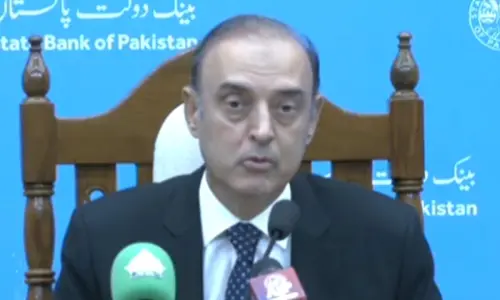
PRIME MINISTER Shaukat Aziz has asked the State Bank of Pakistan, with its new governor in Dr.Shamshad Akhtar, to strike a balance between promoting economic growth and inflation. A lax physical policy can create difficulties, he says. He wants good coordination between monetary, fiscal and foreign exchange policies.
The governor says the State Bank would continue to monitor inflationary developments to achieve price stability, and if need be would tighten monetary policies to achieve both price stability and sustained economic growth.
She underscores the importance of price stability at a time when the price of sugar has been soaring and has reached Rs 33-34 per kilogram in the wholesale market and up to 36 in retail sales. The government has decided to regularly import sugar from India as the need arises and on impose a 15 per cent duty on ‘gur’ exports to Afghanistan and double the supply of sugar to the utility stores. It has authorized the TCP to import sugar periodically. It has really acted quick and adequately before the sugar prices shoot up further.
Being slow or cautious in such situations has not paid dividends so far as the hoarders and market manipulators are quick to exploit this shortage or create a shortage where there is none. The sugar price has almost doubled in a period of two years, according to a market survey.
Dr Shamshad is setting great store by price stability and by asserting that the State Bank will employ all the measures at its disposal to maintain price stability. While she is doing that initially by a rather tight credit policy, the government is taking care of the supply side by promptly importing sugar from India, doubling the sugar supply to the utility stores and authorizing the TCP to play a larger role.
She has a good model to follow in Alan Greenspan who has retired as the chairman of the Federal Reserve after 18 years. Appointed by a Republican president, George Bush Sr, he continued during the Clinton administration and retired under a Republican president. During Greenspan’s chairmanship of the Federal Reserve the US economy had enjoyed steady growth with controlled inflation. He increased interest rate after the recent economic setback by a quarter per cent at a time. He was expected to announce the 14th quarter increase as he retired. His cautious approach to both inflation and interest rates has paid excellent dividends to the US economy. Mr Salman Shah, advisor to the prime minister on finance, says the average rate of inflation during the first half of this financial year has been 8.4 per cent and for the next half of the year it will be 8 per cent. This is one hefty increase in the inflation rate but goods have increased abnormally and they have not come down from the peak after the POL and gas prices too went up.
In her first press interview after being named the governor, Dr Shamshad said the level of inflation in a country was determined not only by the monetary policy but also by the market structure. She did very well to focus public attention on the unpleasant market realities. But correcting the market structure except through the monetary mechanism is beyond the competence of a central bank. It is the market where monopolies and cartels and regular price fixing is too common. It is the market which merrily indulges in hoarding and even when there is no shortage of goods nor is one likely to emerge if allowed to function freely, blatant price fixing is too common.
Pakistan‘s economy is conspicuous by its high profit rate. From wholesaler to retailer, the profit rates here are the highest in South Asia. So the hoarding goes on, beginning with wheat and ending with sugar and cement. The monopolies commission recently fined 14 cement companies for profiteering. This aspect of the market in Pakistan is now receiving official attention and the government is sponsoring a series of one-day seminars on the domestic market. The first meeting was addressed by Humayun Akhtar Khan in Lahore last week.
The internal market has to take steps to lower the cost of doing business, particularly the cost of retail trade. It has to follow foreign models like Wal-Mart of the US, which has been topping the Fortune Magazine’s list of top 500 companies in the US for several years, succeeding General Motors.
Consumers organizations in the country, although small in number, are also protesting against the malpractices in the domestic trade like adulteration, sale of substandard products at high price and use of short weights and measures. Consumers have to get organized and be assertive on a sustained basis if they want to bring to an end their exploitation. There is no shortcut in this area where the traders, big and small, have had a free hand for the last 50 years.
We are now told the country may face loadshedding by the end of the year and suffer a shortage of 1700 MW in 2007 and 8000 MW by the year 2016 if enough power is not produced in this period.
While opting for more thermal power, they are faced with shortage of gas which is increasing compared to its demand. So, the government wants more of the power to come through the new water reservoirs. The hydel power will be cheaper and will reduce the pressure on oil and gas. Formal decision has to be taken in this regard and final priorities decided to begin work on the five dams. The work should start early without kicking up further controversies.
Meanwhile, the government has to come up with a new petroleum policy with new incentives to encourage exploration companies to find more gas and oil and the offshore oil possibilities are also being explored. It is heartening to know that the government is not buckling under the pressure of the US and is talking of building the seven billion dollar Iran-Pakistan-India pipeline. The continuing violence in Balochistan is however very disheartening.
The fight against poverty is to receive another setback, as the 300 million dollar poverty reduction support programme is likely to be delayed following the government’s non-compliance with the agreed power sector reforms. The World Bank wants the various distribution companies under Wapda to fix their own power rates instead of charging the uniform rate prescribed by it. The government has agreed to the reforms, but is too slow in implementing that. If some of the distributing power companies have a lower cost than others, because of less theft and lower loss of power, there is no reason why they cannot sell their power at a lower rate than others with a higher theft rate.
Meanwhile, there is bad news from India. Mr Mani Shankar Aiyer, former consul general of India in Karachi, who had become minister for petroleum in the Congress government, has been shifted from that ministry to the ministry of sports and youth affairs and Murli Deora appointed as petroleum minister. Will that affect the Iran-Pakistan-India pipeline or give it a lower priority? We will have to wait for the turn of events in New Delhi pending the visit of President Bush to India in March. The US is opposed to the pipeline as that could mean more revenues for Iran and also to the Indian and Pakistani diplomatic support to Iran, which the U.S wants to isolate because of its nuclear programme.
Prime Minister Shaukat Aziz says he wants larger cooperation with Russia, particularly in the energy and defence sectors. He says that the energy and water security of Pakistan is important. And Russia is a major source of oil and gas and the prime minister wants Russia to join the quest for oil and gas in Pakistan.
As we talk of a seven per cent growth this year, in place of the 8.4 per cent growth last year, the Chinese statisticians have announced a growth rate of 9.9 percent in 2005. The Chinese economy has become the fourth largest in the world after the US, Japan and Germany. China has achieved this growth rate in spite of its efforts to hold it down to prevent overheating and its adverse consequences.
Meanwhile, India‘s Lakshmi Mittal who is the world’s largest steel producer has made a move to take over the Arcelor steel mills of Luxembourg which is the largest. He is seeking the takeover through a hostile bid which has raised the Arcelor’s share prices. After the takeover, Mittal will produce 115 million tones of steel and have a sale of 69 billion dollars.
Our businessmen who are exploiting the domestic market so ruthlessly should look at what the Indian investors like Lakhshmi Mittal are doing, play the investors game abroad if they can do with farsightedness. But they have to use their legally earned money and not the money taken out of Pakistan without paying taxes.
Meanwhile, Pakistan’s negotiations with the US for an investment treaty is forging ahead, while the negotiations for a free trade agreement are to speed up following a meeting between Shaukat Aziz and President Bush in Washington.
The tight money policy is being followed in Pakistan gently. During the first six months of the financial year, a private sector bank credit of Rs 253 billion was provided against Rs 244 billion in the same period the previous year. That may be said to have been advanced to make an adjustment to accommodate inflation and is not incremental capital. But what matters is how stable are the prices and how helpful the monetary policy is to the man with modest means who finds the cost of living excessive. It is not enough if the prices do not go up further; the common man wants real relief and financial space to breathe.