Resolving Iran’s N-issue
SOME new steps in dealing with the stand-off over Iran’s nuclear issue offer a flicker of hope that the harsh realities may induce some flexibility in Washington and Tehran, leading to a peaceful resolution of the current crisis.
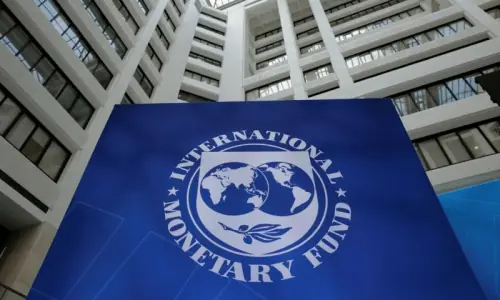
The first and the most important step was taken about two weeks ago by the UN nuclear watchdog, the International Atomic Energy Agency (IAEA), when it decided to put off the referral of Iran to the UN Security Council.
It may be recalled that in September, the IAEA board found Iran in non-compliance with the nuclear Non-Proliferation Treaty (NPT) for hiding sensitive nuclear activities, a finding that requires notifying the Security Council which can then impose sanctions.
The United States charges that Iran is using a civilian nuclear programme to hide the covert development of atomic weapons, an allegation that Tehran denies. However, this time Washington backed up a call to hold off taking Iran to the Security Council, though Washington did warn that the referral would take place soon if Iran did not meet its non-proliferation obligations.
Another important development is that Russia has taken the lead in fashioning a deal that Tehran may accept. This has raised hopes that a way out of the current impasse may be found because Moscow has been one of Tehran’s closest allies. The proposal, which Russia is believed to have drawn up in consultation with the US and the EU3 — Britain, France and Germany — aims at allowing Tehran to continue some nuclear activity while satisfying the international community that its intentions are peaceful. The new offer allows Iran to continue the first steps in preparing nuclear material for power stations, but the crucial work of uranium enrichment would be done in Russia and the fuel shipped to Iran.
Enrichment is the process of purifying uranium so that it can be used to generate nuclear power. If it is enriched further, it can make nuclear weapons. This process is the most technically difficult in making weapon-grade material and mastering it is perhaps the greatest barrier to acquiring weapons.
The concession to Iran in the Russian offer is to allow it to continue the “conversion” of uranium ore into gas. This is the step before enrichment, which the West had previously insisted Iran renounce. The deal aims to allow Iran to preserve some face at home in its nuclear work considered a source of national prestige.
Interestingly, Moscow’s recent arms deal with Tehran has come at a delicate moment in the stand-off over Iran’s suspected nuclear programme. Russia hopes the sale of advanced air defence missile systems to Iran will make it more amenable to compromise on the nuclear issue. The deal is part of a broader one billion dollar package which also involves upgrades to the Iranian Air Force’s 59 Russian made Sukhoi and Mig Fighter jets and the sale of petrol boats.
The latest arms deal reiterates the Russian argument that the best way to keep Iran from acquiring nuclear weapons is to help it realize its right to acquire peaceful nuclear technologies and to enhance its sense of security. There are indications that the US may be more inclined to give credit to the Russian view because Washington has become deeply mired in Iraq and Afghanistan and needs Iran’s cooperation to disengage from both conflicts.
Another encouraging development is that the EU3 have agreed to resume negotiations on Iran’s nuclear programme which broke down in August. The offer to hold talks with Iran omitted the previous European condition that negotiations on long-term cooperation could only restart if Iran resumed a full suspension of activities related to uranium enrichment, which could help it produce weapons.
The EU offer sets no date; but Iran’s official news agency, Irna, says the talks are likely to be resumed this month. It may be recalled that last month Iran’s chief nuclear negotiator Ali Laljani wrote to the EU3 calling for the resumption of talks which had collapsed when Tehran reactivated a plant that converts uranium ore into gas — a precursor to making enriched nuclear fuel.
Iran’s national pride, its geopolitical significance and the assumption by the US and the European Union that a nuclear programme can only be a nuclear weapons one have created hurdles in the way of finding a peaceful solution of the nuclear issue. Iran’s constitutional watchdog — the Guardian Council — on December 3 approved a bill, passed by the Iranian parliament last month, to resume uranium enrichment and end snap UN checks of its sites if Tehran is referred to the UN Security Council for possible sanctions. Under Iranian law, all parliamentary legislation must be approved by the Guardian Council that is composed of six clerics and six lawyers.
The decision by the Guardian Council seems to be in retaliation to British Foreign Secretary Jack Straw’s disclosure on November 29 that a blueprint for making an atomic bomb found in Iran could be part of the “circumstantial evidence” for taking Tehran’s case to the UN Security Council. According to the British foreign secretary, “the evidence which originally came from a document from the A.Q. Khan Research Laboratories in Pakistan, tells us that the Iranians had in their possession information that could lead to the development of the hemispheres, which for certain have no purpose other than the development of nuclear weapons”. The document is being used by the American and British diplomats to convince Moscow and Beijing that Tehran intended to build nuclear weapons and also to ask the IAEA for more intrusive inspections of Iran’s nuclear facilities.
It may be observed that the document in question was handed over to the IAEA by the Iranians who told the UN nuclear watchdog that the document had come to them unsolicited from people linked to Pakistani scientist Dr Abdul Qadeer Khan.
Though Iran has consistently claimed that its nuclear programme is solely for peaceful purposes, it can make a convincing case for nuclear weapons on the basis of security. After the second world war, Iran was the only country to have been attacked with weapons of mass destruction (poison gas) during its 1981-88 war with Iraq and, even worse, the entire international community, including the Americans, remained indifferent and did not even condemn Saddam Hussein.
Another important point is that Iran is a Shia country, surrounded by Sunni neighbours, (a Shia Iraq is still to emerge, though Iraq’s new government is sympathetic to Iran, which is something the US had not envisaged when it went to war against Saddam Hussein). It is almost certain that if Iran acquires nuclear weapons, it will unleash a Sunni Arab backlash, particularly from Saudi Arabia.
Another complication is that eastern Saudi Arabia, where most of the oilfields are located, and many Gulf states, have majority Shia populations, though the rulers are Sunnis. Under the circumstances, a nuclear Iran, if it ever succeeds in becoming one, is likely to destabilize West Asia. The debate about Tehran’s nuclear issue often overlooks an important factor that underlies much of US and European thinking. Israel poses the biggest hurdle in the way of a nuclear Iran. At the moment, Tel Aviv, which is not a signatory to the NPT, is the only nuclear-weapons state in West Asia. But Tehran’s acquisition of nuclear weapons will end Israeli monopoly, which the westerners will do their best to obstruct for their own geopolitical interests.
Tehran continues to assert that its nuclear programme is for peaceful purposes. But if that is so, its detractors ask, it could proceed openly on its nuclear programme after notifying the IAEA and there would have been no need for it to secretly make efforts to enrich uranium for 16 long years before they were discovered through a defector’s disclosures. The Americans, therefore, argue that the Iranian assertions under the circumstances do not hold much credibility. Despite Moscow’s active involvement in the peace process it will not be easy to resolve the conflicting interests of the parties over the nuclear issue. There is danger that the new hardline government in Tehran may not find the compromise offer sufficiently attractive. However, there are encouraging signs as well. Moderate elements in Tehran, like former president Hashim Rafsanjani, are calling for a more cautious nuclear policy. And the blunt reality is that, despite its current defiant posturing, Tehran cannot afford an open confrontation.
The Americans find themselves in an even worse situation. With oil prices not coming down appreciably, the Bush administration’s credibility at an all-time low and Iraq on the verge of a sectarian civil war where Iran seems to hold the trump card, a greatly weakened President Bush cannot afford another war in West Asia. The harsh realities are likely to induce some flexibility on the part of both Tehran and Washington which may allow Iran to save face by allowing it to continue with the “conversion” of uranium ore into gas, a concession which was previously denied by the West. The Americans may feel satisfied that the crucial work of uranium enrichment will be done in Russia and the fuel shipped to Iran.
Only a balanced proposal which keeps the legitimate interests of Iran in view remains the best option to halt the spread of nuclear weapons in West Asia. In return for agreeing not to exercise its right to enrich uranium, Iran must receive American security guarantees, substantial European economic incentives and a roadmap for Tehran’s reintegration into a regional security arrangement for the Persian Gulf.
Whatever offer is made to Iran should not be vague on incentives and heavy on demands, as the EU3’s August deal was, which was justifiably rejected by Tehran. The US and its European allies need to realize that complete Iranian submission is uncalled for. The Iranians are a proud nation and Iran is entitled to respect by virtue of its glorious history and its geopolitical importance. The West should also be aware that Iran’s nuclear programme is more about national pride than weapons and energy.
The writer is a former ambassador.
A forgotten Kashmiri leader
SHEIKH Abdullah, whose birth centenary is being celebrated this month, has not been given his due in India, much less in Kashmir from where he hailed. He was once known as the Kashmiri Gandhi and Sher-i-Kashmir because he fought for freedom against the British and the Maharaja of Jammu and Kashmir.
But for the Sheikh’s concurrence — and this was Jawaharlal Nehru’s pre-condition for integration with India — New Delhi would not have accepted the Maharaja’s accession. Nor would the Kashmiris have organized themselves under the leadership of the Sheikh against the attack by tribesmen and irregular soldiers from Pakistan until the arrival of the Indian forces in Srinagar.
Yet the Sheikh, a personal friend of Nehru, had to spend some 12 years in confinement because he became a suspect in the eyes of New Delhi. He reminded the Indian government of its promise to confine its rule to three subjects: defence, foreign affairs and communications. Jammu and Kashmir had joined the Indian Union on that understanding alone. Apparently, New Delhi was trying to encroach on the state’s other powers.
But this did not make any difference to the Sheikh’s thinking on the accession. In fact, he gave it legal validity through the constitution which the state’s constituent assembly adopted in 1952. Yet, he jealously guarded the autonomy his state enjoyed within the Indian Union. Unfortunately, the tale-carriers who talked about the Sheikh’s “revolt” against New Delhi influenced Nehru. After detaining the Sheikh at Kodaikanal in the south, Nehru went on the defensive. He wrote a letter in explanation to the state chief ministers, some of whom were personal friends of the Sheikh.
The letter dated, August 22, 1953, said: “The Kashmir government could not function and everything was disintegrating. Sheikh Abdullah’s attitude became more and more bitter and he seemed to be bent on upsetting everything in Kashmir. Indeed, in the course of a conversation with a friend, he (the Sheikh) said that he would set fire to the state. I do not know what he meant by that. But it indicated the state of his mind which was almost functioning as if it were unbalanced. So we came to live under constant apprehension of an impending disaster. It was a very difficult and distressing situation. There was no way out. To allow things to continue as they were was to invite disaster and, in any event, that was a feeble way of meeting a situation. To take any steps to check it also meant inviting trouble. The choice, as often in our times, was one of the lesser evil.”
It took Nehru some 12 year to realize that he had made a mistake. During that time, the Sheikh did not complain about his detention even once. Nor did he mince words against New Delhi while talking to some people who met him at Kodaikanal. Among them was Jayaprakash Narayan, a Gandhian. The Sheikh showed no bitterness even after his release. All that he told me — I met him within a few days of his release — was that “Nehru was misled.” He recalled his friendship with him and it came as no surprise to me when the Sheikh stayed with Nehru after his release.
In fact, it was the Sheikh who persuaded Nehru to have a dialogue with Pakistan to sort out the Kashmir problem. Nehru sent the Sheikh to Islamabad in May 1964 to talk to General Mohammad Ayub Khan, heading Pakistan then. The version I got from Ayub during my meeting with him in April 1972 was that: towards the end of his life Nehru had realized the logic of the situation and had shown anxiety to come to terms with Pakistan.
The Sheikh did not comment on Ayub’s version. The Sheikh confined himself to the remark that “he was late” because Nehru died when the Sheikh was still in Islamabad. Pakistan’s former information secretary Altaf Gouhar has said in his book that the Sheikh brought with him the proposal of a condominium which Ayub rejected. However, I did not get any confirmation about the proposal, either in India or Pakistan.
But I can tell those who doubt the Sheikh that he never compromised with the state’s identity. At the same time, he never expressed his doubt over the decision on the state’s accession to India. That his stand had the backing of the people in Jammu and Kashmir is evident from the result of election as late as 1977. This was the only time when a free and fair election was held in the state after the accession. The Sheikh swept the polls and said that election was “a referendum in favour of accession to India.” By then, the Janata government had come to power by ousting Indira Gandhi. He invited her to the state while she was in the wilderness and accorded her the reception befitting a head of state. He told me “his daughter has come to her father’s house.” This was his way of conveying that Nehru, even when he confined him for 12 years, remained his friend.
A few years later, when Indira Gandhi became prime minister again, she offered him the state government, then run by Mir Qasim the Congress chief minister. The Sheikh reached an agreement with New Delhi on the powers that Srinagar could enjoy. However, he realized that he could not reconcile the aspirations of the Kashmiris to what the agreement had conceded.
He also miscalculated the reaction of Islamabad which remained hostile to the Sheikh even after his visit to Pakistan. However, he would often complain that New Delhi was niggardly towards the state’s economic development. Religious forces began to exploit the Kashmiris’ growing alienation and unemployment of the youth.
Secular to the core, the Sheikh did not allow any say to communal elements which were tainting the Sufi ethos of the state. After his death, they spoilt the movement which had a touch of idealism in the beginning and which had fired the youth to resort to the bullet when the ballot box failed to elect deserving candidates. The Sheikh’s grandson, Omar Farooq, had a point when he said at the time of paying homage to his grandfather a few days ago that the Hurriyat could not evade responsibility for igniting violence in the state.
While condemning the Hurriyat, Omar Farooq was only recalling his grandfather’s principle. If means are vitiated, the ends are bound to be vitiated. This is what Mahatma Gandhi and Nehru preached. This is what is the ethos of the national struggle for independence. I wish the Kashmiris had understood the Sheikh and realized what he was up against. He was a proud Kashmiri who fought for the state’s identity.
A weak defence
IN an attempt to quell a growing storm in Europe over the CIA’s secret prisons, Secretary of State Condoleezza Rice has issued a defence based on the same legalistic jujitsu and morally obtuse double talk that led the Bush administration into a swamp of human rights abuses in the first place.
Ms Rice insisted that the US government “does not authorize or condone torture” of detainees. What she didn’t say is that President Bush’s political appointees have redefined the term “torture” so that it does not cover practices, such as simulated drowning, mock execution and “cold cells,” that have long been considered abusive by authorities such as her State Department.
Ms Rice said, “It is also US policy that authorized interrogation will be consistent with US obligations under the Convention Against Torture, which prohibit cruel, inhuman or degrading treatment.” What she didn’t explain is that, under this administration’s eccentric definition of “US obligations,” cruel, inhuman and degrading treatment is not prohibited as long as it does not occur on US territory.
That is the reason for the secret prisons that the CIA has established in European countries and other locations around the world, and for the “renditions” of detainees to countries such as Egypt and Jordan: so that the administration can violate the very treaty Ms Rice claims it is upholding.
Ms Rice did offer some persuasive arguments, including that “captured terrorists of the 21st century do not fit easily into traditional systems of criminal or military justice”; that’s one reason we believe congressional action to regulate those detentions and interrogations is overdue. It’s hard not to sympathize with the secretary of state, who has seen 10 months of meticulous and until now successful work to repair transatlantic relations undermined by a policy not of her making.
Yet the Bush administration surely cannot expect that the uproar in European countries, including staunch allies such as Britain, will be contained through such hairsplitting spin. The political backlash is still growing, and the damage could be considerable. For example, the plans of the new German chancellor, Angela Merkel, to rebuild close relations with the United States have been seriously threatened by emerging reports of German participation in CIA renditions.
The only way to remedy the damage is to change the underlying policies. Such a change would help rather than hurt the fight against terrorism.
— The Washington Post
| © DAWN Group of Newspapers, 2005 |