7
7


KARBALA: Attacks mostly against Shias including a suicide bombing that ripped through a religious procession, killed 43 people in Iraq Thursday despite massive security deployed for one of the holiest days of their faith.
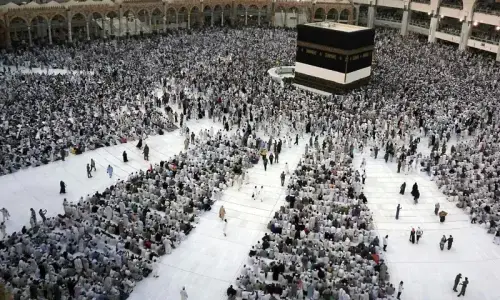
The bloodshed came as a flood of worshippers, including tens of thousands of foreign pilgrims, thronged the central shrine city of Karbala for the climax of Ashura, braving the repeated attacks by Sunni militants that have marred the festival in previous years.
The suicide bomber, who was disguised in a police uniform, struck in a Shia-majority area of confessionally mixed Diyala province, north of Baghdad, killing 32 people and wounding 80, security and medical officials said.
It was the third attack of the day to target Shias.
Earlier, coordinated blasts in the town of Hafriyah, south of the capital, killed nine people, while twin bombings in the northern oil city of Kirkuk wounded five.
A bombing also targeted an army patrol in a predominantly Sunni town north of Baghdad, killing two soldiers.
Shias from Iraq and around the world mark Ashura, which this year climaxed on Thursday, by setting up procession tents where pilgrims gather and food is distributed to passers-by.
An estimated two million faithful gathered in Karbala, site of the mausoleum of Imam Hussein, grandson of the Prophet Mohammed, whose death in the city at the hands of soldiers of the caliph Yazid in 680 AD lies at the heart of Islam's sectarian divide.
Black-clad pilgrims packed the shrines of Hussein and his half-brother Abbas, listening over loudspeakers to the story of the battle in which Hussein was killed, as volunteers distributed food and water.
“I have been coming since I was young, every year, even during the time of the tyrant Saddam,” said Abu Ali, a 35-year-old pilgrim visiting from the southern port city of Basra, referring to the rule of the now-executed Sunni Arab dictator who savagely repressed Iraq's Shia majority community.
Saddam Hussein barred the vast majority of Ashura commemorations, and the associated Arbaeen rituals, until his overthrow in the US-led invasion of 2003.
“I challenge anyone not to cry,” the worshipper said, describing his emotions on taking part in Ashura ceremonies.
The commemorations, which also included a ritual run to Hussein's mausoleum and a reenactment of the attack that killed him, wrapped up in the early afternoon.
Provincial authorities expect two million pilgrims, including 200,000 from outside Iraq, will have visited Karbala in the 10 days leading up to Ashura, with all of the city's hotels fully booked.
Shias make up about 15 per cent of Muslims worldwide. They are a majority in Iraq, Iran and Bahrain, and there are large Shia communities in Afghanistan, Lebanon, Oman, Pakistan, Saudi Arabia, Syria and Yemen.
Sunni militants linked to al Qaeda, who regard Shia as apostates, often step up their targeting of Iraq's majority community during Ashura and Arbaeen, including by attacking pilgrims.
Security measures have been stepped up, with more than 35,000 soldiers and policemen deployed to Karbala and surrounding areas.
Concentric security perimeters barred vehicles from entering the city, while helicopters hovered overhead.
The violence against Shias is the latest in Iraq's deadliest unrest since 2008.
It has prompted Prime Minister Nuri al-Maliki to appeal to the United States for help in the form of intelligence sharing and the delivery of new weapons systems.
Turkish Foreign Minister Ahmet Davutoglu offered Ankara's assistance during a recent visit to Baghdad.