SINDH looks set to maintain the rising trend it had witnessed last year in production of cotton and sugarcane. Output of rice, that had declined sharply, is also expected to increase this year.
Expansion in the areas under cultivation, wider use of right seeds, improvement in availability of water, prudent application of fertiliser and better pest and plants’ disease management are pushing up crop outputs, with a marginal rise in per-hectare yields.
In cropping year 2012-13, cotton output in Sindh had risen 27 per cent to 3.405 million bales from 2.681 million bales in 2011-12. Sindh-based ginneries have reported arrival of about 3.028 million bales of cotton up to November 1 this year showing a year-on-year increase of 19 per cent. Officials of provincial agricultural department and growers say total cotton output during 2013-14 would range between 3.6 and 3.8 million bales.
Better per-hectare yield in some areas, wider use of high-yield BT cotton and a straight seven per cent increase in the area under cultivation are the main reasons that fuel hopes for a larger than initially-estimated output, according to cotton ginners and brokers. Initially it had been estimated that Sindh’s cotton production this year may not exceed last year’s level of 3.4 million bales because of the pest and virus attack on plants in cotton fields in lower Sindh.
Now, the more optimistic cotton crop estimate factors in not only the increase in the area under cultivation but also a modest rise in yield being recorded in several districts. These include Sanghar, Nawabshah, Mirpurkhas, Tando Allahyar and Badin where improved plant care mitigated impact of pest and virus attacks and where most growers used qualitative seeds.
Sindh’s record of per-hectare yield of major crops has generally been better than Punjab’s and cotton is no exception. Officials involved in field surveys and growers say that during the current season, average per-hectare yield of cotton has been recorded over 1000kgs in some areas of the above-mentioned districts against the national average of a little over 800kgs.
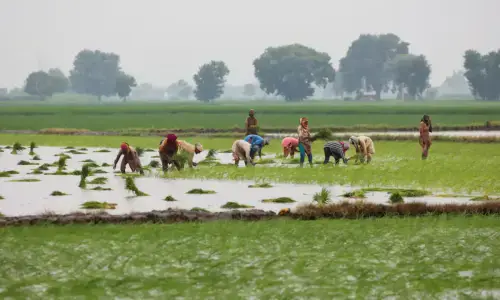
Production of rice, particularly of Irri-6 and Irri-9 varieties, is also up in Sindh chiefly due to a massive 45 per cent increase in the area under cultivation to 741,000 hectares this year from 511,000 hectares last year. This is for the first time in five years that the area under rice cultivation in general has crossed the 2008 level of 733,000 hectares as water scarcity has somewhat eased off.
Agriculturists say this also indicates gradual restoration of growers’ confidence in feasibility of rice growing and high profitability of rice crop after the 2010 super floods that had halved paddy sowing area in the province. An official of Sindh Abadgar Board pointed out that another factor that led growers to sow paddy on a much larger scale this year was that because of water scarcity in the last season many had switched over to minor crops including oilseeds and pulses, because of water shortage.
“But generally speaking they had a bad experience with minor crops which didn’t yield enough profits due to overall higher production of oilseeds and pulses in the country. Naturally then, they reverted to paddy again,” says Hyderabad-based agriculturist Najam Hussain.
Harvesting of Irri-6 and Irri-9 has already begun and reports from fields suggest that their production would be between 1.45-1.5 million tonnes, according to information gathered from officials of Sindh Agriculture Department and some progressive growers.
The area where Irri varieties were sown covered more than 50 per cent of the total area under cultivation of all kinds of rice including hybrid varieties. Progressive growers or the growers who generally get higher than average per-hectare yields say that in areas like Larkana, Qambar and Shahdadkot, Shikarpur, Thatta and Badin, some of them are getting per-hectare yields of about 2,500-3,000kg against the national average of 2,400kg.
But they admit that higher yield giving fields are limited in number which eventually pushes up the per-hectare yield of an entire district only marginally. That has been a problem for quite a while. And the reason why per-hectare rice yields do not rise fast in Sindh, or for that matter in Punjab as well, is slower-than-desired development of new improved seeds.
Sugarcane crushing has started in Sindh after the fixation of the new support price of Rs180 per 40kg, a slight increase from last year’s Rs172 per 40kg. Cane growers and officials of Sindh Agriculture Department say that this year’s total output should be between 16.5 million and 17 million tonnes against about 16 million tonnes of last year’s.
But their optimism isn’t rooted in any significant increase in the per-hectare yield — it springs from the fact that the area under cultivation of cane this year was 14.5 per cent larger than in the last year.
They say that per-hectare yield, being reported from cane growing areas range between 60 and 70 tonnes adding that cane fields producing yields lower or higher than this level are not many in number. National average yield is a little over 55 tonnes.
Timely rains in July and August had fattened cane stalks thus increasing their weight and eventually pushing up per-hectare yield. “Besides, many progressive growers had planted cane skipping cotton,” says a progressive grower Muhammad Ali adding that the fact that sugar futures are traded in the country and cotton is yet to be listed makes a difference.
“Big landlords have lately entered into commodities future trading and so they prefer sugar and rice, price discovery of which has become easier as their futures are traded.”
Two other factors are said to be promoting sugarcane growing in Sindh. First, growers have experienced in past few years that whereas floods and excessive rains damage other crops, sugarcane remains unaffected — cane stalks rather gain weight with rain and flood waters. Second, the setting up of new sugar mills in district Ghotki has led local growers to bring more area under cane cultivation. —Mohiuddin Aazim