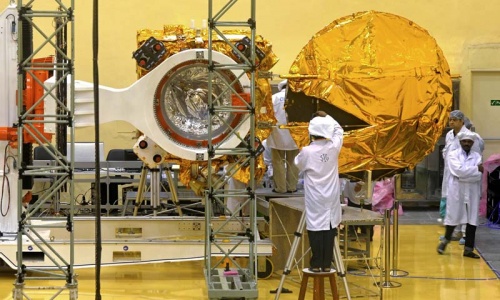
NEW DELHI: India launched its first rocket to Mars on Tuesday, aiming to put a satellite in orbit around the red planet at a lower cost than previous missions and potentially positioning the emerging Asian nation as a budget player in the global space race.
The Mars Orbiter Mission blasted off from the southeastern coast with the satellite scheduled to start orbiting Mars by September, searching for methane and signs of minerals.
“This is our modest beginning for our interplanetary mission,” said Deviprasad Karnik, spokesman for the state-run Indian Space Research Organisation (ISRO).
Only the United States, Europe, and Russia have sent probes that have orbited or landed on Mars. Probes to Mars have a high failure rate and a success will be a boost for national pride, especially after a similar mission by China failed to leave Earth's orbit in 2011.
India's ties with its neighbour are marked as much by competition as cooperation. Government scientists deny any space race, but analysts say India has stepped up its programme because of concerns about China's civilian and military space technology.
The probe's 4.5 billion rupee ($73 million) price tag is a fraction of the cost of NASA's MAVEN mission, also due to launch in November. Analysts say India could capture more of the $304 billion global space market with its low-cost technology.
The Mars mission is considerably cheaper than some of India's more lavish spending schemes, including a $340 million plan to build the world's largest statue in the state of Gujarat, including surrounding infrastructure.
Even so, it has drawn criticism in a country suffering from high levels of poverty, malnutrition and power shortages and experiencing its worst slowdown in growth in ten years.
India has long argued that technology developed in its space programme has practical applications to everyday life.
“For a country like India, it's not a luxury, it's a necessity,” said Susmita Mohanty, co-founder and chief executive of Earth2Orbit, India's first private space start-up. She argued that satellites have broad applications from television broadcasting to disaster management.
India's space programme began 50 years ago and developed rapidly after Western powers imposed sanctions in response to a nuclear weapons test in 1974, spurring scientists to build advanced rocket technology. Five years ago, its Chandrayaan probe landed on the moon and found evidence of water.
The relative prowess in space contrasts with poor results developing fighter jets by India's state-run companies.
The Mars Orbiter Mission plans to search for methane in the Martian atmosphere, the chemical strongly tied to life on Earth.
Recent measurements made by NASA's rover, Curiosity, show only trace amounts of it on Mars.
India's mission will also study Martian surface features and mineral composition.