0
0
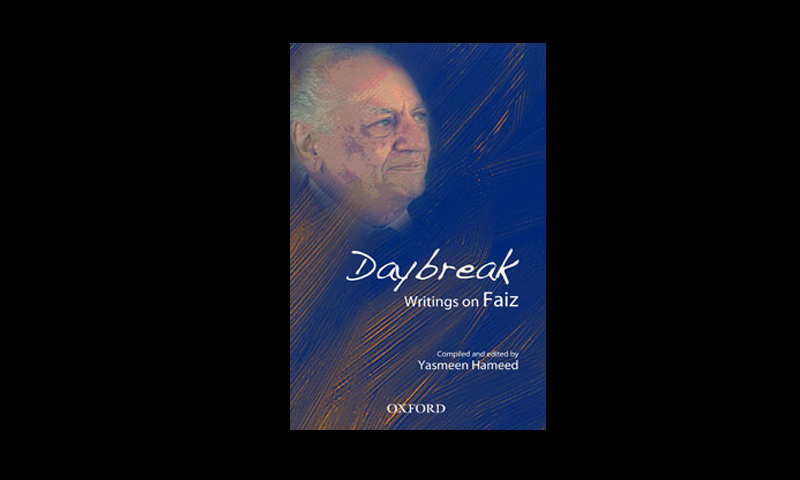

Poet and writer Yasmeen Hameed has compiled and edited Daybreak: Writings on Faiz. It is a creditable effort, primarily because it brings together some very valuable essays and articles on Faiz’s life and works, the essayists’ remembrances of the poet and his own recollections in the form of an interview.
Daybreak is a brilliant example of high-quality analytical writings. Hameed says in the introduction that it was “initiated as a project of the Gurmani Centre for Languages and Literature at the Lahore University of Management Sciences to mark Faiz’s centennial.”
It is almost a given that whenever Faiz Ahmed Faiz is discussed, the names of the likes of Victor Kiernan, Gopichand Narang and Naomi Lazard will surface with all their appreciation for the poet. But Daybreak also surprises readers with some relatively unknown, if not totally unheard of, names for the Urdu world. And they chip in with inspirational ideas and new perspectives from which to view Faiz’s poetry. For example, Oakland University’s Carlo Coppola’s write-up, ‘Faiz in English: How Five Translators Worked Their Art,’ is a cerebral delight.
In fact, the book has quite a few substantial theses on the issue of translation which signifies the need for conveying Faiz’s message, or any other poet’s, to a larger audience. Coppola selects Faiz’s celebrated poem, ‘Mujh Se Pehli Si Muhabbat Meri Mehboob Na Maang’. Coppola’s examination of the poem is fascinating and draws the reader in as he presents each line of the nazm in its original Urdu with interlinear Roman transliteration as well as literal rendering into English. Then five eminent translators of Faiz (Victor Kiernan, Mahmood Jamal, Naomi Lazard, Daud Kamal and Agha Shahid Ali) are brought to the fore and their English versions of the poem are pitted against each other.
To make things simpler, Coppola looks at some “key passages” in the nazm with special references to the words dukh, vasl and peep. The English words used by the five translators for dukh are torments, sorrows, pain and afflictions. This goes to show how toilsome it is to transport a work of art to another milieu in another language.
Naomi Lazard seeks to do the same in the essay ‘Translating Faiz’. The difference is that she begins by giving a personal account of the poet, her remembrance of the time spent with him at a conference and her attempt, with Faiz’s consent, to translate his poetry. She claims that the project proved to be a process of discovery for her. “Describing the translation process is difficult in the same way as trying to describe the process of writing a poem,” she writes. “It is neither a scholarly nor an academic procedure.” Moving on, she tells the reader that the first poem that Faiz gave her for translation was ‘Bahar Aaee’. This made Lazard think that the poem is relatively simple to recreate. Yes, that’s the word she uses — “recreate” — and that’s exactly what she does.
The theme of translation is furthered by Frances W. Pritchett in ‘The Sky, the Road, the Glass of Wine: On Translating Faiz,’ but my favourite part of the compilation is Rimma Kazakova’s piece, ‘Poet and the Modern Age’. The very first line of her essay grabs attention: “The poet in the modern world, as it has always been, is a person with a heart responsive to pain and love.” She mentions some 20th century poets and writers, including Pablo Neruda, Alfredo Varela and Amrita Pritam with whom she rubbed shoulders and references Faiz as having “a special place in the galaxy of my brothers in spirit.” She quotes one of her first editors who had once told her, “We, poets, are not friends. We love each other.” And that’s exactly the kind of feeling that Kazakova gives off with regard to Faiz in her poetically penned piece.
Another good thing Hameed has done in this volume is include an English translation of one of Faiz’s poems after every chapter. It breaks the textual monotony and allows the reader to shift from the academic to the poetic.
Also, how can one overlook Faiz’s interviews, which some believe are not as wide a window into his life as his poetry. But Tahir Mirza’s chitchat with him titled ‘Still As Involved As Ever’ makes the reader understand both Faiz’s political ideals and his poetic leanings. Daybreak is a highly recommended read.
The reviewer is a Dawn staffer Daybreak: Writings on Faiz (Literary Criticism) Edited by Yasmeen Hameed Oxford University Press, Karachi ISBN 9780199065899 402pp.