9
9

IT is some relief that the latest high-level spat between India and Pakistan revolves around whether Nawaz Sharif described his fellow Punjabi Manmohan Singh as an old village woman carrying tales to Aunty or Uncle Sam.
Not being privy to breakfast chatter in New York, I cannot vouch for the authenticity of a participant’s story that was denied with far less assurance than it was reported. One does wonder, though, what precisely that old village woman might have to say about the comparison. Would she take offence?
Dr Singh seemed unaffected, either by this or by the hint that he might have become a bechara after Rahul Gandhi’s intemperate offensive against a decision taken by Ms Sonia Gandhi and Dr Singh. It says something about the political environment we live in that even a Congress heir believes he can best score some brownie points with the electorate only when he attacks a Congress government.
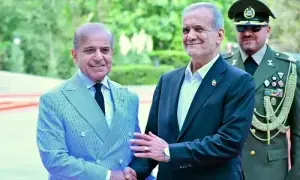
Lost in our immediate concerns we might be missing another perspective. The meeting between Dr Singh and Sharif was not between a departing lamb and an incoming lion, but probably between two helpless men. It took years for Dr Singh’s credibility to weaken. Nawaz Sharif seems to have lost his sheen in just a few months. Both represent weak governments: if Delhi has been grounded, then Islamabad has not taken off.
The two met abroad because they cannot meet at home. But if the purpose was merely to repeat clichés, delivered in pseudo-stern language and heard in stoic silence, why meet at all? Dr Manmohan Singh never asked a question which Nawaz Sharif may never have wanted to, or been able to, answer: what is the reason for the sudden spurt in violence and incursions along the ceasefire line?
Conflict is too complex a dilemma. There are no easy prescriptions. But India and Pakistan have reached a point where even a common effort at diagnosis is not possible. Officially, Pakistan withdraws from any responsibility when it attributes the continuation of Pakistan’s war for Kashmir to “non-state actors”. It maintains, by this formulation, that the state has abandoned war as an option in the struggle for Kashmir.
But the Indian prime minister never raised the question that India’s president, Pranab Mukherjee, asked during his trip to Belgium and Turkey: where do these “non-state actors” come from? As he put in a pithy phrase, they do not drop down from heaven. They thrive in Pakistani territory. They are never challenged while on the Pakistani side of the line. Is this help provided with permission from the Sharif government, or is it an independent operation run by the Pak armed forces?
The reasonable assessment is that Sharif is helpless. He cannot confront his own army; and he will not risk antagonising those powerful vested interests who still believe that India can be bled to slow death. Sharif has made it obvious, by his inaction if not through words, that he has chosen the path of least resistance over Hafiz Saeed, head of the Lashkar-e-Taiba, who [allegedly] orchestrated the Mumbai terrorist attack and continues to nurture assaults against India.
It is possible that given the horrendous resurgence of mass killings, whether of Christians in a Peshawar church or Muslims on a Peshawar street with a car bomb, or Shias across the country, cross-border terrorism in Kashmir might be at the bottom of his priorities.
If Hafiz Saeed is a threat to India, then the Pakistan Taliban are a danger to the whole existing establishment in Pakistan. But if that is the truth, then the best course would be to keep the India-Pakistan dialogue on hold at least until both Delhi and Islamabad are in a position to discuss something concrete. The fudge that was offered as a meal in New York only looks more ludicrous when served with such solemn faces.
Sharif and Singh are not fooling their citizens. The people are wiser than they think. But they are fooling themselves.
Indian public opinion is nostalgic for Pranab Mukherjee, not least because Mukherjee understood the mood of street and village and gave voice to it. He is the prime minister they did not get, because Mrs Sonia Gandhi would not give him the job. The Congress will never acknowledge this, but privately its leaders are beginning to appreciate the perils of heading into a general election without Mukherjee’s counsel and articulation. Mukherjee is as far from a hawk as you are going to get in India, and if he has finessed the government’s wishy-washy language it is only because the Indian mood has hardened.
Dr Singh will not be prime minister after 2014. Pranab Mukherjee will remain president till 2017. Perhaps there is enough time to arrange a chat between Sharif and Mukherjee.
The writer is an author and editorial director of The Sunday Guardian, published from Delhi.