Provincial finances
THE truth can be inconvenient. All the four federating units are groaning under the severe pain of resource constraints due to their heavy dependence on federal funds — largesse in the case of smaller provinces like Balochistan and the NWFP — in terms of meeting their expenditure. This fact is underlined in the provincial budgets for fiscal 2008-09. Balochistan, for example, is facing a resource gap of Rs5.8bn in the implementation of its Rs15.75bn development programme for next year. This shortfall is in spite of a special grant of Rs3bn announced by the prime minister, ironically from his discretionary funds. Others are looking for financing part of their annual development programmes through loans from multilateral institutions like the World Bank and the Asian Development Bank. While the smaller provinces chose to vent their resentment against their difficulties in the preparation of the annual budgetary estimates in so many words, Punjab and Sindh opted to disguise their frustration in ‘softer demands’ for greater provincial control over their respective fiscal resources. That was exactly the point the provinces underscored at an informal meeting of their finance ministers in Lahore earlier this month. Both Punjab and Sindh, with a large base of rapidly growing service sectors, decided to reach out to Islamabad for seeking an expansion in the scope of provincial sales tax to hitherto untaxed services (this is the only area that can help them substantially boost their own meagre provincial tax revenues) and to demand the transfer of its collection function to them.
On the other hand, Balochistan and the NWFP wanted reimbursement of their ‘outstanding dues’ owed by the federal government on account of unpaid gas royalties and net hydel profits. Balochistan strongly feels that the federal government is subsidising gas consumers in the other three provinces at the expense of its development, while the NWFP holds that the centre is doing a grave injustice to its people by capping net hydel profits at Rs6bn despite the far higher amount determined by the A.G.N. Qazi Commission and the Arbitral Tribunal. Simply put, both Balochistan and the NWFP want, and justifiably so, a greater share of the income accruing from their natural resources.
The highly centralised fiscal and tax structure that allows the federal government to control chunks of monetary resources is impoverishing the provinces, especially the smaller ones, and spawning regional disparity and inter-provincial tensions. The rigid, centralised control over provincial resources has in the past forced the federating units to borrow heavily from the federal government or multilateral agencies to support their development programmes. That has resulted in the accumulation of huge, unsustainable debt stocks. The debt stock of Punjab, considered to be the richest province, has already shot up to over Rs304bn, including a foreign exchange component of Rs253bn. Similarly, Balochistan has built up an overdraft of Rs19bn from the central bank and is looking for its complete write-off or conversion into a soft loan to save a few hundred million rupees for development. The conditions in Sindh and the NWFP are not very different, with the former looking for a loan from the ADB to finance its development. The NWFP, meanwhile, is left with little to support development projects in the social sector as it is forced to divert a big chunk of resources towards improving law and order in the province.
Burdened by a huge debt that eats into their meagre resources, little wonder the three smaller provinces are demanding an immediate change in the formula of resource distribution under the National Finance Commission by giving greater weightage to revenue collection, backwardness and area size to make it more ‘equitable’ for them. Punjab, which lacks in natural resources, insists on retaining population as the sole or major criterion for resource distribution among the provinces and sees it as a ‘great equaliser’. Yet, all the provinces are unanimous in their demand for a substantial cut in the size of the federal share — which has been slashed to 56.25 per cent for the next financial year — in the divisible pool of taxes. That would, Punjab believes, largely assuage the smaller provinces’ grievances and remove their objections to retaining population as the sole or major criterion for resource distribution among the provinces.
As is quite obvious from their budget documents and the ministers’ speeches, the provinces also differ with the centre on the issue of implementation of the Public Sector Development Programme, which at Rs549bn is almost double the Rs280bn collectively allocated by the provinces for their annual development programmes. Provincial governments want a bigger role in the selection and execution of projects in their respective territories. The demand is quite justified in view of the fact that provincial governments understand the development needs of their people better than the bureaucrats sitting in Islamabad. (The development programmes of Punjab and Sindh for 2008-09 show a clear bias towards the social sector — education, health, water supply and sewerage — and productive sector — agriculture, irrigation and industry, if and when they can spare resources for that.) Moreover, a number of PSDP projects relate to provincial subjects like agriculture, education, health, etc and should therefore be handled by the provinces. The centre should be concerned only with the execution of cross-provincial projects, and that too in close consultation with the relevant federating units.
If the past is anything to go by, there is little likelihood of the federal government relinquishing control over financial resources. The only way for the provinces to get Islamabad to acknowledge the principle of fiscal devolution, and concede provincial ownership of natural resources, lies in formulating a joint strategy to persuade the centre to this effect. That said, it would be difficult, if not impossible, for them to move in that direction unless they manage to evolve a consensus of sorts and narrow down their differences on fiscal disputes. The Lahore meeting of provincial finance ministers could provide an opportunity for that.
Peshawar kidnapping
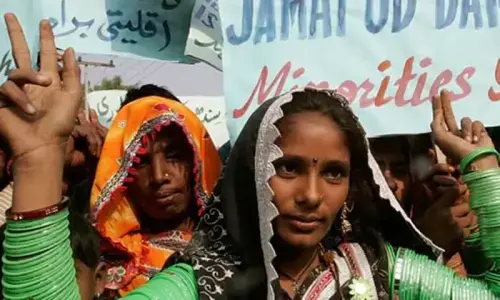
THE kidnapping of a group of Christians in the troubled NWFP the other day can only be seen as an indication of things going from bad to worse, both in terms of growing militancy and violence against minority communities. That the incident took place in a locality of the provincial capital that houses some 500 Christian families leaves little doubt about the target of this heinous act. Though Prime Minister Yousuf Raza Gilani did condemn the incident in strong words during a debate in the National Assembly, it amounted to a condemnation of his own government’s failure to provide protection to its citizens.
The release of some of the kidnapped persons and identification of the captors have, however, given hope that the episode may finally end with the release of all concerned, including that of the lone Muslim in the group who, somewhat intriguingly, has not been set free along with the original group. As it is, our record relating to religious minorities is not particularly distinguished. There can be any number of valid arguments against it but ‘persecution’ is the first word that generally comes to the mind of distant observers. This was evident when a relevant watchdog in the United States recently recommended to the State Department that Pakistan, along with others, be included in its blacklist of countries violating religious freedom. One hopes that the State Department will be more prudent while finalising the said list. But there can be no doubt that incidents like the one in Peshawar do immeasurable harm to the country’s image which is already suffering on several other counts.
How to appoint judges: Is the judiciary independent? - 4
This commission to be set up under the proposed Article 193-A is bound to recommend at least two candidates for each vacancy which means that if the two ministers agree on a candidate he will have to be nominated irrespective of his unsuitability in the opinion of either the Chief Justice of Pakistan or the chief justice of the high courts.
Out of these two, the final selection is to be made by the chief minister of the province. The joint parliamentary board envisaged in the Charter of Democracy is to get involved only at the stage of confirmation and is required either to confirm or not to confirm the only candidate selected by the chief minister. Even if all the opposition members vote against his confirmation the proposal does not say a word about how the deadlock is to be resolved and in any case the appointee will perhaps continue to function as an additional judge.
The seniority principles acknowledged by the Supreme Court for the appointment of the chief justice has been abandoned though the senior-most judge, who would himself be the most eligible candidate, is for some odd reason required to be a member of the commission. Is he expected to campaign for his own appointment during the deliberations of the commission?
Again for some strange reason, when the chief justice of the high court is to be appointed, the federal law minister is to chair the commission with the Chief Justice of Pakistan as one of its members to submit the list of two candidates for the kind consideration of the provincial chief minister. Are these provisions designed only to insult the office of the Chief Justice of Pakistan?
The procedure for appointment in the Supreme Court is even more ridiculous for the appointment of judges. The proposed Article 177-A contemplates the appointment of a commission consisting of the Chief Justice of Pakistan, the chief justices of the provincial high courts and the Islamabad High Court and the federal law minister. In all probability, most of the high court chief justices would themselves be candidates for elevation to the Supreme Court and would be vying for the support of the Chief Justice of Pakistan or the law ministry.
Again, the commission is only required to forward a panel of two names for each vacancy to the prime minister who will have the final word in selecting the one which will only be sent to the joint parliamentary committee for the stamp of confirmation. The seniority principles laid down in Malik Asad Ali case for the appointment of Chief Justice of Pakistan are treated contemptuously by proposing a commission headed by the law minister and comprising high court chief justices to make recommendations. It is absolutely incomprehensible as to how the law minister or the high court chief justices could in any manner acquire the capacity to know who would be the appropriate person to head the apex court.
The only way to defeat executive discretion would be for them to lobby and select one of their five colleagues while bypassing all the senior and competent judges of the Supreme Court.
The displacement of the Supreme Judicial Council through a commission selected in absolute executive discretion consisting of retired judges is a serious attempt to destroy the independence of the judiciary. The proposed provision places the security of the tenure of judges at the mercy of executive whims by empowering the commission to hold an enquiry upon the directions of the executive and simultaneously forcing a judge through a constitutional provision to proceed on leave. This only speaks of a manifest intention to keep the judiciary under the constant threat of executive control.
What needs to be kept in mind is that in any democratic society, the judiciary is viewed as the custodian of the rights and liberties of the oppressed. Indeed, the majority has the right to ensure this but those not in the majority and not even hoping to become part of the majority also have a right to survive and live with dignity and enjoy certain rights and freedom that are guaranteed to them by the constitution and the law. For the protection of these rights recourse to the judicial system is necessary. In a constitutional system under which the judiciary is entrusted with the duty to review executive action, it does not exercise executive powers but is required to keep a vigilant check on the manner executive or legislative powers are exercised. Therefore, unless its autonomy from executive control is ensured, no constitutional system worth its while can exist in any democratic system.
The seniority principle needs to be retained in the office of the chief justice otherwise it would cause a great deal of problems and heart burn. With respect to the appointment of judges in the Supreme Court and the high courts, I would propose that their appointment be made on the basis of the recommendations of committees which will ensure the independence of the judiciary, the participation of representatives of the public and the Bar and at the same time eliminate the possibilities of personal bias and preferences. This would enable the selection of candidates by consensus; a nominee who would be eminently suitable for the office of a judge.
The committee for appointing a Supreme Court judge should consist of: (a) The Chief Justice of Pakistan and two senior-most judges of the Supreme Court (b) The federal minister for law and justice or his nominee (c) The leader of the opposition in the National Assembly or his duly nominated representative (d) A duly nominated representative of the Pakistan Bar Council. Likewise the senior-most judge in the high court should be appointed chief justice, whereas for selection of judges, the committee should comprise the following:
(a) The Chief Justice of Pakistan and two senior-most judges of the Supreme Court (b) The chief justice of the high court and the two senior-most judges of that court (c) The federal minister for law and justice or his nominee (d) The provincial minister for law and justice or his nominee (e) A duly nominated member of the provincial bar council provided that he is not himself a candidate for appointment.
The major problem with the present system is that it entails delays in appointments and there is no disclosure of the opinion of various selectors. The way to overcome these flaws is to evolve an effective procedure. This could be done by stipulating that the particulars of prospective candidates may be circulated by the respective chief justices to members of the committees at least three weeks in advance to enable them to collect more information and form their own opinion. At least one third of the members of each committee (two in the case of the Supreme Court and three in the case of high courts) could also propose other candidates and suggest their names to the respective chief justices. The Chief Justice of Pakistan may then convene a meeting of each committee and after due deliberations, a person approved by at least two-thirds of the members of a committee may be appointed.
Concluded
First Cold War museum
CHECKPOINT Charlie could become the site of Europe’s first Cold War museum, following a plea by some of the most significant figures of the post-war era, which divided the continent into capitalist West and communist East.
Former presidents, foreign ministers and ambassadors have written an open statement calling on the German government to act. They say that, almost two decades after the fall of the Berlin Wall, memories are fading fast, despite the art-house success of films such as Good Bye Lenin! and The Lives of Others, both set in communist East Berlin.
Vaclav Havel, the former Czech President, former Polish Foreign Minister Wladyslaw Bartoszewski, Germany’s former Foreign Minister Hans-Dietrich Genscher and the former US ambassador to Germany, John Kornblum, are among those appealing for ‘the establishment of a Cold War museum’ to ‘safeguard for the long term the memory of the division of Europe and its liberation’. Former Soviet President Mikhail Gorbachev has also given his backing to the project.
As the most famous crossing-point between East and West Berlin when the city was divided, Checkpoint Charlie has been suggested as the most appropriate site for a museum dedicated to lives on both sides of the Iron Curtain.
This week will see the last hurrah for Berlin’s Tempelhof airport, as the capital prepares to commemorate the 60th anniversary of the Berlin airlift, when the Western allies broke a Soviet blockade to deliver supplies to the city. Veterans who landed planes laden with everything from sweets to coal every 90 seconds — will gather at the airport this week.–– The Guardian, London
OTHER VOICES - Sindhi Press
A birthday gift
Ibrat
The 55th birthday of the late Benazir Bhutto has been marked with tremendous sorrow across Pakistan. Even though she is not in this world, she will remain alive in the hearts of millions as a leader with a unique vision and commitment for the people. Her father, late Zulfikar Ali Bhutto (ZAB) had written a long letter to her from his death cell on her birthday and had said, “What gift can I give you from a death cell?”
Then he wrote, “I am giving the people, the masses as a gift to you”.
She had guarded this gift throughout her short life, beginning her struggle when she was 25 years of age and had just returned from Oxford University. During her struggle against the military dictator Ziaul Haq, she was put behind bars and was implicated in a number of cases but she continued undeterred.
Today, on her birthday, her people remember her with tears in their eyes. In fact, Benazir had devoted her life to the restoration of democracy and she was fighting against the fourth dictator when she lost her life. People are still mourning her loss; in fact as time passes by, her absence is felt even more acutely given the present grim scenario…. People have lost all hope of seeing their problems resolved. Had Benazir been amongst us today, the masses would never have been consumed by a sense of hopelessness and helplessness, especially given the leadership vacuum they face. The tragedy is that Benazir, their last hope, has also been thwarted.
Today her party is in power and it has to complete the mission of the late Ms Bhutto. People’s Party has a history of a sustained struggle for the restoration of democracy and the elimination of dictatorial rule. Similarly, in India, the Congress has a record of a struggle against imperialism. After ZAB, Benazir continued this struggle and eventually sacrificed her life in the pursuit of democracy in the country. Sadly, this goal is still far from becoming a reality. Her aim was to achieve the restoration of democracy in its true sense … Only then can her dream come true.
It is strange that as soon as the PPP came into power, threats of Article 58-2(b) began to emerge, and the dangers of the imposition of another martial law cannot be entirely ruled out. Actually, the late Benazir had struggled for a society where democracy could flourish without any fears and that the people’s mandate is held supreme….
Today, on her birthday, we have a gift and a tribute for our late leader — the respect and love of her people and the fact that she will be remembered by them forever. — (June 21)
— Selected and translated by Sohail Sangi