0
0

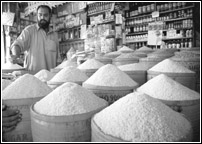 KARACHI: The world is bracing for a worst kind of food crisis, witnessed in recent memory. In the global village, Pakistan cannot escape the impact. But is the food crisis as severe as is being made to feel in the country?
There are varying opinions, but outside the government, stakeholders confidently push forward the view that “there is no shortage of food grains in the country and the crisis is all manmade”. They blame successive governments for mismanaging a perfectly manageable situation.
Sindh Chamber of Agriculture (SCA) Chairman Syed Qamar-uz-Zaman Shah told Dawn that the reason for the present position was that previous government gave an exaggerated crop estimate and allowed wheat export at lower than the international prices. Due to a lack of consistent policy, the government later allowed import of the commodity at exorbitantly high price.
The critics argue that neither the wheat production figures nor the exact cultivation area were reported correctly by the departments concerned.
The SCA chief said that Pakistan had harvested bumper crops of wheat and rice last year, but the lack of storage facilities and wheat smuggling to Afghanistan, India and Central Asian states created shortage of food grains in the country. He said that wheat was being smuggled because its prices in neighbouring countries were much higher than in Pakistan. The government failed to prevent smuggling as the agencies manning the borders lacked the will to do their job, for lethargy or otherwise.
“About 1.5 million tons of wheat has been smuggled this year,” say those in the knowledge of things.
Qamar-uz-Zaman claimed that the rulers were the real beneficiaries of the crisis as they made large chunk of money through hoarders and smugglers by deliberately adopting flawed policies and looking the other way while the smuggling was rampant.
He said that if the government was really sincere in resolving the issue and managing the crisis, it should allow floor mills, in addition to the Pakistan Agricultural Storage and Supplies Corporation (Passco) and provincial food departments, to procure wheat from farmers at the time of harvest. This should substitute the current practice of giving them their quota on a monthly basis. “The step will discourage hoarders,” he said.
Mr Zaman placed the blame for food crisis, squarely on the government departments that were unable to provide storage facilities in the country.
Sindh Abadgar Board (SAB) Chairman Majid Nizamani, however, did not agree with the views of the SCA chief. He said that since the godowns of the defunct Rice Export Corporation of Pakistan were at the disposal of the government there was no shortage of storage facilities.
The SAB chairman concurred that there was a food crisis in the country, but said that there was no shortage of grain. “Don’t forget that Pakistan produces 33 million tons of food grains against its annual requirement of 27 million tons,” he said.
He blamed the government for the current food crisis as, according to him, the rulers lacked sincerity of purpose and there was no rule of law in the country.
Offering a solution to the problem, Mr Nizamani said that the government should increase wheat support price to at least Rs1,100 per 40kg and give a subsidy of Rs400/500 to consumers. “In this way”, he said, “on one hand farmers will be encouraged to grow more wheat and on the other smuggling would not remain a profitable option as the local price would drop at par with the rates prevailing in the neighbouring countries”. He said the government was buying wheat at Rs625 per 40kg from the farmers, but consumers were paying Rs25/28 per kg or Rs1,000/1,120 per 40kg, with the middleman extracting as much as Rs375/500 in unfair profit.
Pakistan Flour Mills Association Chairman Iqbal Dawood said that out of 72 flourmills in Karachi, 34 had been closed down after a ban was imposed on inter-district movement of wheat. He also agreed that there was no shortage of wheat in the country, but it was the mismanagement that had done the damage.
Rice Exporters Association of Pakistan Chairman Mohammad Azhar said that the country had produced 5.5 million tons of rice, but hoarders captured a major chunk of the produce. He said that the government should procure rice from the growers and after storing a certain quantity for local consumers it should allow export of the remaining stock.
He claimed that the local consumers need 200,000 tons of fine rice and 700,000 tons of broken rice. He held the “greedy hoarders” responsible for the current increase in rice prices.
Mr Azhar dispelled the impression that the fixation of minimum export price of rice had benefited the local consumers. He said the MEP was fixed to stop rice exports to India.
Rice prices have been surging worldwide as governments and importers rushed to stock up the grain on growing fears that the food staple will get to be increasingly in short supply.
Due to the fears of a worldwide crisis, the international market has been witnessing an unprecedented hike in food prices for the last few months.
Some of the depressing indicators have been 40 per cent rise in global prices in the past nine months with a stockpile of foodstuff that is lowest in 30 years. Those in the business of food grain have calculated that wheat and rice prices have more than doubled in the last one year, ringing alarming bells worldwide.
When things are not going right, everybody looks for somebody to blame. President Bush, meanwhile, pointed the accusing finger at India’s 33 million middle class, which he said was consuming more due to increase in their disposable income.