0
0

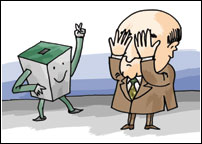 CORPORATE Pakistan has found the outcome of elections 2008 somewhat unsettling. Many business leaders were still in the process of digesting the popular mandate. Commenting on the outcome of the polls they dressed their disappointment in a veil of ‘surprise’.
Except for a bunch of private sector notables who have close association with the winners, the big business class was generally apprehensive. They were closely monitoring the post election political developments to fathom the contours of the evolving scene. They have sensed some realignment in power construct and were nervous at the prospects of readjustment and a cost it could entail. For them, it was too early to come forward and take a position.
When contacted most leaders avoided to offer comments off hand. They did come back with their measured responses. Informally they explained that reservations of their community are not rooted in pathological hatred towards a political set-up. It was, they said, based on their past experiences which unfortunately cannot be recounted fondly. Their experience tells them that elected governments are comparatively unstable, unpredictable and less business-friendly.
Some expressed reservations on the credentials of the leadership of political parties and did not see them as honest people committed to what they consider to be the guiding principle of any government: a neutral promoter of trade and business to achieve the growth and development objectives.
”Post-election scenario is not instilling confidence in business. Everything is up in the air. No one knows which way it is going to bend. A lot of people have started shifting their money out for they do not foresee stability under a coalition of unnatural partners”, a young dynamic corporate manager told Dawn on the condition of anonymity.
”The parliamentary system is not suited to our psyche. Many smaller countries in the region (Singapore, Malaysia) do not have parliamentary democracy but they are progressing at enviable pace affording a standard of living that matches with the most advanced developed countries. President Musharraf should have used the time he had to introduce presidential form of government to put all political elements at rest and to allow the space to the private sector to prove its worth”, said another top notch businessman.
”They were banking a bit too much on Musharraf. The business will have to adapt itself to the changing realities. They need to take a long-term view and abandon their habits of looking for shortcuts. They must give the political setup a fair chance”, Sardar Rahim, a businessman and a well known PML-N leader, responded to Dawn.
”The perception of business is largely based on one-sided propaganda. We need to leave our past behind and look forward to meet challenges ahead. The perception that PML-N is inclined towards fundamentalism is incorrect.
”We have come a long way since IJI. Same is true for PPP which no more adheres to Maoist image or the ANP that has nothing to do with Russia or communism anymore. The world has changed and so have we”, he retorted when the business community’s reservations were spelt out.
Iqbal Bengali, the ex-president of American Business Council, a powerful grouping of companies, sounded positive with an effort. “Whoever forms the government has experience of the past and we are hoping that the focus of the next government would be on economy and reforms. Yes, there is a fair amount of uncertainty currently. We will wait and see how the next government turns things around”, he said.
The big boys of business who have been the principal beneficiaries of the last government were more anxious as compared to the average medium and small businessmen. They tried to pretend to be neutral towards PM office. They were not ready to come on record but said that their chief concern was that the change be peaceful and stability and continuity should be ensured.
There were no evidence to back up the impression but some talked of currency transfers abroad over the last few weeks. “You will not be able to find evidence because there is none. The parallel economy is twice the size of formal economy that works totally independent with its own sets of unwritten rules without any book keeping. When the money is not accounted for its transfer can never be traced”, a business leader in know of things told Dawn.
“Politics is not our domain but the last government was accessible. The fear is that given a chance the politicians will again keep us out of their sight and mind”, said another businessman.
No matter how short-sighted and self-centered, the country needs its business class the way it needs its toiling masses and professionals. The political parties would not be able to deliver no matter how hard they try if the huge community of businessmen is not taken on board when deciding the economic agenda.
For development the country needs industrial expansion and boost in commercial activities The next government will need an innovative approach to earn the trust of the entire business community without conceding to the demands of the renter class.
The biggest test of the next government would be how it handles the challenge of distributive justice without scaring away the entrepreneurs.