



 0
0

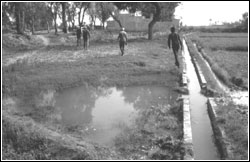 Agriculture provides livelihood directly or indirectly to people inhabiting the country’s over 45,000 villages. Of the total population estimated at 160 million, about 68 per cent live in villages. The country falls in dry region with an average annual rainfall of 240mm.
It has the worlds’ largest and the most integrated irrigation system comprising rivers, canals, distributaries and watercourses. The irrigation network comprises three large dams, 12 link canals, 23 (barrages/head works/siphons) and 1,07,000 watercourses. Despite having such a well established irrigation system, the farmers still face shortage of irrigation water.
There are various reasons of water shortages; the most serious among them is the loss of a large quantity of water at various levels of irrigation (canals- 15 per cent, distributaries - eight per cent and watercourses- 30 per cent). These losses are due to faulty watercourses, seepages and leakages at the Naccas. Theft of irrigation water is another reason of the shortage. The shortage can easily be averted through various conservation techniques like an efficient utilisation system, restoration of productivity of agricultural land through control of water-logging, salinity and floods, managing quantity and quality of drainage effluent and ground water etc.
Efficient irrigation system is a pre-requisite for better and higher agricultural production. Water distributaries bring irrigation water from canals to fields. It is through canal outlets that water from the distributaries is taken to small land holdings through watercourses. Thus the role of improved watercourses is significant because they can save wastage, in many cases, of 40 to 80 per cent water. Unimproved watercourses affect water supply and consequently irrigation and crop yield.
The government, keeping in view the problem of water shortage, has launched major projects to overcome this crisis. One of these projects is the “National Programme for Improvement of Watercourses” aimed at increasing agricultural production by effective utilisation of irrigation water through improvement of watercourses, creating employment opportunities in rural areas, alleviating poverty at farm level, and promotion of good governance through devolution to district administration and finally involving farmers in decision-making activities.
This programme was initiated to improve around 87,000 watercourses (34.9 per cent in Punjab, 33.7 per cent in Sindh, and the rest in other provinces) under the auspices of the Provincial Water Management Departments from December 2004 onwards. The objective was to reduce the high water losses of around 25-30 per cent during its transmission.
The mega project for the improvement of watercourse and lining of canals, a five-year project at an estimated cost of Rs66 billion with 22 per cent share of farmers, is under completion. Other water-related projects of the government are rehabilitation and construction of various dams, lining of canals and reviving of irrigation and drainage system.
The Water Management Department, in close association with farmers of the area, has rehabilitated thousands of watercourses and installed water control structures such as Naccas and culverts. The number of watercourses being improved is increasing day by day and requires the attention of all stake holders to maintain these works for a longer period of time. This programme will increase the life span of watercourses and efficiency of surface irrigation water.
It has been judged that the programme would generate substantial benefits, including saving of eight to ten million acre feet (MAF) of irrigation water per year, reduction in water logging and salinity, enhancement in cropping intensity by five to 10 per cent, growth in crop yield by 10-15 per cent, and many fringe benefits such as reduction in water thefts, improvement in livelihood, and awareness/confidence among farmers.
At present, the pressing problem is the maintenance of watercourses after their improvement. The ball now lies in the court of farmers. They will have to maintain these improved watercourses and apply irrigation water on scientific basis. Farmers’ organisations have come up with an effective solution to stop water pilferage by managing, policing and owning their irrigation systems.
No doubt, the informal Water User’s Associations are already playing their role but these should be strengthened in national interest. Moreover, farmers should not restrict themselves to the appropriate management of irrigation water but should also take part in planning, designing, construction and maintenance of watercourses in order to reap full benefits of the efforts and augment this programme on sound footings.
The improved watercourses invite farmers to adopt new agricultural technologies leading to higher level of productivity and monetary gains.

























