



 0
0

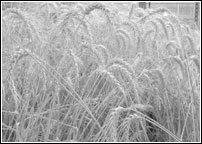 THE State Corporation of India recently invited a tender for import of 511,000 tons of wheat for Oct-Dec 2007 at a price as high as $380 per ton. But, Pakistan failed to grab the opportunity of earning precious foreign exchange--- despite Minfal’s claim of having harvested a bumper crop of 23.5 million tons amidst global shortages--- as compared with 21.2 million tons produced last year.
Paradoxically, the government had to ban the export as prices of wheat and flour rose sharply in the domestic market. There could either be large-scale hoarding, or the government’s claim of bumper crop of 23.5 million tons was wrong.
Press reports also suggest sizeable wheat smuggling to neighbouring countries. Recently, the government also had to ban export of wheat products. It is a pity that in an age of advanced statistical and computational techniques, Minfal can not accurately assess measure the wheat production even four months after the harvest.
According to USDA, global wheat production was 594 millions tons during 2006-07 as against 616 millions tons in 2005-06. Wheat prices escalated in the international market from $160/metric ton to present $300-325/metric ton.
India is importing 3-4 million tons of wheat to beef up its strategic reserves. In this scenario, export of two million tons would have fetched a precious foreign exchange of $600 million and an amount of more than Rs36 billion would have been pumped into the rural economy of Pakistan. Increased crop would have also kept the wheat and flour prices low thereby saving poor consumers from spiraling food inflation. But, due to un-imaginative policy of the Minfal, Pakistan and its farmers were deprived of earning good prices and precious foreign exchange.
Had the Minfal and the farming community been more innovative and taken the international wheat production shortage into account, the country would have been able to harvest a much bigger crop last year as it was a proven fact that price signals are the most decisive factors in enhancing production.
Given that wheat is the staple food of the people, its importance demands a sizeable crop without fail, to meet the needs of ever-increasing population. Consistent good crops are also needed to control high food inflation which is making the life of ordinary people miserable. Based upon its natural resource base, farmers enjoy comparative advantage in wheat production but still it is not a cash crop due to its low support price. Surprisingly, crop area under wheat is stagnant at about 8.4 million hectares and production has not increased much since 21 million tons was harvested in 99-2000, though a better crop was claimed this year.
Wheat policy is inward looking and ignores the international conditions altogether. Farmers with subsistence land holding do not have any knowledge of international scenario and just adopt the traditional cropping pattern which is not in sync with the market force of the world. Big farmers never take farming on economic factors as to them land is a means to attain political power and prestige which is then used to amass economic power as well.
The provincial agriculture departments are engaged in issues dealing with the production and supply of agriculture inputs. The policy making in case of wheat is the domain of the federal government. The Minfal should, therefore, adopt the wheat policy well before the growing season keeping in view the international production scenario.
An innovative wheat policy--- “Grow for ourselves and exports” is needed. Instead of fixing the wheat production target arbitrarily, at 10-15 per cent above the previous year’s production, Minfal should fix the target in September on the basis of crops harvested in Europe and especially, on expected crop size of Australia and Argentina as they are major wheat-exporting nations.
Another factor would be carryover wheat stocks available with major wheat producers every such as USA, Russia, Ukraine, Australia and Canada etc. If the production in Australia and Argentina and the global wheat stocks are less, Minfal can just increase wheat target, predict expected price in next year and start educating farmers to increase the crop area and gear up production effort so that a larger size of crop is harvested which, can not only ensure food autarky, but also generate sufficient surplus for exports.
Wheat prices in the international market are expected to be in the higher range due to fears of on-going drought in Australia. Another factor is the increasing use of corn by bio-fuel industry. This may lead to increased demand for wheat in international market.
It is time that policy-makers in Minfal and farming community forums, such as the Kisan Board should start looking outwards for developing production patterns of different crops.

























