0
0

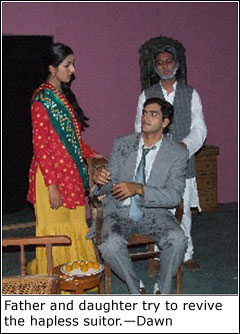 KARACHI: ‘Shaadi ka Paigham’, constituting theatre group Natak Walay’s first independently-managed public production, opened at the PACC Hall on Sunday. The performance was followed by a short but sweet concert by Taal Karisma which presented four experimental pieces quite remarkable in their complexity.
A Shoaib Hashmi translation of Chekhov’s ‘A Marriage Proposal,’ the one-act, three-person comedy has been directed by Mohsin Ali Shah and stars Farhan Ahmed, Rabab Hashim and Shah. Given that the play is a translation and not an adaptation, it maintains the setting given to it by Chekhov: a rural backdrop characterised by small land holdings. Perhaps in deference to the classic Urdu of Hashmi’s script, the director chose to dress his actors in the sherwani and gharara of what appears to be pre-partition India, although no specific mention is made of the play’s contextual location.
A mock-ironic take on marriage, the plot concerns Kamal (played by Farhan Ahmed) visiting the house of his neighbour Mr Sherwani (Mohsin Ali Shah) to ask for his daughter Roshan Ara’s (Rabab Hashim) hand in marriage. Sherwani is delighted but Kamal and his intended start arguing immediately. Their altercations are interspersed with moments of shyness befitting a marriage proposal and as Sherwani sums up, the stage is set for yet another happy marriage. The actors played their parts competently on the whole with Shah standing out as the strongest actor. Even in scenes of high-tension, Shah maintained the mannerisms and bearing of the 50-something Sherwani and delivered his lines with convincing aplomb. Ahmed, in his role as the hypochondriac Kamal, displayed an initial tendency to rush but managed to overcome this shortcoming by his second entry. Similarly Hashim, as the wilful Roshan Ara, settled into her role and delivered a balanced performance after some initial nervousness.
Final year students at the National Academy of Performing Arts, the actors’ training was readily apparent in voice projection, their control over movement and enunciation, and their awareness of stage conventions. The director had worked the blocking out well and the actors’ moves underlined not only the shifts in mood but also who had the upper hand, and effectively used the available space.
The performance was simply and cleanly lit with front-of-the-house fresnels, which are the only ones available at the PACC Auditorium – fortunately, this play does not really demand complex light changes. With an effective set constructed of painted flats bearing minimal visual clutter and a few well-placed pieces of furniture, the director brought the actors, rather than the backdrop, into focus.
‘Shaadi ka Paigham’ was followed by a performance by Taal Karisma, comprised of students of NAPA’s music department. This percussive fusion band has three permanent members, Ahsan Bari (composition and guitar), Alan Simon (composition and percussion) and Joseph Fernandes (percussions) who are joined for these performances by Farhan Anwer Raza (keyboards) and Gul Mohammed (sarangi).
With a self-stated aim to reintroduce forgotten, mostly eastern, instruments and show their capacity to fuse with western ones, Sunday night’s performance combined the sarangi, the guitar, the tabla, drums, the Egyptian darbuka, the African djembe, chimes and cymbals. The first piece, entitled ‘C’est la vie,’ used body percussion which the band claims to have introduced to Pakistan – making music without any instruments except the body itself. The second piece, based on the raga Aimen and dedicated by the band to the city of lights, constituted a delicately-mixed harmony with the sarangi providing a hauntingly unifying melody. Most remarkable of the four pieces, however, was ‘Ebb and Flow,’ a technically complex composition using a parallel beat structure with the melody in 7 beats and percussions in 10 ½. The comfort with which the musicians handled their instruments and their friendly informality with the audience served to lend the performance intimacy and therefore increased vitality.
Due to run until September 6, the production has been sponsored by Neutrogena, Imagination Unlimited, the PimSat institute of higher education, FM96, McDonalds and Dhindhoorchee. Director Mohsin Ali Shah feels that it has been a learning experience. “We put up this production for the experience of performing on successive nights,” he commented, “the play’s pace and the actors’ progression change when you’re performing at a stretch.” Asked what he has learnt, he wryly mentioned the ‘other’ tasks that are the director’s lot, such as handling sponsors and advertisers, and simultaneously putting together a production and marketing team. — HM