Do we want kidneys from deceased or living donors?
WHILE many countries have long had laws that prohibit the sale of human organs for transplantation, whether from living or deceased donors, we seem to have had considerable difficulty over the past 15 years in promulgating a similar law that would make the sale of human organs illegal, despite international and local pressure.
Apart from pressure by the local organ sales mafia, the inability to promulgate a law on organ procurement and transplant so far seem also to have its roots in our inability to decide on whether we want to have organs from mainly deceased or living donors.
While the policy guidelines on the procurement and transplant of organs — as set by the developed nations and the UN — advocate the supply of organs from deceased patients followed by organs from living related donors, and forbid the sale of or compensation for human organs from live unrelated donors, two recent developments have favoured a growing lobby in the world which is challenging the organ sales taboo and advocating increasing the number of living donors by legalising compensation payment of live unrelated donors.
One development is the emergence of transplant tourism or the black market trade in human organs, an activity for which we unfortunately have had a notorious contribution. As if our role in the trading and sale of human organs alone was not enough to defame our country, reports of forced abduction and drugging of people and removal of their kidneys by unscrupulous gangs involved in the trade — gangs whose members include not only the middlemen or agents but surgeons and police officials as well — doubled our infamy.
Thus, the international anti-organ sales lobby like WHO, the World Medical Association and the Transplantation Society argue for the urgent need of countries like Pakistan to enact a law allowing organ transplants from deceased donors to beat black marketing and exploitation of the poor in organ sales.
But the pro-organ sales lobby on the other hand argue that legalising and regulating organ sales to increase organ supplies is necessary for eliminating the exploitation and black market in organs and thus, making the growing demand for organ transplantation safer for both recipients and donors.
Another development which has favoured the pro-organ sales lobby is the legalisation of organ sales by Iran and Saudi Arabia, the first countries in the world to do so.
When Iran legalised the sale of organs by living donors, The Economist hailed its regulated system of compensation for living donor organs as a model humane move, better than the illicit trade. The officially approved Association of Kidney Patients in Iran, a non-government organization which is responsible for all legal kidney transplants, oversees the transactions of kidney sales, with each donor reportedly getting between $2,000 to $4,000.
In order to stop its citizens from patronising the black market organs trade in China, Egypt, Pakistan and the Philippines, Saudi Arabia reportedly passed a law in October 2006 establishing a regulated live donor organ procurement system under which the government pays a monetary reward of $13,000 and other benefits, including life-time medical care, for unrelated organ donors.
Unlike Saudi Arabia and Iran, however, most major international health concerns and governments and their national professional institutions encourage organ transplantation from deceased donors, object to the procurement of live organs for transplant through payment, consider this practice as unethical and repugnant, and forbid their surgeons from being involved directly or indirectly in the organs trade.
Similarly in Pakistan, major transplantation institutions like the Transplant Society of Pakistan, the Pakistan Society for Nephrology, the Pakistan Association of Urological Surgeons as well as the Sindh Institute of Urology and Transplantation have been advocating for legislation against the sale of organs for transplantation and for the procurement of organs from deceased donors (cadavers).
Our attempts to legislate on the issue date as far back as 1992 in the form of the first bill on organ transplants which, instead of being passed by Parliament then, was thereafter delayed, redrafted time and again and tabled in parliament in 1994 and 1996, according to an expert writing in a letter-to-the- editor in Dawn.
The most intensive effort at redrafting the organs bill and tabling it before Parliament has, perhaps, taken place during the past two years. But despite the intervention of the Supreme Court last year asking the government to promulgate the law against the organ trade, we are back at square one when instead of a law at last, a fresh bill was tabled before Parliament again on August 17.
During the past two years, we have been told off and on by several leaders, including the federal health minister, the Senate Chairman, and the Deputy Attorney General, that a bill prohibiting the sale of human organs was being drafted and would be tabled before parliament soon.
Even President Musharraf chipped in on this issue. In November 2006 at a ceremony in Karachi where 700 live altruistic organ donors were presented medals, the Sindh governor reportedly read a letter from the president who denounced the commercialisation of organs and supported legislation to ban organ sales.
The organs bill finally tabled in the Parliament on August 17 reportedly provides for a system of procurement from deceased donors and prohibits the sale of organs by living donors. The crucial question remains: Will this bill get pass Parliament this time and become law when other bills on organ transplant previously tabled couldn’t?
For the sake of the tens of thousands of people who suffer from end stage organ disease and require transplants, it is hoped that the recently tabled bill regarding organ procurement and transplants will soon finally become a law that would help establish an ethical, humane and fair national system of organ procurement and distribution, providing for life-saving transplants from deceased donors as well as from voluntary altruistic unrelated living donors.
For this law to be effective there should also be provisions in it to curb misuse and abuse of the cadaver organ donation system. After all, if a black market in living donor organs can thrive in Pakistan, so can a black market in cadaver organs emerge.
The mushrooming business of education
Driving down the many roads in Karachi — some broken, some yet to be broken — it is easy to spot the countless schools that have opened up in small, boxy houses. The giant boards that flank the front wall of these ‘academic’ institutions profess that the schools are English medium, registered and recognised by the government, and offer both the matriculation and ‘O’ Level systems of education, the latter becoming more popular by the year.
They claim to have the best teachers in town, state-of-the-art computer labs and syllabuses that will shape any student into tomorrow’s intellectual. In short, they profess to be the best seat of learning a parent can imagine for his/her child.
The story-line is similar for all schools; only the script differs. And given the huge number of schools popping up right, left and centre, one cannot be blamed for assuming that the literacy level in Karachi must be quite high.
Unfortunately, this is not the case. Illiteracy is still very much rampant in
the city, and according to the website of the Sindh education department, the illiteracy rate is hovering around 37 and 35 per cent in kids who are 15 years and above and 10 years and above respectively. Of course, there is always the likelihood that the figures could be much higher since the given source is a government department.
Even if we thank God for small blessings – one being that Karachi can still boast of a better literacy rate than many other cities – the glass still looks half empty. For instance, look at the performance of most private schools. That the academic institutions have become commercialised has become a known, and even an accepted fact. But what’s more deplorable is the fact that the more this “business” becomes commercialised, the further the standard of education drops.
Sub-standard teaching, along with an ill-planned syllabus, has given rise to tuition centres around the city. It is, of course, a different debate that the people who run these tuition centres are the same people who teach in schools. And not surprisingly, the quality of teaching is 100 per cent better in the tuition centres. Elite private schools aside – where parents are at least satisfied with the quality of education despite the burning holes in their pockets – most parents who enrol their kids in private schools are left wondering about their kids’ future.
I remember one of my teachers used to say that it’s easy to get a degree; it is far more difficult to get a quality education. With a little variation, this certainly seems to hold true for kids in primary schools as well.—Sa’adia Reza
Preserving history
The historic building of the Sindh Assembly, where the first resolution for the creation of a separate Muslim state — Pakistan — was passed, will be preserved as a national monument after the construction of an additional block in its backyard.
Though the foundation ceremony of the additional block was scheduled to coincide with the Independence Day celebrations, the Sindh chief minister left for Saudi Arabia to perform Umra in the meanwhile. Hence the ceremony was postponed and a new date has yet to be announced.
The foundation stone of the new block will have the names of all members of the present assembly, according to Speaker Syed Muzaffar Hussain Shah. He expects the construction work will be completed within two years once it kicks off.
All the structures located on the premises, including those housing employees’ quarters and katchi abadi offices, will be shifted to alternative places. However, the two privately-owned structures located at the corner of the assembly building will be acquired so that the architecture of the whole area is in consonance.
The original Sindh Assembly building was constructed in a span of two years after its foundation stone was laid on March 11, 1940. The building was opened for business on March 4, 1942. The following year, the first resolution for the creation of a separate state for Muslims of the subcontinent was passed on March 3, 1943. The mover of the private resolution was G.M. Syed and it was supported by Shaikh Abdul Majid.
The text of the resolution reads: This house recommends to convey to “His Majesty’s Government through His Excellency the Viceroy, the sentiments and wishes of the Muslims of this province that whereas (the) Muslims of India are a separate nation possessing religion, philosophy, social customs, literature, traditions, political and economic theories of their own, quite different from those of Hindus, they (Muslims of India) are justly entitled to the right, as a single, separate nation, to have independent national states of their own, carved out in the zones where they are in majority in the subcontinent of India.
“Wherefore they emphatically declare that no constitution shall be acceptable to them that will place the Muslims under a central government dominated by another nation, as in the order of things to come, it is necessary for them to have independent national states of their own and hence any attempt to subject the Muslims of India under one central government is bound to result in civil war with grave, unhappy consequences.”
Through an amendment made in the resolution, the words, “civil war with grave” in the last line, were substituted by the word “disastrous.”
The resolution was opposed by Hindu members of the legislative assembly but after discussion Dr Hemandas R. Wadhwani asked the speaker to put the resolution for division and the result thereafter was:
Ayes: Shaikh Abdul Majid, Khan Bahadur Allah Bukhsh Gabol, Khan Bahadur Haji Amir Ali Lahori, Arbab Togachi, Mir Bande Ali Khan Talpur, Mir Ghulam Ali Khan Talpur, Sir Ghulam Hussain Hidayatullah, Khan Bahadur Ghulam Mohammad Isran, Syed Ghulam Murtaza Shah, Khan Bahadur Syed Ghulam Nabi Shah, Pir Illahi Bakhsh Nawaz Ali and Nawab Haji Jan Mohammad.
Nays: Rai Sahib Gokaldas Mewaldas,
Dr Hemandas R. Wadhwani and Lolumal R. Motwani.—Habib Khan Ghori
Picture perfect
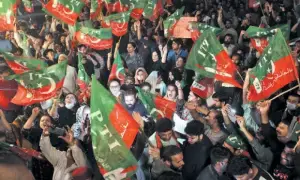
Pictures don’t lie, so they say, but some do. There is the example of press releases and accompanying photos. Recently many major newspapers of Karachi received copies of a short write-up with the same photo of a group of distressed souls demanding their rights.
The release read that millions had taken to the streets for a particular cause and in doing so were successful in shaking heaven and earth. Many newspapers, eveningers especially, dutifully printed the item without as much as verifying the episode. But when investigated further, some interesting revelations came to the fore.
It was learnt that the six or seven people shown protesting and raising slogans in the photograph were the only ones present on the occasion. Officials at the government office outside of which they were protesting complained bitterly about reports of their jumping over the back wall in order to escape the rumpus.
Firstly, whenever there is a protest of the calibre that was being claimed in the press release, you see road barriers and traffic jams everywhere. But nothing of the sort was witnessed on the day. Secondly, when some of the protesters were confronted by the government employees working in the office outside of which they were protesting, the people immediately demanded return fare and chai paani. On top of that, some blurted out that they were domestic helpers in the rival camp head’s house. Still, they all fit rather well in the photographer’s frame and made a perfect picture, giving the wrong impression of course.—Shazia Hasan
Compiled by Syed Hassan Ali
Email: karachian@dawn.com
| © DAWN Group of Newspapers, 2007 |