Congressional rebuke
THE latest congressional report should provide food for thought for those who are running America’s war on terror. The report, prepared by the Congressional Research Service, contains a scathing criticism of American foreign policy insofar as it concerns the war on terror and comes to the conclusion that, instead of achieving its objectives, it is helping create sympathy in the Muslim world for terrorists. It declares what has long been known — that “what the US government says does not match what it does”. It notes with concern, for instance, that US support for totalitarian regimes in the Muslim world enables radical Islamist groups to exploit economic and political tensions in countries ruled by pro-western governments. More significantly, the CRS report criticises the State Department’s report on terrorism because of its “mute” criticism of countries which are of strategic importance to the US — countries like Pakistan, Saudi Arabia and Egypt. In all these countries, the report says, the US could have done more to advance democracy. However, the most important part of the report concerns groups which the US regards as terrorists but which have joined the political process. Hezbollah and Hamas fall in this category.
In the last Palestinian elections, Hamas captured a majority of votes and was successful in forming a government. The same is true of Hezbollah, which has deputies in the Lebanese parliament besides two ministers in the government. Both Hamas and Hezbollah have an extensive network of community services which give financial aid to the families of those killed and provide healthcare, education and jobs to their constituents. This is one reason why they were able to win votes and join the political process. But the Bush administration has refused to accept their political credentials and has consistently characterised both as terrorist organisations. In both cases it joined with Israel to destroy the two groups. In the case of Hamas, Washington approved of Tel Aviv’s decision to freeze the Palestinian Authority’s share of revenue receipts, while the US — and the European Union — cut off all non-humanitarian financial assistance to the Ismail Haniye government with the avowed aim of undermining it. Both the US and EU pressured commercial banks not to transfer to the PA money pledged to it by some Arab countries, Iran and Russia. Still, the Hamas government has managed to survive both the financial squeeze and the Israeli invasion of Gaza in June, which had America’s full support. As for Hezbollah, America’s categorical support for Israel’s war on Lebanon and its blockage of any ceasefire moves at the Security Council are too recent to warrant any elaboration.
The full text of the report is not yet available, but while it does speak of “major policy dilemmas” for the US with regard to groups like Hamas and Hezbollah, the CSR findings skip America’s failure to make an earnest attempt to seek a solution of long-standing problems like Palestine and Kashmir which are a major source of frustration among Muslim peoples. The US has let Israel exploit the war on terror by attempting to delegitimise the freedom movement in Palestine by equating resistance with terrorism. Against the background of America’s war on Iraq, the carte blanche given to Israel and the repeated threats to Syria and Iran, one can understand why extremists and terrorist groups see in all this an opportunity to find validity and strength for themselves.
A sad day for cricket
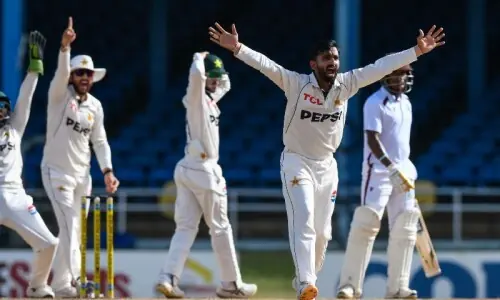
A VARIETY of opinions can be heard on the morning after one of the most controversial days in the history of Test cricket. However, one consistent theme runs through all the arguments currently on offer: the biggest loser on Sunday was not Pakistan but the game itself. This was the day when one man’s ego — and innate bias, many will say — brought the game into disrepute. Almost single-handedly, Australian umpire Darrell Hair created a watershed that will feature prominently in cricketing lore, for all the wrong reasons. England became the first team to be handed a Test match it did not quite win, but it can be safely assumed that so tainted a “victory” brought little joy to the home side or its fans. The Pakistan camp, meanwhile, is seething with anger. By changing the ball on what appears to be a whim, Hair questioned the players’ integrity and effectively called them cheats. The biggest question is, where is the proof? As Simon Barnes pointed out in The Times, “Sky [TV], not short of cameras or curiosity, was unable to find any footage of a guilty player doing some sneaky thing to the ball. All we have, then, is Hair’s judgment: Hair’s punishment.” Those who saw the ball in question reportedly found nothing that could be interpreted as suspect.
The ball is now firmly in the court of the International Cricket Council (ICC), an organisation not known for clear thinking. The Pakistan board has repeatedly told the ICC that it has no faith in Darrell Hair, going so far as to request that he should not be appointed for any matches involving Pakistan. The ICC, in its wisdom, instead ensured that Hair featured in some of Pakistan’s most important matches in recent years. There is a widespread view that Hair is heavily biased, for whatever reason, against subcontinental teams, particularly Pakistan and Sri Lanka. Sunday’s controversy has only added to these fears. If the ICC supports Hair and further penalises Pakistan — which is highly likely — it must provide incriminating footage confirming that ball tampering did indeed occur. If none is forthcoming, it has to be ensured that the Oval Test was Darrell Hair’s last as an umpire.
Addressing Baloch grievances
THE level of hostilities between the military and the rebels in Balochistan may have decreased significantly, but the militant presence in the province continues to be strong as evidenced by a string of bomb blasts over the past few days. Despite official claims that the government’s writ has been restored in the restive areas, it is clear that the authorities have not gained full control of the situation and that subversive acts, such as the blowing up of pipelines and power transmission towers, will not stop anytime soon. The government recently promised to spend Rs100 billion on building infrastructure in the underdeveloped province. But it has often announced similar intentions in the past and one does not know how committed it is to improving the lives of the poverty-stricken Baloch whose situation has been made worse by unemployment and deeply entrenched, regressive feudal customs.
Besides engaging the province’s disgruntled leadership in a political dialogue, what is needed is a series of measures to show that the government is sensitive to the needs and demands of the people. There is no substitute for long-term economic development, but immediate needs too have to be addressed. Here, the government has failed miserably, as indicated by its disinclination to help the thousands of people rendered homeless by the conflict. Besides, its intelligence personnel have been picking up people suspected of having links with the militants and holding them incommunicado, while a strong military presence is giving rise to bitterness and anger among the people who already have reason to feel bypassed by the economic benefits of Balochistan’s mineral resources. Further erosion of confidence in the government will create greater frustration and anger. The authorities should act before the prevailing sense of deprivation heightens in Balochistan.
The worsening law & order situation
ON August 11, 1947, Quaid-i-Azam Mohammad Ali Jinnah, the first president of the Constituent Assembly of Pakistan, in his address to the members informed them that their assembly had dual functions of writing a constitution and making laws to govern the country. In that respect, they had all the powers to take final decisions.
This clearly indicated that the country was to follow the path of democracy and that the legislature was the supreme body fully authorised to decide on the system of governance. The Quaid did not specifically say what kind of constitution would be made. He left it open to the members who were assigned the duty of crafting a constitution.
However, while laying down the guidelines, he mentioned the problems that confronted the country and said that the first priority was law and order. He said: “You will no doubt agree with me that the first duty of government is to maintain law and order, so that the life, property and religious beliefs of its subjects are fully protected by the state.”
We made our first constitution in 1956. It fell victim to the first martial law in 1958 and was abrogated. General Ayub Khan wrote the second constitution of 1962 himself. This was abrogated by the second martial law of General Yahya Khan in 1969. Our third Constitution was made in 1973 for what remained of Pakistan after the eastern wing broke away. This has survived two suspensions after the military takeovers of 1977 and 1999.
Military takeovers, not permitted by the Constitution, were validated by the Supreme Court under the law of necessity, elections were held and the Constitution was restored. Parliaments elected under the umbrella of army governments put the seal of approval on army takeovers and laws passed by the army, with the complete cover of validation and incorporated the same in the Constitution as the eighth and seventeenth amendments.
These amendments are scars in the body of the Constitution. But despite the patchwork of the above-mentioned amendments, Article 9 provides that no person shall be deprived of life or liberty save in accordance with the law. Article 25 provides that all citizens are equal before the law and entitled to equal protection of the law. In normal circumstances, when the elected government is in power and law and order is beyond the control of the police and other law-enforcement agencies, the army can be called in aid of civil powers by a magistrate under Section 129 of the Criminal Procedure Code.
Under Article 245, the armed forces, under the control of the federal government, are supposed to defend Pakistan against external aggression or threat of war, and, subject to the law, act in aid of civil power when called upon to do so. So it is very clear that according to the Constitution and the law, the armed forces are under the command of the federal government and it is their duty to defend the country and come in aid of civil power, whenever called upon to do so. Nowhere does the Constitution permit or allow the army to take over the government or dismiss or subvert the Constitution and impose martial law.
The present government that appears democratic is in actuality an extension of the fourth military takeover of October 12, 1999, which was validated by the Supreme Court under the law of state necessity with directions for elections within three years. General Pervez Musharraf who seized power, continues to be chief of army staff and the president. The same chief justice, who was the author of the validating judgment, was appointed as chief election commissioner and elections were held under him.
The elected parliament has approved the military takeover and the laws made by the army under the seventeenth amendment. Consequently, the present democratic set-up has emerged with the president in uniform as chief of army staff.
After 9/11, the president, without any hesitation, gave a categorical assurance to Washington that Pakistan supported it in the war on terror. The tables were turned and Pakistan became an ally of the United States in the war against international terrorism. The US government thinks that terrorism is bred in Muslim countries and is taught by Islam and that the international coalition has the right of defence and pre-emptive strike at the source. Pakistan is a frontline supporter of the US in the war against terrorism and is at the receiving end of praise, financial support and appropriate compensation for services rendered, including steps for secularisation.
What is happening in Pakistan is a matter of great concern and anxiety. The law and order situation is worsening day by day. People are being killed in Waziristan where arrests and deportations are also taking place of those who have been residing there for long. The situation in Balochistan is getting out of hand and needs a political instead of a military solution. Sectarian killings of innocent people and bomb blasts in mosques and imambargahs have become the order of the day.
In April this year, when people had assembled to celebrate the birthday of the Prophet (PBUH) in Karachi’s Nishtar Park, there was a bomb blast in which more than 50 persons were killed. Was it an attempt to show that terrorism is in the blood of Muslims and they kill each other even on sacred occasions? No such thing happens on Christmas Day or on days of religious importance to the adherents of other faiths.
This promotes the perception in the West that Muslims are terrorists by nature, while Jews are victims regardless of what their government does in Lebanon and Palestine. More recently, Shia leader Allama Hassan Turabi, who always preached unity between Sunnis and Shias and among the Muslim people, was killed. Generally, too, people are being killed for small amounts of money. There is large-scale vehicle snatching and cell phone theft. There is unemployment, inflation and poverty is driving some to suicide. Even public utilities like water and electricity are not available and people routinely come out on the streets to protest.
The present government is powerful because it has the open support of the armed forces. The president is head of the state and the government and is also the serving chief of the army staff. He calls all the shots. Political parties supporting him in parliament want him to continue as president in uniform for another five years. This has given rise to intense debate. The question arises whether the present government under the protective wing of the armed forces has succeeded in providing security to the people and maintained law and order.
Attempts have been made on the lives of the president, the prime minister and a corps commander. The law enforcement agencies are concerned about the security of the VVIPs and when they come to Karachi, all roads are blocked for five to six hours, causing intense traffic jams that sometimes result in fatalities as in the case of those who cannot reach the hospital in time. So whenever VVIPs come to Karachi, it would be better if either curfew is imposed or arrangements are made for their travel by helicopters.
In the normal course, when there is a civil government elected under the Constitution, the army can be called in aid of civil power by a magistrate and also under extraordinary circumstances when natural calamities occur like earthquakes, floods, rains, fires and accidents, which cause heavy damage to life and property. The current situation of heavy rainfall and frequent and prolonged load-shedding, causing people to protest is an example.
If this extra powerful government is not able to control the situation, then we have reached the end of the road. People are using the services of private security companies on payment because the government is unable to protect them. It is apparent that we have not heeded the advice of the Quaid that it is the first duty of the government to maintain law and order so that the life, property and religious beliefs of its subjects are fully protected by the state. It is well known that superpowers have only policies and not friends and that they use smaller countries to support their policies for as long as needed, in return for economic aid. Democracy is not an immediate requirement for smaller countries, and sometimes monarchies and military dictatorships also suit the policies of superpowers and get full support. After the military takeover in Pakistan, President Bill Clinton declared sanctions against the de facto government of General Pervez Musharraf and was not prepared to meet him. But after 9/11, the policy was changed to fight terrorism and Afghanistan was to be attacked. The support of Pakistan was now needed, regardless of the fact whether there was a democracy or not.
Circumstances and priorities change. News items in the local press about a month ago said that Mr Richard Boucher, assistant US secretary of state for South and Central Asian affairs, met the chief election commissioner in Islamabad and assured him that America wanted the army in Pakistan to be subordinate to civil authority and to achieve that objective America would support free and fair elections in the country with the participation of all political parties. This probably prompted retired generals, some politicians and analysts to write an open letter to the president to give up the post of army chief. So now there will be fireworks in the political arena and let us keep our fingers crossed for better prospects of a real and unadulterated democracy.
The writer is a former chief justice of the Supreme Court.