0
0

KARACHI, April 18: The media should play the role of a catalyst to ensure a positive social change, said speakers at a workshop here on Monday.
The five-day workshop on “Training of trainers on media and local government” was organized by the Pakistan Press Foundation (PPF) with support of European Union at a local hotel.
Addressing the concluding session of the workshop, the head of EU’s delegation to Pakistan Michael Dale said the role of media was very vital, as it was a go-between between the government and civil society. He said that the media was not only the conscience of society but also its safety valve.
Mr Dale said it was very difficult to be unbiased while reporting, but it was the prime responsibility of media to ensure objectivity and impartiality while discharging their professional duties.
He said sometimes to boost sales, some newspapers indulge in sensationalizing of news. He said it was a two-edged sword as if used for a positive purpose, it would get appreciation of readers, but if an unbiased news item was sensationalized, the media would lose its credibility. He said that the credibility and confidence of readers was a major asset of the media.
Mr. Dale said the media should play the role of a catalyst for a rapid and positive social change. He said that it were not the yes-men but the people who dared to say ‘No’, which helped the society to progress and prosper. He said that the media could only help the society by raising bold questions.
Mr Dale said that not only in countries like Pakistan but also in the Western societies many vested interests find their way in government. He said here the responsibility fell on the shoulders of media to unearth the negative vested interest in the larger interest of public and society.
Quoting example of Western countries, he said that people sued media there for giving wrong information.
Mr Dale hoped that the participants would use information obtained during the training workshop in their practical work. He stressed for public-private partnership to solve the problems of masses. He assured that the European Union would continue to support such training programmes in future.
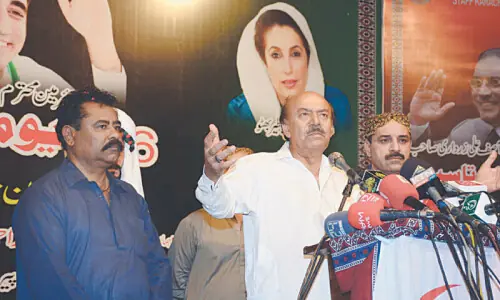
Earlier, City Nazim Syed Mustafa Kamal, addressing the workshop, said the local government and media had a close relationship.
He said that the objective of local government, the third tier of government, was to facilitate masses at grassroot level.
He said that the media provided a useful guidance for the local government regarding the problems of people. He said that during the last four months as a city mayor, he had found the media very positive and helpful.
The city nazim said that Karachi was a big city with a population of around 18 million, and having 170 union councils. He said that it was not possible for the city government officials to monitor each and every area of the city and know all their problems. He said that here the city government had to rely on media, which provided it with useful information about the problems faced by the masses.
He said that he always welcomed the criticism and took it as a positive response. He said that sometime vested interest also used media for their negative designs, but again these cases were very rare and 99 per cent media reports were a very positive and constructive.
Syed Kamal said that for the first time in history of Karachi, his administration was inviting suggestions and feedback from the citizens before initiating a new uplift scheme.
Quoting example of the Hassan Square Flyover projects, he said that suggestions had been invited from citizens and decision was taken in their light.
PPF Chairman Fazal Qureshi, General Secretary Owais Aslam Ali, Roshan Ara and others also spoke.—PPI