



 0
0

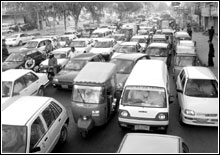 THE city government has reportedly signed an agreement with a foreign firm to construct a 24-km long ‘elevated expressway’ from Jinnah Bridge to Quaidabad at a cost of $225 million.
The expressway would follow the route M.T. Khan Road-Club Road-Hotel Metropole-Sharae Faisal-Quaidabad.
Since, VIP movement aside, this is not the most congested route in Karachi, nor the one identified by numerous studies undertaken regarding provision of a ‘mass transit’ system for Karachi, one suspects that this huge expenditure is envisaged just to facilitate the frequent movement of VIPs on this route. Though the firm is reported to be financing the project, ultimately it is the taxpayer who would pay through his nose for this monstrosity!
The duplication of this route at massive cost and inconvenience to the taxpayer is hardly necessary. Ultimately, the taxpayer would be doubly hit. He would suffer the consequences of construction of such a mega project right in the heart of the city, along an important city artery, while he would continue to suffer the impact of “VIP movement.” The real issue is the excessively stringent measures taken for such movement.
During the last decades, the government has commissioned numerous studies to provide a ‘mass transit’ system for Karachi. Reports of these studies are gathering dust in archives of the city government and its predecessor Municipal Corporations and other government agencies. They have spent millions, perhaps billions, on these studies but without results.
And now all of a sudden we hear that an agreement has been signed, to construct an ‘elevated expressway,’ that seems to be more the result of a quirk of some bureaucrat’s imagination than well-considered deliberation and planning.
Already objections have been raised from time to time about ongoing mega projects like Lyari Expressway, Northern Bypass, Gwadar city project etc. having been started without thorough environmental assessment studies having been carried out.
In the current case, it is doubtful if even preliminary homework has been done regarding the project’s economic and technical feasibility! Any decision on public transport should be a carefully weighed decision, arrived at after due consideration of options available and their cost, plus other important factors such as their environmental impact, inconvenience to public during the construction phase, ease of use, maintenance and recurring costs, and so on. The history of mass transit studies undertaken and their fate so far makes interesting reading.
Soon after taking over in October 1999, Gen. Musharraf ordered that the Karachi Circular Railway operations, then completely suspended by the Pakistan Railways, should be restored and possibility of revitalizing and expanding KCR be explored. Meanwhile, competing for the government’s favour was the light rail project, under the Karachi Mass Transit Project study. But the federal government failed to earmark funds for it in the 2000-2001 budget.
Thereupon, the Canadian government, which had promised to provide part of the funds, requested GOP to postpone the $600 million project for at least two years. Sohrab Goth to Tower had been identified by this study as priority-I corridor. Thus the light rail corridor project remained unimplemented.
In 2000, the Sindh government had also agreed to make the KCR an integrated part of the light rail system in Karachi envisaged in the KMTP but rejected the Planning Commission’s advice to review KMTP’s feasibility, and hired financial advisers to suggest ways of raising funds for it.
In March, 2001, the federal government asked the Sindh government to prepare a plan by May 2001 for an integrated transportation system that should include KMTP, KCR, Northern Bypass, and the Lyari Expressway etc. along with the priorities of the various projects and also promised assistance of about Rs20 billion. However, the federal government’s ‘transport policy wizards’ were said to have made recommendations against a rail-based mass transit system in Karachi.
Though the plans submitted to the Planning Commission by the Sindh government gave the greatest importance to the KCR, Northern Bypass and KMTP’s priority corridor, no funds were allocated for the KCR or the KMTP in the federal budget. Instead, funds were allocated for Lyari Expressway and Northern Bypass and work awarded to Frontier Works Organization.
When the Railways washed its hand off KCR completely, graciously offering the Sindh government to use the railway rolling stock and railway track, war of words ensued between it and the Sindh government. The Railways unilaterally declared KCR to be irrelevant stating that “there are not enough link bus routes.”
The Sindh government, in turn pointed to the Railways’ systematic neglect of KCR over the years, thereby depriving the commuters of a relatively inexpensive and safe service.
In March, 2002, revitalization of the KCR was again taken up and a Steering Committee set up by the Governor, headed by Provincial Transport Minister and comprising of the City Nazim and several provincial bureaucrats. The governor particularly emphasized that low-income areas be included in the final plan.
Now the elevated light rail project envisaged in the KMTP was much criticized by many because it was not considered aesthetic and likely to cause massive air and noise pollution, besides creating disruption of gigantic proportions for many years during construction, as the main corridors lay alongside the main transport arteries of the city.
Meanwhile, a local consulting firm, Engineering Consultants Ltd., was entrusted with preparing a revival plan for the KCR.
Following in the footsteps of foreign consultants, ECL prepared a ‘grandiose plan’ that envisaged a huge initial outlay of about Rs15 billion just for upgrading the existing 48 km of the KCR system and equipping it with new special rolling stock.
Mr Jafar Wafa, a former official, rightly observes that the Engineering Consultants’ “master plan” for KCR revival seemed to have floundered on the question of outlays because the great annual cost of operation and maintenance and the proposed expensive expansion plans mentioned therein were tailor-made for bureaucracy to get the proposal rejected.
In September 2002, all plans for KCR revival and implementation of KMTP were shelved. Instead, a $1.2 billion ‘space-age transportation’ project based on ‘Magnetic Levitation Trains’ was proposed by the City District Government, Karachi. It signed an MoU (without the consent of the Federal Planning Commission or the Provincial Planning Department) with the Swiss-German firm Inter Glob for running electro-magnetic trains, to be completed by an international consortium on BOT basis.
No monetary investment was required from the city government, according to the then city Nazim, Naimatullah Khan. He claimed that the project would not only help solve the city’s transport problem, but could also be extended up to Islamabad and then onward to Afghanistan and the Central Asian states.
Strangely, the proponents of Maglev claimed its ‘advantages’ (high speed, fast acceleration time and more energy efficiency) compared to conventional trains at ‘higher speeds of 250-300 kmph.’ are such systems required by us and are they affordable, remains a moot point. One is astonished at the temerity of some of our decision-makers in gambling public money over experiments with grandiose projects.
Thus the procrastination in reviving KCR and rulers’ tendency to prepare ‘superlative’ schemes has combined to frustrate all efforts at implementation of realistic and modest plans to solve the city’s transport problem.
Our bureaucracy apparently suffers from two maladies: one, blind dependence on foreign advice for issues where our own experience and good sense should prevail and two, going for the superlative without regard to need and affordability. Another problem of course is seeking short-term instead of long- term solutions to problems.
Karachiites wonder why this project, which has obvious serious drawbacks, has suddenly been produced, as if out of a hat. It does not even lie along the priority corridors identified by the more comprehensive earlier studies.
It is a high cost solution that would increase debt burden on the citizens. The firm would, in return, have to be given rights for a long period to recover the cost with a heavy mark up from the citizens of Karachi. Most, likely, by the time this project is complete, the cost would be several times this figure. That neutralizes the presumed attraction, viz. that the firm is to foot the initial cost of $225 million. Since they plan to impose a toll for the use of this ‘elevated expressway,’ it means in effect that the citizens would have to pay a penalty to ‘facilitate VIP movement.’
Moreover, the construction of this expressway, if it is elevated all the way through, would mean that the already spent capital on the renovation and widening of M.T. Khan road and other roads en route would simply go to dogs. The construction of this quite unnecessary monstrosity would certainly involve great dislocation of services and day- to- day life and business of the citizens would be disturbed, with attendant economic and financial costs.
This is another example of the ruling mindset, lack of foresight and coordination before new projects are initiated. It is a pity that in their public statements the “VIPs” decry ‘VIP culture’ and in practice promote this very culture. Some introspection and examination of priorities is long overdue.
A proposal a few years ago of an ‘elevated expressway’—the “Lyari Skyway”—to be built in the Lyari river bed, was much criticized and dropped on the grounds of cost, environmental pollution and hazard.
The current project would cause infinitely greater pollution and disruption during the construction phase because it passes through built- up city areas. The proposed expressway is unsuited to the kind of vehicles and traffic we have.
The consequences of accidents and vehicle breakdowns on the expressway, on which there are only four intermediate exit pints, would be much more serious than on a normal at-grade roadway. It is doubtful if a proper EIA has been done or public objections invited for this project.
The most paying investment, as far as transport infrastructure is concerned, would be a rail-based system that uses the KCR as the backbone.
The world over, metropolitan mass transit systems are invariably rail-based. In Bombay, an extensive, on-grade rail system takes much of the commuter load during peak hours. In Karachi, government policies encourage consumer financing, and provision of cars rather than public transport vehicles on bank lease, which goes to increase the traffic density on the roads. Such short-sighted measures aggravate the real problem, which is to provide safe and economical public transport.
One wonders why the existing asset of KCR is not utilized through revitalization and renovation. This would cost much less and cause much less inconvenience and dislocation for commuters during the construction phase. Or has their predilection for mega projects become pathological? Are there other interests at work that spur them on to undertake ever new mega-projects, irrespective of relevance or suitability?

























