Afghan war: the way out
IN a crisp editorial published on February 23, the New York Times expressed the view that “the Pakistani army has been losing the war against Al Qaeda and Taliban fighters in the northwestern frontier” because “Pakistan’s military ruler, Gen Pervez Musharraf, has increasingly been diverting his armed forces to quell a growing insurgency in Balochistan, the gas-rich province that borders Iran and the Arabian Sea.”.
This opinion has an uncanny resemblance to Selig Harrison’s earlier article in the Washington Post which also attributed “Pakistan’s failure to go all out against Al Qaeda and Taliban forces along the Afghan frontier” to General Pervez Musharraf’s ‘other war’, which is increasingly forcing him “to divert ground forces and US-supplied air power from the Afghan front and from Kashmir earthquake relief efforts to combat a bitter insurgency” in the strategic province of Balochistan.
There should be no hesitation in admitting that peace, stability and development in Balochistan impinge upon the very survival of Pakistan as a viable nation state. The complex issues at stake there warrant a separate and exclusive focus which one would try to attain another day. Here one would like to dwell on some other ramifications of the comments made in two leading newspapers of the United States, particularly when read with some other media reports.
Amongst them is the story of increasing tactical harmonization of the anti-US resistance from Iraq to Afghanistan, the gathering storm over Iran and its explosive potential, and the growing turbulence in several provinces of President Karzai’s new republic. Then there is the baffling phenomenon of Kabul seeking to explain its domestic difficulties by shifting the blame to Islamabad. A number of questions confront the mind of a concerned Pakistani who would like to see Afghanistan and Pakistan knit together in the closest possible cooperation.
First and foremost, what is the war that the Pakistan army is allegedly losing and whose war is it anyway? Are we to believe that the vast structure of security created by a massive invasion of Afghanistan by the United States, which is increasingly underpinned by expanded Nato forces, is effectively undermined by a handful of tribals and Taliban supposedly using the tiny North Waziristan, occasionally being referred to as Taliban’s new Islamic state, as a sanctuary?
There is mounting evidence of the failure of American policies in this region, but is there any honest reappraisal of the causes of this failure? Is anyone computing the material and moral cost of the wars that the Pakistani armed forces are expected to fight without a national consensus on their rationale and objectives? Above all, how sincere and meaningful are the initiatives of President Karzai’s government to achieve national reconciliation? For that matter, how successful has been the much hyped-up reconstruction of the war-ravaged Afghanistan, an enterprise that must be considered as a pre-requisite of any lasting peace there?
When six million Afghans went to polls in September 2005, there was no illusion that the process would be entirely free of some irregularities and imperfections. The presence of a large Pakistani force along the Durand line made a significant contribution towards allaying fears of violence and disruption. But there were major problems in the design of the electoral process. Many of us were apprehensive that the rules framed by occupation powers would create a highly fragmented national assembly, singularly handicapped to address the task of rehabilitating the Afghan state and society after a protracted multi-dimensional conflict.
The secret hope was that members of the Wolesi Jirga , once elected, would create blocs that subordinate Afghan pluralism into high national purpose. More than five months down the line, it is possible to read the developments and see how far they fulfil this hope. The hope, in turn, can be defined in terms of a capability to take legislative decisions, establish a result-oriented advise-and-consent interaction with the executive, and above all, the parliament restoring what in a democracy is a mystical relationship between the people and their elected representatives.
Given the laws under which the election took place, it is not possible to analyse the parliament with total precision. But one could, over the weeks that have followed the election, discern dominant tendencies and alignment, even as they remain fluid and changeable. The Kabul government seems to be assured of the support of about 80 members in the 249-strong Wolesi Jirga. The somewhat sobering fact is that the principal “blocs” comprising this supportive phalanx — namely Rabbani’s Jamaat-i-Islami, other splinters of the same movement and the Nahzat-i Milli led by the redoubtable Ismail Khan, Ahmad Wali Masood etc, and Sayed Ahmad Gaillan’s Mahaz-i Milli Islami — command the allegiance of 10 to 12 members each. The rest is made up by at least five parties with single digit representation. More than 20 members support the government in their individual capacity.
An equal number constitute the ‘opposition’ but with the difference that three blocs — Younas Qanooni’s Hizb-i-Afghanistan Naween, Dostum’s Junbesh-i-Milli and Mohaqaq’s Hezbe-i-Wahdat — include 25, 20 and 18 members respectively. Experts identify another 64 members organized in minuscule groups that choose deliberate non-attachment and prefer to float.
According to one study of the composition of the Wolesi Jirga, 47.4 per cent are Pushtuns, 21.3 per cent Tajik and Aimaq, 12 per cent Uzbeks and eight per cent Hazaras. Six other ethnic groups account for the remaining 11 per cent.
Support for the Karzai government does not seem to follow ethnicities too closely either, and fluctuates on various issues. By far the largest number — possibly 133 out of 249 — represents the former Mujahideen who continue to be conservative in outlook. They are by no means united except in a broadly held view that Afghanistan should be an Islamic state. One surprising feature of the national assembly is the presence of at least 23 members with past Marxist affiliation. There are others who reject the communist or PDPA past but remain wedded to the idea of a secular state.
This mosaic of political blocs does not seem to provide coherent parliamentary guidance for the president, especially under conditions of foreign occupation which may last a decade or more. Members of parliament are still too close to the era that witnessed a ruthless struggle for power in the wake of the withdrawal of Soviet forces and also to the ideological conflict of the Najibullah years. There is also no unified view on coming to terms with the Taliban. One may be voicing a personal bias but the two personalities potentially capable of promoting national reconciliation are Hazrat Sibghatullah Mojaddedi and Pir Gaillani as their influence can cut across ethnic and the traditional-modernistic divides of the Afghan society.
Insofar as they had a hard core of religious beliefs, the Taliban were rebels against their traditional appeal and, probably, continue to resist their influence. But venerable figures like them could construct a strategy that replaces the policy of physically liquidating the Taliban by a policy of encouraging them to return to mainstream politics envisaged in the Bonn agreement. The Karzai government does not seem to accord a high priority to their potential power of healing the old wounds.
In fact, a major factor in sustaining insurgency in Afghanistan seems to be President Karzai’s failure to transcend the eternal demonization of the Taliban by a vengeful army of occupation. In their beginning, the Taliban were often more naive than evil. They represented an anachronistic movement that sought to overcome the savagery of civil war, and the sheer banditry that developed in its shadow, by an across-the-board return to a mediaeval “emirate”. Their error was egregious but certainly not a reason for their mass murder.
Once they were dispossessed of power, a truly nationalistic authority should have created opportunities for the re-education and rehabilitation of these ‘knowledge-seekers’. President Karzai should have demonstrated a greater ability to distance himself from the blood feuds of the Northern Alliance and the outside force driven by the indiscriminate desire to avenge the atrocity of 9/11. History has offered him an opportunity to be a national healer but so far he has not risen to it.
The terrain, the people, and the high ethnic and religious motivation combine to ensure that the conflict in Afghanistan is long and bloody. Whether there is a ‘mastermind’ behind it or it is simply adoption of similar tactics from Iraq by analogy, the advent of the suicide bomber will make it even harder to win the war in George Bush’s sense of the word. A way out can be found if decision-makers in Afghanistan and Pakistan can liberate their minds from the semantic net in which Washington’s war party has enmeshed them.
Basically, it is a question of redefining objectives. It is also a matter of recapturing pride in our own sovereignty and independent analysis. The Pakistan army is being asked to fight wars that have been scripted in distant shores. It is also being judged — and declared to have failed — by external, extra-territorial criteria.
The two countries expend far too much energy in proving that they are acting out the external script very efficiently. They would be much better off if they were to approach the tangled web of issues in the region intrinsically bringing to bear upon problems the accumulated experience of centuries and the wisdom of their own people. The more Afghanistan drifts into alien explanations of — and alibis from — its own political failures, the more vulnerable will be its nascent new relationship with Pakistan.
It is not an ordinary matter when responsible men in Pakistan accuse Afghanistan of fomenting insurgency in Balochistan , and Afghans, in turn, trace the training of suicide bombers to Pakistan. The need of the hour is for the two countries to stop competing for facile accolades from a distant capital, regain their lost pride in national sovereignty and develop a grand design for a strong bilateral relationship and, indeed, a shared place of honour in the region to which they belong. Nothing is more corrosive to national pride than the resignation to an indefinite stay of foreign forces in Afghanistan. What they need is a shared strategy that Iran and the Central Asian states also tacitly accept and turn into an achievable regional solution.
The writer is a former foreign secretary.
E-mail: tanvir.a.khan@gmail.com
A spring of discontent
ASHURA 2006 will stand out in memory as the Ashura when ‘nazar’ and ‘niaz’ shifted from ‘halwas’ and ‘kheers’ to ‘channa pulao’. With the price of sugar crossing Rs 45 for a kilo this was perhaps inevitable.
Had misgovernance not reached its current level, even with a smaller crop of sugarcane and non-availability of Brazilian sugar for import, the price ought not to have soared so high nor so fast.
With years of victimization of growers by the cartel of sugar millers having led to catastrophic consequences, the harsh reality of millions of children being sent to school by mothers without their usual cup of sweetened tea to wash down their chapatis remains unnoticed by the ruling oligarchs of Pakistan whose now nauseous mantra on improvement of the economy rings totally false.
From Ayub Khan’s time, permission to instal sugar mills has been given as a form of political bribe, becoming thereby the jewel in the crown of the military-industrial complex of Pakistan. As the hidden hands of Pakistan’s establishment came to be increasingly sullied, politicians with clean hands went more and more out of style. The sugar mill, the ghee mill and the textile mill became guarantors of public office. The trimmings and trappings of power brought bankers to the doorstep with easy credit lines and no serious requirement to debt reservicing. And with the easy money came the media men, professional spin-doctors that hawked the “feel-good” factor on development, devolution and, en passant, on democratization.
Blaspheming the Holy Prophet (PBUH) while guzzling the oil pumped out of the land and shorelines where his believers are born, raised and interred, may not have been viewed as an insupportable humiliation by the advocates of a “shining” Pakistan had vehicles not been torched and shopfronts not gutted. But it is the sermonizing on sanity by oil and gas guzzlers and their agents which has ensured that the jobless young spill out into the street to fight pitched battles with the discredited arm of the law, the tired bullies that pass off as the police of our country. The sermons by holders of high office emphasizing the imperative of not destroying our own property telecast on private and public TV channels are in tune with presidents Clinton and Bush in a remarkable affirmation of like-mindedness, which has only added to the prevailing popular outrage.
The tax-paying Pakistani may legitimately question the somnolence of our great foreign office and its directorate of external Publicity, its ambassadors in Denmark, Norway, France and Italy, as to why in the age of the internet the offensive material was not brought to light before the president embarked on his royal tour of Norway? The reluctance to deal with the issue has clearly emanated from the Musharraf regime’s determination not to compromise its image of “enlightened moderation” even if it requires subduing the natural outrage of the people the government pretends to represent.
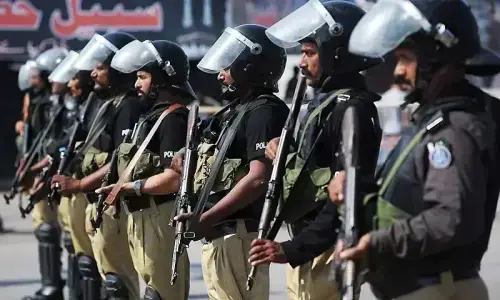
Small wonder then that the slogans raised in the demonstrations have reflected public anger against Bush and Musharraf, even though neither can possibly be mistaken for a Dane or a Frenchmen. In small towns like Chiniot bullets are fired on processions of teenagers and children, and even when a couple of them are killed, the boss of Punjab does not feel motivated enough to rush to Chiniot to console their families; only schools throughout Jhang district are closed, along with our “Parha Likha Punjab”.
So while the MMA and ARD leaders and followers vent their frustration on yet another prorogation of parliament and the compliant Election Commission declares nearly all ruling party candidates for the Senate from Punjab elected unopposed and while Aziz’s disjointed government prepares for the Bush visit, a tight programme of protest is announced by the MMA/ARD leaders. The price of sugar will still remain high. The squabbling within the ruling party will certainly continue, apathy in the bureaucracy will not abate, the manipulators on the stock exchange will maintain a bullish trend while we sell more family silver.
Unemployed youth will continue to multiply, law and order will be increasingly fractious as we ply more trains and buses to India and import more and more from our new-found friend. ‘Enlightened moderation’ will remain glued to its precarious perch until it is perhaps too late to build back on honesty, efficiency and good governance without Pakistan enduring a serious convulsion.
We are today a state with open borders, at war with ourselves, with a compromised sovereignty, a rotten and corrupt oligarchy, no motivation except to cut corners and the stigma of lack of legitimacy emanating from a uniform. Six and a half years is long enough for any measure of competence to have been determined. If the gaudy chambers and conference rooms we have built cannot determine this, then the streets may.
The writer is a former ambassador.
Integrity politics
TIGHTENING lobbying rules in the US without doing something to improve enforcement would be like overhauling the tax code while abolishing the Internal Revenue Service. The existing rules are too permissive and don’t require enough disclosure; more is needed. But such changes need to be coupled with a better system to police compliance.
The best idea so far, in legislation proposed by Reps. Christopher Shays and Martin T. Meehan, would create an Office of Public Integrity. This office would serve not simply as a passive repository of filings, as the current system does. Instead, it would be an independent, nonpartisan entity, on the model of the Congressional Budget Office.
It would be empowered to review documents, accept outside complaints, refer matters to the Justice Department, conduct investigations and make recommendations to the House and Senate ethics committees.
This would keep members of Congress involved, as they need to be, in setting and enforcing the rules for their own conduct, but it would help energize the ethics committees, which, especially in the House, have been gridlocked by partisanship. Sen. Barack Obama has proposed creating an Congressional Ethics Enforcement Commission, composed of former judges and former members of Congress, to investigate complaints.
—The Washington Post
Holocaust and the free speech
MANY were appalled to know that David Irving, a far-right British historian and researcher of the Second World War, had been jailed in Austria for three years for denying the existence of the Holocaust.
The indignation has spread to other countries, and in Britain, where they have started passing around the hat, there is dismay that the verdict could turn Irving into a rightwing martyr. What happened to free speech and freedom of expression? What happened to the right to express one’s opinion without fear of censure?
David Irving has no shortage of champions. In a six-page essay in The New York Review of Books Gordon A. Craig, a leading scholar of German history at Stanford University, noted Irving’s claims that the Holocaust never took place and that Auschwitz was merely “a labour camp with an unfortunately high death rate.” Though “such obtuse and quickly discredited views” may be “offensive to large numbers of people”, Craig argued that Irving’s work is “the best study we have of the German side of the Second World War” and that “we dare not” disregard his views.
Another ally is the commentator Mark Hand who offered some seductive arguments: “Should people who downplay the Confederate States of America’s treatment of slaves and the US government’s treatment of Native Americans face criminal charges? Should the people who publicly contend that the US government was justified in killing hundreds of thousands in Hiroshima and Nagasaki face criminal charges? Should the people who deny the wickedness of the US invasions of Vietnam and Iraq face criminal charges? Should the people who deny the wickedness of Israel’s conduct against Palestinians face criminal charges? Of course not!
He continues, “we are dealing with a simple yet extremely dangerous case of nation-states gone wild. Instead of addressing their complicity in modern-day atrocities — such as providing either unabashed logistical support for or tacit approval of the US government’s crimes around the world — these governments arrest people for public speech. Irving, Zundel and others who face criminal charges of ‘denying the Holocaust’ have not committed violence against anybody. They have not given orders to soldiers to invade and occupy another country. They have not given orders to police or soldiers to arrest and imprison individuals without charges. They have not given approval to secret police, soldiers or prison guards to torture individuals. “Irving, Zundel and others have expressed their opinions about one of the most despicable periods in our world’s history. These expressions might anger people. But these people are not in positions of power today that would give them the means to implement policies that mimic the conduct of the Nazis. Today, the leaders of liberal democratic governments are the ones with the authority, police and military firepower to mimic selected policies of the Nazis and the policies of other notorious regimes in our world’s history without fear they will face the consequences of their deadly actions.
“If one does not like what some people might say or write about the Holocaust, then that person should ignore it... What we should not ignore is when nation-states, with their monopoly on violence, lock up people for expressing their opinions about government atrocities committed 60 years ago. More important, we should not ignore the fact that the governments that are locking up individuals for speaking their mind about the actions of the Nazis are the same governments aiding and abetting (or refusing to denounce and stop) the atrocities committed today by the world’s only superpower and its confederates.”
The Holocaust has never been a big issue in Pakistan where the Jewish population is negligible and anti-Semitism, if it does exist, stems from the actual or perceived treatment meted out to the Palestinians by the Israelis. This has not stopped the occasional critic from exhuming this dreadful event from the pages of history and from questioning the six-million-figure which now appears to be the generally accepted number of Jews that were killed by the government of the Third Reich either through gassing or other forms of extermination.”
They have pointed out that the Nazis couldn’t have possibly carried out such a massive, wholesale annihilation because they just didn’t have the necessary rolling stock to transport Jews from different parts of occupied Europe to the concentration camps in Poland. In their opinion the figure probably ranges between 600,000 and a million. But, and this is significant, none of these critics ever suggested that wholesale executions did not take place. The gassings were inhuman and totally unjustified. But the question nevertheless remains: should a historian be persecuted 60 years after the event, just because he doesn’t subscribe to the official, or majority view?
This question also raises another important issue. Will those European governments sensitive to crimes against Judaism that lock up people who claim that the Holocaust never took place, start rounding up those newspaper editors who reproduced those disgraceful, blasphemous caricatures and start putting them on trial for crimes against Islam? Muslim leaders know this will never happen because European governments have always been practising the policy of double standards. In fact, European governments and their mouthpieces in the media take cover under the cloak of free speech to justify publishing insults against Muslims who have now replaced the communists as the universal enemy, but forget all about free speech and the right to have one’s say, when one of their own kind decides to defy conventional thinking of atrocities committed against Europe’s Jews. As it is, quite a few Muslims believe the blasphemous cartoons were part of a fiendish plot to keep Turkey out of the European Union.
And so, while Vienna is celebrating the 250th anniversary of the birth of Wolfgang Amadeus Mozart and the rich and famous are flocking to the opera house to hear ‘The Marriage of Figaro’ — surely the greatest opera ever composed — David Irving will spend the next three years in prison for giving two speeches in Austria in 1989, whilst Ernst Zundel faces up to five years in prison for publishing his opinions on the Zundelsite website while living in Canada.
While it is a little sad that pockets of intolerance have moved to the West, it is interesting to note that while David Irving has a lot of supporters who believe he is being punished for his extreme rightist views, he appears to have an equal number of detractors who see him as some sort of literary fascist agitator. In fact, the edition of the Daily Mail dated May 1, 1959 quoted Irving as saying, ‘You can call me a mild fascist if you like’. Critics believe he was much more than that. He referred to Adolf Hitler as ‘Herr Hitler’ and according to the Anti-Defamation League Irving also supported apartheid in South Africa, racist cartoons, and gave an appreciative view of Nazi Germany . In fact, by the early 1980s Irving was starting to be seen as a Nazi sympathizer.
In 1977 Irving published Hitler’s War, the first of his two-part biography on Adolf Hitler. In it, Irving tried to describe the war from ‘Hitler’s point of view’. He portrayed Hitler as a rational, intelligent politician, whose only goal was to increase Germany’s prosperity and influence on the continent. Irving’s book faulted the Allied leaders, most notably Winston Churchill , for the eventual escalation of war. He also claimed that Hitler had no knowledge of the Holocaust; while not denying its occurrence, Irving claimed that Heinrich Himmler and his deputy Reinhard Heydrich were its originators and architects.
Irving’s works were generally ignored by academics, and often criticized as inaccurate when reviewed by specialists. However, his command of language and a wealth of anecdotes led generalists to write favourable reviews in the popular press, and many of his works sold well, such as The Destruction of Dresden.
He was particularly noted for his mastery of the voluminous and scattered German war records. His revisionist portrayal of Winston Churchill in Churchill’s War made quite a few Conservative loyalists wince when he described England’s Grand Old Man as ‘a debauched alcoholic, a coward, an unabashed racist, and a corrupt warmonger servile to the interests of ‘international Jewry’. Irving also accused Churchill of ‘selling out the British Empire’ and ‘turning Britain against its natural ally, Germany. Harsh words, but do they justify locking up a person for three years?