0
0

Railway in the red
INDIA’S Railway Minister Laloo Prasad Yadav told the Lok Sabha on Friday that Indian Railways, on the brink of bankruptcy just five years ago, had achieved a miraculous turnaround earning a record profit of 2.47 billion dollars. The extra cash will be used to finance an expansion in the country’s rail network, already among the largest in the world, and allows Mr Yadav to also take the credit for cuts in fares. Compared to that, the state of the railway system in Pakistan couldn’t be worse. In 2004-05, the Pakistan Railway had incurred a loss of Rs 3.56 billion, which was over Rs 900 million more than even the revised target of Rs 2.6 billion. And in the first quarter of fiscal 2005-06 the PR had a shortfall of over a billion rupees. The reason for the sharp decline has been attributed by railway officials to a surge in oil prices and in operating costs, which have also caused the PR to levy a fuel surcharge on all travel beyond 51 kms.
However, the fact that Pakistan Railway is running at a loss is nothing new; it has been the case for a number of years. Given that both Pakistan and India inherited the same rail network and infrastructure, what could be the reason for Indian Railways doing so well while the PR is stuck in a rut? One key factor is said to be India’s booming economy which has contributed to a sharp rise in freight as well as passenger traffic. However, Pakistan too has been experiencing high GDP growth rates for a few years but this does not seem to have improved the PR’s precarious state. Clearly, the problem lies in the way the system is run and managed. Another reason for the decline is the increasing popularity — and promotion, for political reasons — of other modes of transportation of goods and of travel. Besides, successive governments have not given the railway system the priority it deserves, often promoting road and air travel at its expense, and spending large sums on building new highways instead of trying to improve the operations of the PR, ensuring better travel facilities and services.
As the recent turnaround of the Indian Railways shows, public-sector corporations needn’t necessarily be white elephants. For a number of years, various senior railway officials have made the sale of the organization’s assets, especially land, a key plank in the reform process. However, as the experience of leasing railway land for a golf park in Lahore has shown, this is not the right approach because the proceeds from the lease did not have any discernible impact on the PR’s financial state. What the PR needs to do is to get back to the basics. This means having a train service that is affordable and runs on time (regrettably, these days a train running late is the norm) and on a track that is extensive and safe to travel on. The whole idea is to make the journey more comfortable, especially since train travel could be a good substitute for road or air travel because it is far safer and cheaper. For this a complete overhaul of the system is called for. The security issue is also important but it has cropped up only of late and is linked to the country’s overall law and order situation. There is also the matter of dead wood, which the PR must shed. Inefficient staff needs to be weeded out, and this will help cut down the PR’s massive salary bill.
Lanka peace back on track?
CONTRARY to what many people had feared, the latest round of talks between the Sri Lankan government and the rebel Tamil Tigers ended on a positive note in Geneva last Thursday, with both sides pledging to uphold the 2002 ceasefire agreement and to meet in April for further discussions. While there was no forward movement on a final solution to the ethnic hostilities that have been plaguing Sri Lanka for more than two decades, the outcome of the two-day discussion — the first in almost three years — was welcomed by the Norwegian peace monitors as being beyond their expectations. The Norwegians had good reason to be apprehensive before the talks. Ever since the election of President Mahinda Rajapakse last November, an upsurge in violence on the island has killed more than 200 people. Moreover, the Sri Lankan government is no longer satisfied with the present ceasefire agreement and wants it amended. The Tigers, who oppose this, threatened to pull out of the talks if the government continued to question the terms of the truce. For their part, the rebels demanded that the government disarm rival rebel factions. Both sides accused the other of violating the agreement on several occasions.
But with the ceasefire agreement still holding, there is hope, at least for now, that the country will not slide back into civil war. More than 60,000 people have died in the two-decade ethnic conflict and a million have been made homeless. The aftermath of the 2004 Asian tsunami that killed and displaced hundreds of thousands in Sri Lanka has compounded the crisis to an extent where neither side can afford to engage in hostilities as mutual cooperation is needed to accomplish the gigantic task of reconstruction and rehabilitation. The government that still has the upper hand needs to show greater flexibility in its approach, even if it is surrounded by hard-line elements in parliament. It must stop harassing ordinary Tamils who have nothing to do with the Tigers, and open a political discussion on self-rule for the minority community in the north and north-east of the island. These steps have been discussed before and are vital to reaching a final peace settlement.
World Social Forum
A VICTIM of neglect and political violence, Karachi will regain some of its lost eminence when it plays host to the World Social Forum next month — a six-day event that is expected to attract several thousand delegates and activists from around the world. Prominent among them will be Bishop Desmond Tutu and the Dalai Lama, as well as Arundhati Roy and Tariq Ali. The forum, which was launched in 2001 in Brazil, sees itself as a worldwide civil society movement through which people can express their views on issues like anti-globalization, war, poverty and human rights, to name a few. These issues are becoming increasingly pertinent at a time when terrorism and extremism dominate world headlines and the plight of the underdog goes unnoticed. It is heartening to hear that the forum also plans to discuss urban issues of eight Asian cities, including Karachi, currently undergoing a revamp of sorts in the name of development — without taking into account the consequences of a haphazard process. By sharing personal experiences and formulating new strategies for urbanization, the World Social Forum aims at challenging the prevailing mindsets. This kind of initiative must be encouraged and one hopes that the Pakistan chapter of the forum will keep the dialogue going as there is a dearth of intellectual interaction and community activism in the country.
The organizers are expecting between 8,000 to 10,000 people from abroad and have met relevant higher-ups in the government to facilitate visas for those delegates. One hopes that there are no snags in this regard because such an event will promote the country’s image at a time when the Muslim world is being viewed with suspicion and fear in the West. Last year the Mumbai forum attracted over 130,000 people and the Pakistan chapter hopes to attract about 35,000 participants from within the country and abroad which would be a remarkable feat.
Europe divided over caricatures
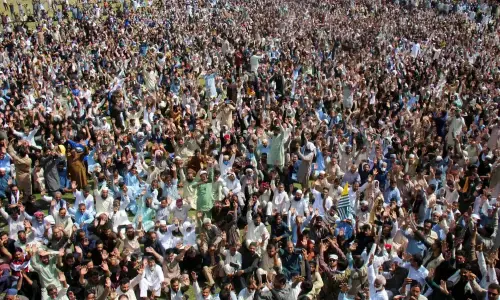
AS angry protests over publication of the caricatures of Prophet Mohammed (PBUH) continue in Pakistan and many other Muslim countries, public opinion in Europe remains divided on just how far governments and media organizations should go in trying to defuse what many now recognize as the worst challenge yet to relations between the West and Islam.
The crisis has prompted a multitude of very different responses from Europeans. Extremist groups — as well as some mainstream rightwing parties — have unsurprisingly used the outrage in Islamic countries as further proof to back their claims that Muslims are fanatical, violent people who are unwilling and unable to use legal means of protest.
Discussions across Europe have focused on reconciling the freedom of expression with respect for religious beliefs, with many politicians gradually recognizing that freedom of the press must be backed up by responsible reporting which does not encourage racial hatred and discrimination.
There is also slow acknowledgment that while it is important to rebuild bridges with Arab and Muslim countries, European governments must pay attention to and respect the views of an estimated 20 million Muslims who live in Europe. Significantly also, the furore has spotlighted the role Turkey — a candidate for EU membership — can play in helping Europe forge a stronger relationship with its Muslim neighbours.
Europe’s increasingly strained relations with Iran have also taken centre stage as has the surprise victory of Hamas in last month’s Palestinian legislative elections. Fears that anger in Islamic countries could have a long-term impact on EU relations with Arab nations prompted the bloc’s governments earlier this month to dispatch their chief diplomat Javier Solana to the Middle East for a much-publicized fence-mending tour. Solana admitted after the visit that Muslims continued to be very angry at the caricatures but said moderates on all sides were trying hard to defuse the crisis.
However, spotlighting differences on the issue between EU governments, Solana’s peace efforts with the Muslim world ran into immediate criticism at home, with Dutch ministers criticizing him for the “apologetic tone” he used in talking with Arab representatives. Dutch Foreign Minister Bernard Bot put in a protest at reports that Solana had expressed “sincere regret that religious feelings have been hurt” and also vowed to “to reach out...to make sure that people’s hearts and minds are not hurt again.”
The Dutch daily De Telegraaf quoted the Dutch state secretary for European Affairs Atzo Nicolai as characterizing the tone used by Mr Solana as “shocking.” Nicolai said Solana had “toured around in order to offer apologies. On behalf of whom, I ask. You and me? We haven’t drawn those cartoons.” The spokesman said the Netherlands was also deeply unhappy with a joint statement issued on February 7 by Solana on behalf of the EU together with the Organization of Islamic Conference (OIC} and UN secretary-general Kofi Annan.
Anti-Muslim feeling in the Netherlands has been on the rise since the murder last year of filmmaker Theo Van Gogh by a young Dutch-Arab radical. The country, once seen as a model for harmony among religions and cultures, has taken a much more strident tone in dealing with its Muslim minority. The crisis remains top of the political agenda in Denmark where the caricatures were published in the first place and where the opposition Socialists are demanding a review of the government’s response to the furore.
Prime Minister Anders Fogh Rasmussen has admitted that although the situation in Muslim countries has calmed down, the issue is far from being resolved. “We are now entering an international phase and I will not rule out that there may be solution within the auspices of the United Nations,” Rasmussen said recently.
The centre-right premier, whose government depends on parliamentary support from the extreme-right party, has been criticized for his initial response to the crisis, including his refusal to meet ambassadors from Muslim nations who wanted to protest against the publication. Rasmussen had defended his actions and said the burning of embassies and flags in Muslim countries were now the main issue, not how the government responded to the crisis.
Foreign Minister Per Stig Moller — who once regaled EU reporters by comparing Muslim fundamentalists to communists — has said he hoped EU foreign ministers who meet in Brussels on February 28 will adopt a joint statement on the crisis, including condemnations of recent attacks on European embassies but also stressing freedom of speech and respect for other religions.
As they struggle to find ways of easing tensions with Muslim countries, many in Europe are discovering that Turkey — a candidate for EU membership — could play a vital role in defusing the conflict triggered by the cartoons. Interestingly, Austria which opposed the start of membership talks with Turkey, has now suggested that Ankara could help defuse the current row over the cartoons with other Islamic nations. Turkish Foreign Minister Abdullah Gul will meet with foreign ministers of the 25 EU member states at a meeting in Austria in mid-March where he is expected to push for the creation of a so-called “Alliance of Civilizations.” The initiative, which aims at linking Arab and western civilizations through dialogue about cultural and religious differences, was launched by the Turkish and Spanish premiers in cooperation with UN Secretary-General Kofi Annan.
Austrian Foreign Minister Ursula Plassnik has also supported the UN initiative, saying it would be one of the best ways to strengthen the dialogue between Europe and the Arab world. Turkey is the only Muslim country queuing up to join the EU and its membership continues to be the subject of intense — often Islamophobic — debate within the bloc.
Meanwhile, Arab League Secretary General Amr Moussa has been in Brussels to urge stronger EU efforts to prevent a Europe-Islam culture clash. Commenting on the publication of the caricatures, Moussa said he was shocked by Europeans’ tendency to “insult” Islam. “Is it a new trend not to respect Muslims...is it a way of insulting their sacred creed?” Moussa queried, adding that Europeans must understand the root causes of the angry Muslim reaction to the cartoons.
Extremists on both sides of the divide were the victors in the current row, he said, adding that Arab governments recognized freedom of the press but said this was “limited by responsibility.” “We have to do everything to avoid this clash of civilizations,” he insisted.
Struck by these and other remarks, more thoughtful EU policymakers have admitted — albeit very late — that publishing the caricatures was “unwise.”
In a recent debate on the issue in the European Parliament, leading EU policymakers also warned that extremists in Europe and the Islamic world were likely to be the winners in the current crisis. “We must not allow the minority of extremists to win,” European Commission chief Jose Manuel Barroso said during the EU assembly debate. “It is through a vigorous but peaceful dialogue of opinions... that mutual understanding can be deepened,” Barroso said.
Barroso was careful not to comment on the cartoons themselves but Poul Nyrup Rasmussen, a former Danish premier who now leads the Party of European Socialists, said the publication of the caricatures was “arrogant and disrespectful.” “It showed a total lack of knowledge about Islam,” said Rasmussen. The Socialist leader, whose party is in opposition to the current centre-right Danish government led by Prime Minister Anders Fogh Rasmussen, said freedom of speech and mutual respect must go “hand in hand.”
The caricatures had been the “last straw” for “many years of social and economic frustrations in many Muslim societies,” Rasmussen said, adding that the crisis was being used by extremists to inflame hatred and violence.
Hans Goert Poettering, leader of the European Parliament’s conservative group, slammed some Muslim governments for “stirring up reaction” against the caricatures. Many EU policymakers insisted repeatedly that freedom of press and expression were not negotiable and rejected suggestions of a media code of conduct. But several, including EU chief Barroso, said that freedom of religion must also be respected.
Euro MPs strongly condemned violent demonstrations directed against European targets in many Muslim countries, but pointed out that the protests had been the work of an extremist minority. Karin Riis-Jorgensen, a Danish lawmaker from the Parliament’s liberal group said, however, that the crisis had also increased support for the far right in Europe. “This has all been abused by extremists both in Europe and outside,” she said.
More quixotic Europeans, are taking a more aggressive approach. Reports in the press said that Oriana Fallaci, an Italian journalist known internationally for her books lambasting Islam, was working on a satirical cartoon of the Prophet Mohammed.
The unconfirmed report was immediately slammed by Italian Muslim leaders, who warned that it risked sparking angry reactions among followers of Islam.
Fallaci, who is 75 and lives in New York, has published two books that take a highly critical look at Islam. In The Strength of Reason she warns of the dangers of a “Muslim colonization of Europe”. Her first book, The Rage and the Pride, was dedicated to the victims of the March 11 Madrid bombing and has become a bestseller in Italy and abroad.