Losing perspective
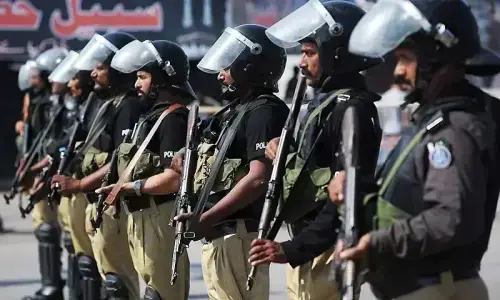
WAS Tuesday’s mayhem in Lahore preventable? From all accounts, the Punjab authorities failed to anticipate the trouble that could take place and were caught unprepared when it broke out. They placed their trust in the sponsors of the protest, a religious organization, and it is such innocence that leads to charges of tacit government approval, if not encouragement, of what is going on. The administration proved itself to be totally inept; police presence was hardly visible in television shots of the mob violence in full fury. A youth was seen openly brandishing a pistol. The organizers have tried to suggest that other groups had penetrated their procession and it was they who were responsible for the destruction on The Mall, including the fire in the Punjab Assembly building. It is incontrovertible that an element of anger against the government for its support for the US, seen as an aggressor in Iraq and Afghanistan and the spearhead of a crusade against Islam, and for its efforts to project a liberal image is present in the current protests. But that cannot absolve the Tahaffuz Namoos-i-Risalat Mahaz of its complicity in what happened. And the Punjab government cannot escape responsibility for its extremely blundering handling of the situation. A fuller explanation is needed from Chief Minister Pervaiz Elahi than the one given so far. The events in Islamabad also need to be thoroughly investigated, and it is inexcusable that despite the ugly precedent set by Lahore, the Frontier government should have let mob rule prevail in Peshawar yesterday. The possibility of agents provocateurs being involved in the troubles has been mentioned, and should be investigated.
All violence now needs to be controlled with firmness. There must be acres of video footage of those attacking buildings, banks, cars, motorcycles, restaurants and hotels and pillaging shops —— all in the name of depending Islam — and they must be rounded up and given condign punishment. “Vowing to take stern action” has become a meaningless phrase in view of lack of meaningful action in incidents of violence, sectarian attacks, terrorism and sabotage. The hurt and outrage felt by Muslims at the blasphemous cartoons published in European countries is in danger of being pushed into the background by the wave of destruction that has engulfed us; justified protests, made legally and peacefully, and in concert by Muslim countries, will lose force. The image now in vogue of Muslim societies as volatile and excitable will be reinforced. Will the foreign companies whose establishments have been targeted consider investing more money in Pakistan? Other western concerns too will be scared away. Governments in Muslim countries seeking to sponsor or participate in the anti-blasphemy demonstration should be careful: in their effort to take the sting out of the fundamentalists’ frenzy or to prove themselves more Muslim than the latter, they might only be weakening their own position.
Lastly, perhaps western governments and sections of their media will now realize that the cartoons involved have handed Muslim extremists with a new issue on a platter. A fresh opportunity has been provided to give a religious turn to what is essentially a political issue — America’s colonial obsession with controlling the world and its readiness to transgress all lines and borders in pursuit of its aggressive intent. Trying to prevent this needs wisdom, a sense of responsibility and courage rather than the foolhardiness of burning buildings and looting shops.
The Guantanamo shame
ONE would hardly be surprised by a UN report that terms the American techniques of interrogation and forced feeding of prisoners at Guantanamo Bay as torture. It is logical that the UN human rights experts should have recommended the closing down of the detention camp. If there is anything surprising about this suggestion, it is the delay on the part of the UN experts to reach this conclusion. Given the reports focusing on happenings at Guantanamo since it was inducted as a detention centre in January 2002 in the wake of 9/11, the demand for its closure should have come much earlier. Amnesty International, other human rights bodies and even governments — Germany being the latest to join their ranks —have been voicing concern over the American treatment of prisoners at the detention centre on the Cuban island. As could have been expected, the US has rejected all the allegations and has described the latest report as unauthentic because the authors never visited the camp. That of course doesn’t make Guantanamo a paradise on earth. The western media has carried extensive and in-depth stories of pitiless mistreatment at Guantanamo which has also been the subject of many books.
It is now widely known that this prison is illegally run. In fact, the US set it up outside this offshore prison in a naval base in order to evade its own laws. For instance, only nine out of its current 500 inmates have been charged, the others are held without any charges made against them. Terming the prisoners as ‘enemy combatants’ has also not been accepted as legally tenable. Similarly, reports of forced feeding of prisoners, their mental and physical torture and resort to sacrilege to provoke the detainees are quite believable considering what happened at Abu Ghraib in Iraq. The Geneva Conventions have virtually been torn up by Washington at Guantanamo Bay in a display of its military might. Yet it may be forced to close the prison in deference to law. But does the US plan to transfer the Guantanamo inmates to the high security prison in Afghanistan that is reported to be under renovation? That will only worsen the US image.
Dangerous billboards
ONCE again, strong winds in Karachi knocked a massive billboard off an apartment complex and on to a main road on Tuesday, injuring several motorists and causing a major traffic jam for two hours. A similar incident occurred last September on a busy road when a billboard fell, luckily on an empty parked car and several motorcycles. In 2003, however, during heavy rains, a man died when he sought shelter underneath a billboard which suddenly fell on him. While no death was reported in either of the recent incidents, it nonetheless highlights the dangers billboards pose to safety, whether it is during harsh weather or when one is distracted by their pictures while driving on roads. Aware of the safety factors the city government has recently launched a drive against illegally erected billboards. According to the former city nazim, there are 17,000 billboards in the city, of which 11,000 are illegal. This is a startlingly high figure and shows how easily the relevant laws and rules can be beaten, possibly with the connivance of certain corrupt officials who allow such billboards to be posted, making a quick buck for themselves in the process.
So far, the police have registered one case against the billboard owner and residents in the area are correct in demanding that the owner pay damages to those afflicted by the accident. There has to be a sense of accountability and an example made of those who break the law. The city government must continue in its drive against all illegal billboard advertisers.
WTO’s shifting paradigms
EVERSINCE the multilateral trade negotiation were first conducted under the auspices of the General Agreement on Tariffs and Trade (GATT), the process has been variously described as a “roller-coaster”, “muddling-through” or “limping forward”. According to many analysts, the fact that the process, despite several hiccups, has not been completely derailed is an achievement.
Another fact is that while 120 regional trade agreements (RTAs) were in existence before the advent of the World Trade Organization (WTO) in 1995, another 130 RTAs have cropped up between 1995 and 2002. In other words, in order to “save” themselves from the powerful forces of globalization, the countries are welding themselves into regional groupings all over the world. Sadly, this is still a dream in South Asia.
The first question that needs to be addressed is whether globalization is likely to be helpful to developing countries. Over the past two decades, the scope and pace of technological changes have gone into overdrive and the revolution in information technology has been widespread. At the same time, the collapse of the Soviet Union gave impetus to free markets and neo-liberalism, making it easier for finance and trade to move freely across borders. Of course, the process was not smooth as the East Asia financial meltdown in 1997 shows. In this crisis, serious concerns were raised about the disruptive forces of capital flows and the overwhelming power of multilateral corporations.
There are lessons to be learnt. Financial flows are a double-edged sword and capital inflows promote growth but sudden outflows disrupt growth, jolting investor confidence. Interestingly, India and China did not suffer much because of capital account controls. The factors that mattered were not just managed capital flows but also macro-economic stability and continuity of appropriate policies, profitability of investments, facilities to repatriate profits, etc.
Issues in globalization of trade and commerce are much more contentious than those focusing on financial transactions. The 1990s registered a big boost in trade flows: world trade went up six per cent per annum and 10 per cent in developing countries.
Despite potential gains, those against globalization point to the “hypocrisy of the industrial countries who have been relentlessly pushing for the liberalization of trade but are refusing to give up their large domestic agricultural subsidies and barriers to manufactured exports from developing countries even though their own industries have been were built behind high walls of protection.
They also point out that globalization hinges heavily on the powerful technical and communications revolution in information technology. In this context, it is worth noting that out of the 40 satellites 35 belong to the US. Also, the optical fibre lines are mostly controlled by the US. Furthermore, it is pointed out, that multinational companies monopolize a large bulk of trade and hold most patents.
Based on these, one view is that globalization is reversing the development process in developing countries and is tantamount to “re-colonization” in terms of financial and technological dominance. The other view is that globalization is an advanced stage of technological development, skills enhancement, productivity growth and overall economic and social development. According to this viewpoint, the downside of globalization can be managed if the developed and developing countries improve governance and minimize potential adverse effects of globalization through social safety nets.
At this point, let us appraise the recent Hong Kong ministerial conference and start by recapitulating some of the issues and framework agreements in three broad areas before the conference began: agreement on agriculture (AoA), non-agricultural market access (NAMA) and General Agreement on Trade in Services (GATS).
According to one estimate, the US has been dumping agricultural commodities in world markets. The least developed countries lose $40 billion annually in agricultural export value because of US and EU subsidies. The AoA was negotiated during the Uruguay Round and was included in the WTO. After the failure of the fifth WTO ministerial at Cancun in 2003, the July 2004 framework stipulated that all the non-tariff barriers be converted into tariffs; all tariffs be frozen and developed countries reduce tariff by 36 per cent in six years and developing countries by 24 per cent in 10 years. Even though the OECD countries provided huge subsidies to their agricultural sectors the challenge facing the ministerial conference was how to phase out export subsidies and domestic support price programmes.
It was agreed that agricultural export subsidies would be abolished by 2013 by the US and EU. According to one estimate, export subsidies constitute less than two per cent of total support to agriculture. The more dominant $360 billion annual farm support subsidies were not addressed. However, the 50 least developed countries will get duty-free access to rich countries’ markets by 2008 on 97 per cent product categories. Subsidies on cotton would also be removed in 2006. With respect to NAMA, the preference of the rich countries was to push for accelerated opening of the developing countries’ market for manufactured goods even though the developed countries had for decades promoted their own manufacturing activities behind protection barriers and had used their colonies’ captive markets to generate huge trade surpluses in their favour.
The average tariff rates on industrial goods in developed countries were higher in the matured stage of industrialization. The obvious outcome of the process of direct competition with more advanced countries, before the developing countries acquired competitive muscles, was de-industrialization as shown by the falling share of industries in GDP during 1990-2002. For example, in Pakistan this share fell from 25 per cent to 23 per cent; in India, from 28 per cent to 27 per cent; in the Philippines from 34 per cent to 33 per cent. On the other hand, some East Asian countries were able to push up the share of their industrial output in GDP during the same period through a variety of policy interventions including tax incentives, subsidies and tariff protection.
According to UNCTAD, in a sample of 40 countries, half had registered de-industrialization during the trade liberalization process, which resulted in the shrinking of their fiscal space which, in turn, weakened their capacity to fight against poverty, joblessness, environmental degradation and social setbacks. Still, rich countries pushed developing nations to raise their “binding coverage” from less than 10 per cent to 95 per cent. The increase in the binding coverage was intended to lock the developing countries into commitments that they would not raise tariffs in future. It deprived them of their policy autonomy and the ability to protect infant industries.
In Hong Kong, it was resolved that the tariffs in developed countries would be reduced or eliminated. The developing countries were allowed to designate an “appropriate” number of tariff lines as “special products” deserving “special safeguards”. It was also agreed that the modalities for easy access to markets would be completed by April 30, 2006, and a comprehensive draft prepared by July 2006.
GATS was adopted at the Uruguay Round in 1995 and defined four modes of supply of services, covering a broad range of services pooled into 12 sectors and 160 sub-sectors. In theory, the GATS process provides options to members to select the sector for full liberalization, partial liberalization or no liberalization at all.
Liberalization of services is a very sensitive issue. In most developing countries, governments play a major role in ensuring public access to essential services such as health, education, water supply etc. According to an NGO in Pakistan, the privatization of water supply in some countries led to the disconnection of water lines and excessive water tariffs. Despite this outcome, developing countries were under pressure to submit initial offers through bilateral agreements.
The developed countries insisted on obtaining benchmarks for key sectors. At the same time, the developed countries offered little in the movement of semi-skilled workers. Before going to Hong Kong, developing countries did not favour liberalization of services. Having hastily agreed to the trade-related intellectual property rights (TRIPS) and the trade-related investment measures (TRIMS), the developing countries were reluctant to commit to any benchmarks too quickly. On the insistence of developing countries, work visas for skilled and semi-skilled workers were discussed at the ministerial conference but no positive response came from developed countries.
The conference agreed to establish a several billion dollar Global Financing Facility to help the least developing countries in the establishment of their capacity to compete in global markets.
It is difficult to judge the success or failure of the conference. The dynamics of globalization are such that multilateral trade negotiations would forge ahead even if the WTO is selective. However, by not discussing the issue of the mobility of labour across the continents globalization remains incomplete. Also, if the EU does not yield much in its protectionist position on farm subsidies, developing countries will not move on tariffs on manufactured goods.
The year 2006 is crucial for trade negotiations. The current fast-track US Trade Promotion Authority expires in June 2007. The US needs to get congressional approval of the WTO agreement well before June 2007. If the June 2007 deadline expires and there is no deal then the US Congress can amend any WTO agreement and could derail the whole WTO process for a long time to come.
The writer is a former advisor to the World Bank.