A year of calamity and turbulence
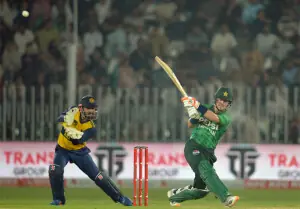
THE outgoing year will be remembered for Pakistan’s worst natural calamity and a year in which “ordinary” women hit world headlines; private armies blew up gas installations and challenged the might of the state; religious lobbies focussed on such inanities as a mixed marathon and a religion column in passports — a year in which terrorists never failed to strike, whether the target was Bari Imam or a Qadiani place of worship, a year in which the ruling party swept local body polls amidst charges of rigging and manipulation, and a fantastic year for cricket lovers when England that had won the Ashes after 18 years went home roundly beaten by Pakistan. The earthquake that rocked Pakistan on Oct 8 and killed nearly 100,000 people and rendered 3.5 million homeless exposed the nation’s unpreparedness for humanitarian disasters. The people accused the government — not without some justification — of being slow in responding to a calamity of such magnitude. But the government said landslides had blocked access to the disaster areas. Then the nation rose to the occasion in a demonstration of concern and philanthropy unparalleled in the country’s history. Trucks carrying relief goods crawled along serpentine routes as people from Karachi to Khyber rushed relief goods to the north. The international community established bridges of relief supplies, the biggest gift coming in the form of helicopters, provided by the US and other nations, enabling volunteers and rescue teams from 80 countries to reach the stricken areas and pull out the dead and the alive and treat the sick. The donors’ conference later pledged 6.2 million dollars in aid, a greater part of it in soft loans, for reconstruction.
The opposition accused the government of going it alone and trying to capitalize on the tragedy and boycotted the parliamentary committee set up to oversee relief work. But the biggest political controversy was created by the government when it began what appeared to be a well-orchestrated but ill-timed campaign in favour of the Kalabagh dam, even though it knew that large sections of public opinion in the three smaller provinces were strongly opposed to it. President Pervez Musharraf undertook a tour of Sindh to sell the idea to the people and insisted that it was Sindh that would benefit most from the KBD. The flood water which India released without warning and which played havoc with agricultural lands in Pakistan, he said, could have been stored if the Kalabagh dam and reservoir were in place. In fact, he said, without the KBD, large swathes of Sindh could turn into desert. Sindh responded by setting up a multi-party anti-KBD alliance and holding rallies throughout the province. As the year drew to a close, the Abbasi report was released which seemed to make a case against the KBD and in favour of the Skardu-Katzarah dam. But in Sindh, the province that felt most perturbed over the project, opposition and treasury benches joined hands to oppose the dam. The New Year will show whether there will be a consensus on the issue. President Musharraf has said that the KBD will have no canals and that a reservoir will be built in Sindh near Sehwan.
The government’s campaign could not have come at a worse time, given the situation elsewhere in the country, especially Balochistan. In January-February, a confrontation between the government and the militants in the Sui area was averted, but the sabotage of the gas pipelines caused losses running into billions of rupees. By the end of the year, the situation seemed to be hotting up again following action by the security forces against tribesmen who mounted a rocket attack on Kohlu when the president was there. It remained inexplicable why the recommendations of the Mushahid Hussain committee remained unimplemented. The committee had recommended safeguards for Baloch rights for employment, besides suggesting greater Baloch representation on the boards of oil and gas companies. Regrettably, the government failed to act on Baloch grievances regarding provincial autonomy. Sections of Baloch leaders feel that the quantum of autonomy as enshrined in the Constitution does not serve the cause of Balochistan and that even the provincial rights that exist in the Basic Law are not fully honoured. This is at the root of the raging anger and turbulence in Balochistan.
The question of provincial autonomy is not confined to Balochistan alone. Many people in Sindh and the NWFP, too, point out that the Constitution has a federal and a concurrent list but not a provincial list. The issue could be tackled in a positive spirit if Baloch leaders acted in concert with politicians, constitutional experts and intellectuals in the other provinces. The cause of Balochistan is being poorly served by leaders who themselves are feudal potentates and whose contribution to solving their own people’s problems has always been questionable. In fact, many Baloch sardars do not want any economic development in their fiefdoms and look at schools, roads, electricity and industries as potential threats to their overlordship. Gwadar, for instance, will become a major port in Balochistan and serve as an outlet for trade between Central Asia, Afghanistan and Pakistan on the one hand and the world outside on the other. Yet many, if not all, Baloch sardars are opposed to the development of Gwadar, and the port is often targeted by nationalists. Baloch concerns that outsiders may occupy jobs in Gwadar are understandable. But the solution lies in seeking safeguards from the government for jobs for the Baloch and not in acts of terror. However, at the root of it all is the problem of federalism and centralization that has plagued Pakistan almost ever since its inception.
As the year drew to a close, there was nothing to be cheerful about so far as democracy was concerned. The process of local body elections was completed, and, as expected, the government queered the pitch against its rivals to ensure the victory of PML-backed candidates. Regrettably, there was no indication from the president when, if at all, he plans to shed his uniform. So long as the army chief is also the head of state, it would be difficult for the world to regard Pakistan as a democracy. The press no doubt enjoys freedom — a gift from the late Mohammad Khan Juenjo; nevertheless, democracy has yet to be given free play and democratic institutions remained emasculated. The all-powerful National Security Council continued to be headed by the general-president, while Article 58-2b gives him the power to sack an elected prime minister and dissolve the National Assembly. More depressingly, democratic pluralism remained under threat from religious extremism, as shown by the attack on a mixed marathon by religious extremists in Gujranwala and the government’s surrender to the religious lobby’s demand for re-inserting the religion column in passports. The attacks on an Ahmadi place of worship and the blast close to the offices of a gas company — reportedly by a Baloch group — show that the government has not been able to stamp out terrorist networks, despite some successes in arresting leading Al Qaeda men. The year that has just begun could be crucial in Pakistan’s quest for a democratic dispensation if the government and opposition could pledge to abide by the norms of parliamentary democracy. For this, the nation would expect the government to finally separate the offices of army chief and president and repeal 58-2b, while the opposition should help seek a solution to national problems instead of pursuing a negative course in most matters.
Is Kalabagh dam the most urgent need?
FIVE governments have come and gone and 32 years have lapsed but the rulers can neither build the Kalabagh dam nor abandon it. It has now become an open duel of declarations for and against, between President Parvez Musharraf and the Sindhi, Baloch, Pashtoon people who constitute three out of four provinces and at least half the nation.
While in a genuine democratic set-up the people are the final arbiters on all matters, technical or otherwise, the project has become highly objectionable to even experts of the three provinces and it is only the infamous Wapda which for very obvious reasons, blindly supports the project.
Be that as it may, the question here is that does a project, for which funds have yet to be found, which will take more than 15 years to complete and which will be required for use at least 20 years hence, deserve the desperate urgency being attached to it, when every thing else is crumbling? While it is true that a government worth the name has to look ahead, anticipate problems and take timely steps to deal with them, this cannot be done at the cost of existing emergencies which remain ignored.
The failure of the government to adequately deal with the earthquake disaster in the north has lowered it in the estimation of the world community. Even while the president was touring Sindh to plug the Kalabagh dam, people were dying up north for want of help and attention. The United Nations, Oxfam and other foreign institutions are visibly more concerned than our rulers. Should not the latter be deeply focused on that task of saving lives and providing shelter rather than turning all energies to raising a highly controversial issue?
Similarly the life, honour and property of the citizen has never been at greater risk. It is most alarming that the law enforcement agencies stand totally defeated by criminals and have become useless. Not only do they flatly refuse to enforce the law but senior officers at all levels are constantly in touch with notorious outlaws, begging and pleading with them not to commit crimes in their jurisdictions.
It is unbelievable but true and can be proved that recently a DPO arbitrated between two warring groups of outlaws and resolved their dispute. Both sides were brought to the district police headquarters under police escort and returned to their hideouts with the same honours. When the guardians of the people play host to those who murder, kidnap, rob and loot should the government not be more concerned with providing security of life?
The stench of corruption has hit the sky. Pakistan has the dubious honour of being declared the fifth most corrupt country in the world by Transparency International. It is beaten to a higher position only by four obscure African countries. This is not surprising as not only notoriously corrupt individuals and those with criminal records occupy high positions in government but the doors of all anti-corruption institutions are firmly closed.
It is very demeaning that the donor countries, providing funds for the disaster up north, have insisted on guarantees against pilferage of the funds they have pledged. Corruption aided by incompetence and sifarish has led to the collapse of all government institutions which has put the process of governance into reverse gear. This has seriously affected the life of the citizen and brought a parallel black economy into existence. In such circumstances progress and development have become impossible. Is it not therefore imperative for the rulers to deal with this disastrous situation on a most urgent basis?
When educated unemployed young men are forced to commit suicide; hungry men and women sleep on pavements and newspapers print photographs of children scavenging garbage dumps for a meal, for the rulers to give more priority to hallucinatory schemes that may end up breaking up the country is tantamount to Nero playing the fiddle while Rome burnt. Poverty is increasing at an alarming rate of more than four per cent per annum and 50 per cent already live below the poverty line even though the standard parameters of assessing this have been reduced.
The private sector has to be activated to provide jobs. As an incentive the infrastructure and climate for investment has to be created by controlling crime, corruption and bureaucratic red tape, and by providing better communication facilities. No more need be said in this connection than to merely state that a lesson must learnt from the rise of Dubai, a state not even the size of a district of Pakistan with no natural resources. What is the use of having more water (not really) 20 years ahead when, if the current state of affairs prevails, the future of the country becomes uncertain?
The high cost of living has defeated all attempts at control and the rulers are at their wit’s end. The prices of even basic foods are out of reach of the common man who can no longer afford two square meals a day. Inflation has to be controlled, production and exports increased and the rupee made more valuable in the open market. An effective price structure has to be enforced but the writ of the government is not worth a dud nickel: for the last three years 28 sugar mill owners in Sindh have contemptuously rejected the prices of sugar cane laid down by the government. This has destroyed the sugar industry and created hardships for the growers. Even the grocery, meat, vegetable and fruit shops have taken on the government and ignore the prices fixed by it. Thus, the government is reduced to adopting the attitude of the man who has embarked on making his second million after having failed to make the first. How can this state be allowed to persist any longer?
During his first visit to Sindh, the president summoned his party men including ministers and members of the provincial assembly to launch them as standard-bearers of his the clam project. It must have come as a shock and a warning when even this lot which had been supporting the dam refused. They had the awareness of the mood of the people and the need to go back home.
During his second visit in quick succession, the president went to a wider forum of the people. He resumed his odyssey on the very day that people from all over Sindh marched to Karachi to demonstrate against the Kalabagh dam. While addressing the usual canned gathering at Sukkur airport on the same day, he was interrupted by a member of the audience who objected to even the mention of Kalabagh by him.
Providing security of life to the citizen is the foremost task of any government. Close behind this comes the need to provide a good standard of living free from extortion and victimization. These basic requirements are a sine qua non for further progress and development. But far from this there is civil war going on in the north which has now been extended to Balochistan and the people of Sindh have their backs against the wall due to exploitation, deprivation and oppression. This is hardly the time to kindle more flames by propagating a project which may best be justified as nothing more than an ego trip or a red herring.