Imperatives of reconstruction
Nearly eight weeks after the most devastating earthquake in the history of the subcontinent, Islamabad is rife with talk of reconstruction. The thousands of selfless volunteers who performed operations, arranged tent villages, provided food and medicines and simply held hands with survivors in the immediate aftermath of the tragedy, are quickly fading out of the news. Taking their place are officials of the civil government, conspicuous so far by their complete absence through this calamity, along with the UN, World Bank, Pakistan army and a host of high-level experts from international as well as local organizations.
The discussions revolve around issues of damage assessment, compensation, urban planning, construction materials and technologies, drafting new building codes and seismic design. The challenge is to rebuild the affected area. The intentions are noble and the concern is real. And yet, the reconstruction effort is already beginning to miss its mark.
The problem lies in the delineation of scope of this massive project. The narrative on which the post-quake reconstruction strategy is based is careful in quietly placing the fundamental causes of the destruction outside its scope. Nature has been identified as the primary culprit, with all leaders, from Musharraf to Bush emphasizing the ‘natural’ aspect of this catastrophe. Further emphasis is placed on the unfortunate timing of the disaster, with the Himalayan winter fast approaching.
Such a narrative immediately absolves the state of any blame. Rather than revealing the actual causes of the devastation, it obscures them. By giving an air of inevitability to the ensuing damage and casualties, it shifts the focus away from the political dynamics and economic policies that have been making the Pakistani population increasingly vulnerable to any disaster, ‘natural’ or man-made. And by portraying the victims as an inherently hapless lot, it seeks to objectify rather than question the nature of their fate.
The fact is that natural disasters almost always take a greater toll on more vulnerable populations. Weaker or illegitimate states, where endemic corruption prevents stringent, pro-people regulation from being enacted or implemented, are often in a poor position to protect their populations from external shocks or normalize their lives after the disaster. This is confirmed by several studies done by organizations that have long been providing relief in numerous countries.
The UNDP, the International Federation of the Red Cross (IFRC) and Oxfam, for instance have repeatedly singled out Cuba as an (admittedly unfashionable) example for other countries to emulate. Between 1996 and 2002, six major hurricanes hit Cuba, yet a total of only 16 people died. In other countries, hurricanes of similar intensity have typically resulted in death tolls that are several times higher than those experienced by Cuba. Take Katrina, for example, which killed thousands of people in US, a country much more highly developed and resourceful.
How is Cuba, a poor country by all accounts, able to mitigate disasters where other countries fail? According to Oxfam, Cuba’s socio-economic model which is based on investment in social capital through universal access to public services, and promotion of social equity, reduces the vulnerability of its population. Moreover, the high levels of literacy, developed infrastructure in rural areas and access to a world-class health care system function as highly effective shock absorbers. Cuba’s equitable socio-economic model has prevented polarization in society and led to the development of a high degree of social cohesion and trust among its population as well as with the government. This solidarity is what makes possible speedy and complete evacuations of entire cities or the effective distribution of relief supplies.
The contrast between Cuba and Pakistan could not be starker. Compared to Cuba’s 96 per cent literacy, Pakistan’s is exactly half at 48 per cent — and this is based on probably the broadest definition of literacy that has ever existed. Illiteracy leads to low levels of general knowledge, inability to collect and process important information and a lack of self-confidence or capability. In everyday life, these characteristics are reflected in general safety hazards that people expose themselves to. And in the event of an earthquake, and the resulting injuries, sanitation or hygiene problems, they engender inappropriate responses which amplify the human and physical damage.
Compared to Cuba’s reliable and highly efficient healthcare system, which has long inspired several western countries, Pakistan’s public healthcare is chronically under-funded and in the process of being rapidly privatized. The present crisis exposed the sorry state of most hospitals in the neighbourhood of the quake hit area. And bigger public hospitals elsewhere have had to rely predominantly on donations provided by ordinary citizens of the country.
Training imparted to doctors around the country is not uniform either, and several eminent doctors have raised serious concerns about the flawed diagnoses and substandard wound management, which resulted in unnecessary amputations.
Similarly, infrastructure in rural areas remains poor, with many small towns cut off from cities during winter. Even in normal times, these towns lack ready access to public services. Now, with inhabitants of those towns unable to protect themselves from the elements, or treat the wounded, and the poor roads destroyed, relief operations in the area are proving to be extremely difficult. Indeed, in parts of Neelum Valley in Kashmir, thousands were starving even a month after the earthquake.
Finally, deeply entrenched feudalism, which various dictatorial governments have exploited and promoted for their own advantages, has effectively suppressed all efforts to form grass-root level political structures. For decades, Pakistani citizens have relied on patronage from their feudal masters rather than any community-based organization. These feudal lords have in turn, served the votes of their subjects up to their own political patrons. This exploitative system has long served the elite nicely and community-based organization is not welcomed. This has resulted in complete lack of empowerment of the people. That means graft and embezzlement can go on and the governments can make policies to suite a small elite without any fear of accountability. No wonder nearly hundred per cent government buildings collapsed including the schools and colleges killing thousands of children. By not equipping the Civil Defence department and providing civil defence rescue and first-aid training to the population, we again made them vulnerable. It is wrong to blame nature when our own policies built in vulnerability for the population.
It is perhaps not surprising that little if any trust exists between the people and the government in this set up. Rather than serving the people, public services such as the police have become essential instruments for running this patronage-based system.
The devastation in the October 8 earthquake and the pitiable performance of the state in relief provision were manifestations of socio-economic dynamics that have been gathering strength for years, making the population increasingly vulnerable to shocks. The state’s pro-market policies combined with a feudal political system have wiped out social safety nets and diluted the glue which held people together.
The devastation was amplified by flawed development that has occurred in the absence of effective governance. Lack of building regulations and physical planning codes, widespread lack of compliance with them, and/or uncontrolled market forces as the only arbitrator of economic development all contributed to the sheer scale of the disaster.
Were it not for the thousands of volunteers and private donors, who showed overwhelming generosity and courage, the devastation would have been even greater. But in the absence of effective and functional community-based political and social structures, social cohesion, and trust, their efficacy was also limited.
Now long-term rehabilitation is likely to be hampered by the same political dynamics and flawed development that have been steadily increasing the vulnerability of the masses. In all likelihood, reconstruction efforts will skirt all the issues discussed here, and focus on rebuilding the hit cities ceteris paribus.
What actually needs to be reconstructed in the aftermath of this calamity is a crucial question. How widely we debate the causes of the devastation and how willing we are to scrutinize the political and economic policies which engendered much of it will determine how successful we are in building the mechanisms that are necessary to avoid such tragedies in the future. The scope of discussions in Islamabad so far does not offer much hope in this regard.
The writer teaches Strategy and Policy at the University of Cambridge.
Questions
Ever since Bob Woodward revealed he knew the identity of CIA agent Valerie Plame before Robert Novak did, many questions are being asked in the newsroom.
If Bob Woodward knew who she was before Novak, should Bob Novak get the Pulitzer Prize for leaks? Why didn’t Woodward (a.k.a., Robert Redford), the most respected investigative reporter in Washington (along with Carl Bernstein, a.k.a., Dustin Hoffman), tell us two years ago what he just revealed to his editor, Len Downey, two weeks ago?
Why did Ambassador Joe Wilson (husband of Valerie Plame) write an op-ed piece for the New York Times saying there was no uranium in Niger? Was he going to write a book on it in hopes of making it into a TV series titled “Desperate CIA Housewives?”
Who sent him to Africa to find out if they were selling uranium to Saddam Hussein for his weapons program? If it was Plame who came up with the idea for Wilson to go to Niger, was it because, as a CIA officer, she wanted firsthand information, or did she send him to save her marriage?
Why did the White House react so strongly to Wilson’s op-ed piece? Was it because it gave aid and comfort to the Democrats, or because, if there were no nuclear weapons, there would be no reason to go to war to bring democracy to the Middle East?
Who in the White House leaked Plame’s name to the media, which could have been either a criminal act or a crime of passion?
When the Justice Department appointed Patrick Fitzgerald to lead a grand jury, how many millions of dollars did they give him to get to the bottom of the leak, and why didn’t they turn it over to Court TV, which would have investigated it for half the cost?
The reporters who were asked to appear before the grand jury were told they had to reveal their sources. Why did Judy Miller of the New York Times refuse to squeal and spend 85 days in jail — and why, after she did her time, did the New York Times fire her? To add insult to injury, Maureen Dowd, a columnist for the Times, wrote a piece saying Judy was a “pushy” reporter who took her seat at a White House briefing. Was this Dowd’s way of getting even, or was she stuck for a column that day?
Finally, Judy got a waiver in writing from her source saying she could use his name. It turned out the source was J. “Scooter” Libby, who was Vice President Dick Cheney’s chief of staff. Why did Fitzgerald indict him for perjury and obstruction of justice, but not for leaking Plame’s name? Did the grand jury go along with the special prosecutor because anyone named Scooter had to be guilty of committing a crime?
Karl Rove’s name kept popping up in the press. He denied all the rumors. So why did he hire a highly paid criminal lawyer to defend him, and why doesn’t he answer Robert Novak’s telephone calls?
This is where we stand now with Valerie Plame, a beautiful lady undercover agent who had her picture in Vanity Fair.
Judy Miller has written a book, which is her way telling her side of the story. Maureen Down can now sit in Miller’s chair anytime she wants to. And finally, Bob Woodward now spends all his time on talk shows explaining why he kept mum. He would have spoken a lot sooner, but unlike “Deep Throat,” his source refused to meet him in a garage.
— Tribune Media Services
Concession is not surrender
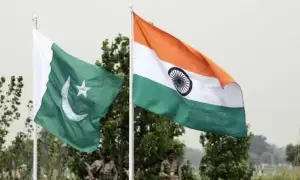
I AM veering round to the viewpoint that Atal Behari Vajpayee might have pushed the India-Pakistan dialogue faster and farther than Prime Minister Manmohan Singh has done. Yet when I talked to the latter some months ago, I found him more articulate and more forthcoming than Vajpayee had been when he was the prime minister.
My hunch is that if it were up to Mr Singh he would have gone ahead but the Congress that he represents is too cautious, too unsure of what it can concede. The party believes that if it were to make even a small concession to Pakistan, it would be suspect. On the other hand, the BJP, the Congress imagines, could get away with any concession, without arousing fear in the majority, because of the partys Hindutva credentials. There is a grain of truth in it. But the Congress exaggerates its misgivings.
The country has reaffirmed through the last general election that its temperament is secular. It has brought down the BJP by 35 seats, from 183 to 148 in the Lok Sabha (lower house). In the past few years, people in India have also indicated that they are keen to foster good relations with Pakistan. Be it contact, cricket or a colloquium, a new type of equation is emerging between the two sides.
Tension is absent. The fear to go across the border has disappeared. Instead, there is an ardent desire to visit each others country. Could anyone have imagined a decade ago that there would be a wave of sympathy sweeping the urban India in the wake of earthquake in the Kashmir area under Pakistan? The desire to render assistance was spontaneous. Not only did the organizations but also individuals send money and material on their won. I saw in Delhi women going from house to house collecting cash and clothes for the victims. Even the fundamentalist among the Hindus raised no voice against New Delhis contribution of $25 million to Islamabad.
However, the amiable atmosphere has been vitiated by the Delhi blasts which claimed 70 lives. The murder of M.R. Kutty, a truck driver working in road construction in Afghanistan, has further spoilt the climate. Indias National Security Advisor, M.K. Narayanan, has said that Pakistan had a role in the Talibans killing of Kutty because it was wary of growing friendship between India and Pakistan. (Narayanans contradiction that he was misquoted has been considered a denial under pressure.) A new spurt of violence in Kashmir has also cast its shadow over the pace of normalcy.
Yet the general tendency is not to dwell on negative developments. Unlike the past, there is now an effort to take things in their stride. It is recognized that certain desperate elements in Pakistan, particularly some in the armed forces, are trying to thwart the peace process but the distinction is made between the people of Pakistan and the establishment. The first is trusted implicitly while the second doubted unquestionably. The inclination to have good relations with Pakistan still overwhelms the negative feelings. That is what should weigh with New Delhi.
Unfortunately, the mindset bureaucrats and the prejudiced intelligence agencies call the shots. They have a fixed line and they have not departed from it even in the new environment. The government understanding is based on the information they feed and that is the reason the peace process doesn’t pick up speed.
Knowing that the Pakistan establishment believes in maintaining distance, we do not have to react in the same way. Our endeavour should be to defeat its designs and go over its head to appeal to the Pakistanis. People-to-people contact has proved that conciliation is possible despite the Pakistan establishment. President General Pervez Musharraf has himself conceded that they could not resist the pressure of people-to-people contact.
Since Manmohan Singh has said that the peace process is irreversible, our policy has to be such that can retrieve people on the other side. They must see India reaching out to them as happened during the earthquake. Breaking away from the past is essential. New Delhi must go out of the way to improve relations with Islamabad, however obnoxiously it may behave at times. Only then will Pakistanis realize that while India is making concessions, their own country is not responding.
Trade is one field where we can make the difference felt. Unilateral concessions in excise and duty can make Pakistani goods competitive or even cheaper in Indian markets. The best is to let goods from across the border come without any levy of any kind. If this is too bold a step for New Delhi to take, let it select 30 or 35 commodities for free entry. We are already 40 years behind. Had we taken such a step earlier, the entire scenario would have changed by now. Pakistanis would have developed a vested interest in Indian markets. It is still not late to let them take advantage of Indias vast market, unhampered and unencumbered.
The two points on which the peace talks are stuck are the Sir Creek and the Siachen glacier. In the first case, there is a map of 1913 which indicates the division of the Sir Creek. When we insist that China accept old maps for delineation of borders between the two countries, why not go by the 1913 map on the Sir Creek? After the settlement at the Rann of Kutch on the basis of arbitration, there is hardly anything left in the Sir Creek. We are now going to the sea to determine what should be the line. This is a waste of effort.
Take the Siachen glacier. When in service the Indian generals say that it is of great importance. But once they retire, they argue that the glacier is of no strategic value. Our prime minister has described it as the mountain of peace. Why not travel towards that vision? Troops on both sides may have to be redeployed and, at one time, there was such an understanding. We reversed the decision. New Delhis purpose should be on how to convert the glacier into a mountain of peace. We can continue to have aerial surveys even after that.
Concessions on Sir Creek and the Siachen glacier are not worth stoking fires of estrangement. India does not concede much if it makes the concessions. On the other hand, its gesture will convince people in Pakistan that India is doing its best. Strengthening the people of Pakistan is important because they are fighting a battle for the restoration of democracy. Peace with India, still considered an enemy in their textbooks, is important because in that lies the hope of Pakistanis to return to a civilian rule.
The writer is a leading columnist based in New Delhi.
Bosnia’s slow progress
Before the war in Iraq, Bush administration policy-makers used to deride the elaborate nation-building regime the Clinton administration and the European allies created in Bosnia. Now, perhaps, they might learn something from it. Ten years after the United States brokered the end of a bloody civil war that killed more than 200,000 people, Bosnia remains at peace and is inching toward reconciliation, thanks to the continued presence of Western peacekeeping troops, an international overseer and aggressive multilateral diplomacy. Its leaders agreed last week to prepare constitutional reforms by next March that will knit the country closer together and make effective policing and foreign investment more feasible. They also opened negotiations with the European Union on an association agreement. Though it will probably take another decade, the bloodiest battleground of the Balkan wars of the 1990s at last appears headed toward becoming a stable part of Europe.
To its credit, the administration has helped Bosnia along in recent months after conspicuously ignoring the Balkans during President Bush’s first term. Undersecretary of State Nicholas Burns pushed for the constitutional agreement, which was announced in Washington; he also persuaded Bosnian Serb leaders to publicly call for the surrender of indicted war criminals Radovan Karadzic and Ratko Mladic. The reforms are meant to remedy the weaknesses of the 1995 Dayton accords, which created a loose confederation in Bosnia featuring two self-governing republics and three presidents. Though it succeeded in ending the war, the peace deal left Bosnia to limp along under a powerful international high commissioner; some 7,000 of the 60,000 U.S. and European troops deployed a decade ago are still there. If the new reforms take hold, the high commissioner will relinquish power. But foreign troops will probably remain for some time, and Bosnia will remain under the tutelage of the European Union for years while preparing for membership.
Some of the architects of the Iraq invasion regarded Bosnia as an example of how excessive international interference could breed dependence and prevent postwar reconstruction. But the real lesson it offers is how active and sustained international intervention must be to rescue a failed state. Communities that have been slaughtering one another — like the Bosnian Muslims, Serbs and Croats —cannot create and accept a new political system overnight. Establishing security and rebuilding a minimal level of trust is the work of many years. After a decade of Western peacekeeping, political supervision and development aid, Bosnia at last seems to be moving forward, but its own leaders say it may be another decade before they live in a normal country. As Americans think about how to stabilize Iraq and Afghanistan, Bosnia offers a sobering measure of what may be required.
—The Washington Post
| © DAWN Group of Newspapers, 2005 |