0
0

 WHERE is the world’s biggest single oil reserve? Logic will point toward the Middle East: Saudi Arabia, Iran, Iraq etc. Most of the people outside the petroleum industry and some insiders too have never thought of Canada as an oil rich country.
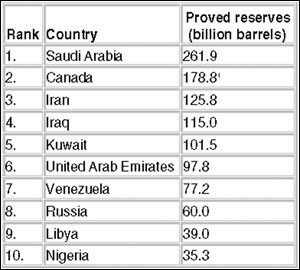
Canada has not only the single biggest oil reserve in one place__ Athabasca, in the province of Alberta __ but also the second largest reserves in the world, after Saudi Arabia. Much bigger than those of Iran and Iraq and almost double that of UAE.
Some of the estimates even put Canada’s oil reserves close to Saudi Arabia at 250 billion barrels. The reason why Canada is not a known as a major oil producer is that oil is not found in its crude liquid form in Canada. It is in the form of oil sands, a complex hydrocarbon compound.
Biggest Oil Reserves by Country, 2005 Rank Country Proved reserves (billion barrels) 1. Saudi Arabia 261.9 2. Canada 178.81 3. Iran 125.8 4. Iraq 115.0 5. Kuwait 101.5 6. United Arab Emirates 97.8 7. Venezuela 77.2 8. Russia 60.0 9. Libya 39.0 10. Nigeria 35.3 NOTES: Proved reserves are estimated with reasonable certainty to be recoverable with present technology and prices. 1. Includes 174.5 billion barrels of oil sands reserves. Source: Oil & Gas Journal, Vol. 102, No. 47 (Dec. 10, 2004). From: U.S. Energy Information Administration.
Oil sands are complex mixture of clay, sand and water. Around one to 20 per cent—depending of where you have extracted it— of oil sands is bitumen. Bitumen is oil but it is extremely viscous and much heavier than the ordinary oil.
It is said that around 120 million years ago, a series of shock waves, which led to the formation of Rocky Mountains, compressed the sedimentary rocks found there, resulting in crude oil. Much before that all this area was a vast ocean. This crude oil, over many centuries, changed into bitumen. Beside Athabasca, the other two areas in Canada where we find accumulation of oil sands, are Peace River and Cold Lake.
The mining and extraction of oil sands is a complex process, resulting in costs per barrel which are much higher than the costs for crude oil drilling in Middle East. Oil sands are mined from open pits and then mixed with hot water to form slurry. The slurry is then shifted to special separation vessels that segregate the slurry into three layers: bitumen, sand and water.
Bitumen is skimmed off from the top and processed further. The processing mainly consists of upgrading which is breaking bitumen into smaller molecules, removing carbon, sulphur and nitrogen and adding hydrogen. Coking, hydrotreating, catalytic conversions are used to achieve the resulting synthetic crude oil.
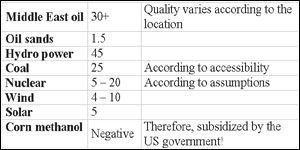
 Now let us discuss the issues which have inhibited the extraction of the Canadian oil sands for all these years. The first issue is the EROEI, energy returns on energy invested. In layman terms, EROEI tells you how many units of energy you can get by spending one unit of energy. The following table shows you the EROEI of various energy sources.
Middle East oil 30+ Quality varies according to the location Oil sands 1.5 Hydro power 45 Coal 25 According to accessibility Nuclear 5 – 20 According to assumptions Wind 4 – 10 Solar 5 Corn methanol negative Therefore, subsidized by the US government! Source : http://www.abelard.org/briefings/energy-economics.asp
It is clear that Middle East oil is much cheaper source of energy than oil sands. This is due to two reasons. First, oil sands had to be converted into crude oil after a lot of inputs and processing as described above. Secondly, this process of conversion requires energy. So, as energy prices increase, making it economically feasible to extract oil from the oil sands, the price of extraction also increases, making oil companies think again.
But with the two-fold increase in the price of oil and concerns about supply from the Middle East, oil sands extraction on a massive scale has been pushed into the realm of possibility. Already, according to the Canadian Finance Minister, Mr. Goodale, $63 billion investment has been committed in oil sands over the next fifteen years.
Extreme climate is another factor that makes the extraction of oil sands difficult. The Athabasca field, largest oil field in the world, is located near the city of Fort McMurray where average temperature remains below zero for more than six months and can drop to minus twenty to minus thirty degree centigrade for weeks. Obviously, it is not easy for employees of the oil companies to work there. Workplace accidents regularly happen and suicide rate is quite high.
Oil companies working in Canada also worry about the time when open pit extraction will not be possible. Almost eighty percent of the Canadian oil sands are deep down and open pit mining is impossible. Bitumen has to be drilled from deep depths. Several techniques, called ‘in situ’ techniques have been developed.
Steam is first injected into the oil sand which lowers the viscosity of bitumen, making it possible to bring it to the surface as it is lighter and in liquid form. It is then processed in the same way as bitumen extracted from the open pits. These ‘in situ’ techniques, however, further increase the costs of getting oil from oil sands.
Despite all these concerns, future of oil sands extraction looks bright as oil prices are increasing and new technology developments are lowering the extraction costs.
There is also talk of using nuclear energy to bring the extraction costs down. Other nations and multilateral bodies have also started taking notice of Canada’s resource. Recently, an IMF committee urged greater investment to expand refining capacity__ particularly to accommodate the ‘heavy oil’ i.e. oil sands found in Canada. But whether Canada will become Saudi Arabia of the twenty first century is a question still difficult to answer.