0
0

Language controversy
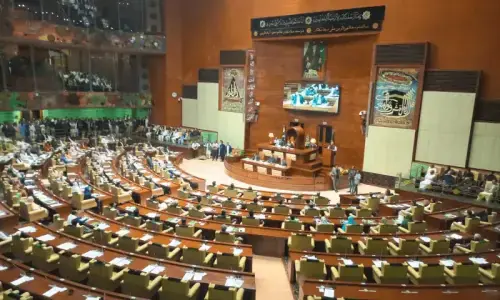
IT IS a pity that the language controversy in Sindh, which was believed to have been laid to rest 33 years ago with the adoption of the Official Language Bill of 1972 by the Sindh Assembly, has reared its head once again. The language crisis, which had led to widespread agitation and loss of life in the province in 1972, had been resolved in a spirit of goodwill between the Sindhi speakers and the migrants, most of whom speak Urdu. This spirit was reflected in the 1972 act under which Sindhi, which was recognized as the official language of Sindh, and Urdu were to be taught as compulsory subjects in classes IV-XII. This was to be done progressively over the years. Sindhi was introduced up to the matriculation level in the seventies. Although Urdu has emerged as a link language in the country and most people speak it quite fluently, this would hardly justify the neglect of any regional language in its home province.
Sindh is a special case in view of the bilingual and multiethnic composition of its population. To promote cohesion among the Sindhi and Urdu speakers, it was logical to give equal weight to the two languages. That is how ‘salees’ (easy) Sindhi was made compulsory for Urdu speakers and vice versa. The system worked quite well over the years, though Sindhi was not introduced in college (Class XI) as it should have been under the 1972 law. Probably this was overlooked, because that was also the period when colleges were nationalized and a period of instability began in the education sector.
When the government recently decided to rectify this lapse and introduce Sindhi salees for Urdu speakers in Class XI, there was a strong reaction from several quarters. Those resisting the introduction of Sindhi in college have done so for several reasons. There are, of course, the chauvinists who erroneously feel they don’t have to learn Sindhi. There are others who are disturbed by the administrative aspect of the matter. The notification was issued after classes had started in colleges in August. A substantial number of Sindhi language teachers have to be recruited and textbooks provided. After a flurry of notifications introducing the subject, then withdrawing it and then ambiguously providing a choice between Urdu and Sindhi salees, the Sindh chief minister made it clear that the matter had been finally settled and that Sindhi would be taught to Urdu speakers in Class XI. A notification to that effect has yet to be issued. Language can be an emotive issue and is easily politicized as we have already learnt the hard way in the case of Bengali in East Pakistan. For people living in an area it makes sense for them to learn the language of the indigenous population. Why shouldn’t everyone learn Sindhi in Sindh? The intermingling of languages and cultures enriches society and it should be encouraged. The only problem is our failure to consider the practical steps needed, such as recruiting well-trained teachers who can make the students proficient in a particular language — be it Urdu or Sindhi. The second problem is that the authorities have the propensity to take vital decisions at the eleventh hour. They then try to implement them without proper planning and preparation. This opens the wisest of moves to exploitation by vested interests.
Monstrous absurdity
IT is an extraordinary statement that seems to scuttle the very basis of all peace plans and “processes” that have been launched over the years to resolve the Arab-Israeli conflict. “I don’t think a Palestinian state will see the light of day in the coming years”, said Israeli Defence Minister Shaul Mofaz as quoted by the Israeli press. More menacingly, the hawkish minister doubted if Israel could reach a peace agreement with the present Palestinian leadership. “We must wait for the next generation,” Mr Mofaz was quoted as saying. The statement comes in the wake of fresh violence in Gaza, with Prime Minister Ariel Sharon deciding to suspend further talks with the Palestinian Authority unless it cracked down on Islamist hardliners. The truth is that any occasion is good enough for Israel to not only break off talks with the Palestinian leadership but to cast doubts about the very idea of a Palestinian state coming into being. When Yasser Arafat was alive, Mr Sharon refused to negotiate with him, saying he must first crack down on the militants. After his death, Israel has never consistently talked to the post-Arafat leadership consistently.
The US still remains pledged to the two-state solution, but the Likud leadership continues to flout this idea by every means, including the continued expansion of Jewish settlements, the construction of the separation barrier and the usurpation of more Palestinian land. Now the defence minister speaks of waiting “for the next generation” of Palestinian leadership for talks to begin. This is the kind of monstrosity and military arrogance that Nazi Germany displayed towards its neighbours and occupied territories. Israel has no choice but to vacate the West Bank. It pulled out of Gaza but not before countless Palestinians had been killed, maimed, expelled and their economy ruined during the 38 years of its occupation. Among the killed were also hundreds of Israelis. The Zionist leadership could have saved all those lives by quitting much earlier. Will the Israeli leadership repeat its mistake and quit the West Bank only after thousands more have been killed? Why not save lives and do today what the irresistible force of history will make it do some time in the future?
Relief camps must continue
THE fear that support for earthquake victims would taper off soon seems to be happening already, judging by the disappearance of relief camps from Rawalpindi and Islamabad. According to a report in this newspaper on Wednesday, of the 100 roadside camps that had sprung up the week after the earthquake, only a few remain. This is particularly disturbing as international aid officials are emphasizing the need for relief work to continue as many survivors have yet to receive any assistance. Undoubtedly, the public and several NGOs have played a valuable role in facilitating the collection and distribution of relief goods. The outpouring of support witnessed all over the country may lose momentum once Eid is over as people, volunteers included, return to their everyday lives. To ensure that earthquake victims are not forgotten, NGOs involved in humanitarian relief work must keep the process going and ensure it is not weakened by apathy or indifference. It is possible that organizations have moved on from collecting goods and are now devising new strategies, which may explain their absence from the field vis-a-vis their camps. It is also possible that many have had to shut down temporarily because they did not have proper staff to man them. It is important that aid organizations adopt a proper system for collection, transportation and distribution of relief goods without gaps or lapses.
There are also cynics who believe that a few organizations are cashing in on the outpouring of support by appropriating the funds for themselves before disappearing. This may be true of a few groups but certainly not of the many which are involved in the relief process. It remains even more important for people to check the credentials of the group they are donating to. Earthquake victims are still relying on peoples’ generosity, for which bona fide camps must continue with their good work.
Raising more funds for reconstruction
DONORS at the UN-sponsored international conference in Geneva held last week have pledged far less funds for providing relief and shelter to the October 8 earthquake victims than what Pakistan had expected. In fact, the new pledges by the 60 countries which attended the conference amounted to only 15.8 million new funds; the rest of the 580 million had been pledged earlier, most of it for reconstruction work to provide homes to the 2.5 million rendered homeless.
The UN officials, including secretary-general Kofi Annan, dealing with the aftermath of the worst earthquake disaster in the history of Pakistan have been much disappointed by the small figure of 580 million. Voicing their dissatisfaction were the staff of the UN, the World Food Programme, the Unicef and allied agencies.
Senior UN officials like Jan Egeland who look after relief work and have noticed the increasing number of deaths on account of tetanus in the quake-affected areas are aware of the horrible consequences that an inadequate medical relief to the 73,000 injured can cause as they are dealing with such problems on a day-to-day basis. They talk of the funds being available for only two weeks.
There are a number of reasons why the donations are small, barely 10 per cent of the five billion dollars that is needed. Donors, it is stated, are suffering from aid fatigue particularly after they had contributed 10 billion dollars for the aid of the affectees of the Indian Ocean Tsunami, followed by those of the hurricanes Katrina and Rita in America. Added to that is the forecast or fear in America that it may face more hurricanes or other natural calamities in the near future.
Another reason is that Pakistan economy is doing very well and has recorded a growth rate of 8.4 per cent last year and hopes to achieve a seven per cent growth this year; it boasts of having the best performing stock exchange in Asia; its tidy foreign exchange reserves are also taken note of. But if rich America can appeal for help to the world in the aftermath of hurricane Katrina, there is no reason why Pakistan should not seek global assistance.
But Pakistan is in the 13th group of corrupt countries in the world. It is up from its 2nd and 3rd position earlier because many African countries are perceived to be far more corrupt. Leaders in Pakistan have been talking of turning the challenge in to an opportunity and prepare the region for tourism by constructing hotels, motels and other tourist facilities.
Of course that should be done, but by Pakistan with Pakistani funds and this is not the time to talk about it too loudly, while appealing for funds for relief. Hence John Wall, the World Bank representative in Pakistan, has cautioned the country against misuse of relief and reconstruction funds. One good result of the tragedy is that India and Pakistan have come closer in their working relationship to help the survivors, particularly those who can be accessed more easily from the Indian side of the LoC.
Earlier, Pakistan had suggested five points on the Line of Control for Kashmiris on both sides to cross and comfort each other and India suggested three points. But following a meeting in Islamabad of the foreign office officials, India has agreed to the proposal of five points for crossing from November 7. The crossing will have to be done initially on foot as the paths are damaged. And that has been welcomed by Mir Waiz Umar Farooq who had earlier described the LoC as an evil line that must be abolished.
John Egeland says most of the 580 million dollars pledged now are for reconstruction work and posed the question: of what use these funds would be if many of the survivors were to die in the icy Himalayan cold. Following Pakistan’s appeal to the European community for help the Nato is sending one thousand trained personnel to Pakistan. Some political circles have raised strong objection to the presence of Nato soldiers on Pakistan soil. But the Nato men, it has been clarified, are either engineers or other technical personnel and they will leave soon after their work is over. Among them are 370 soldiers from Spain and they will leave as soon as their assignment is completed.
If we can have 200 US soldiers on our soil to do relief work and are to be joined by another 200 soon, some of them with helicopters, any objection to Nato presence becomes irrelevant.
The country is gradually coming to realize the impact of the earthquake on the economy and we cannot pretend that it will be business as usual. The State Bank of Pakistan says the growth target of seven per cent may have to be revised down by 0.2 to 0.4 per cent and the deficit may rise to four per cent. And inflation may rise to 8.3 per cent from the projected 7.75 per cent.
President Musharraf has set great store by the next conference of donors to be held in Islamabad on November 19. He hopes the donors will be more generous in Islamabad than they were in Geneva. And If they are not, and the Islamabad conference turns out to be a repeat of the Geneva, then Pakistan will have to mobilize itself around Rs 300 billion (five billion dollars) to complete the reconstruction work. But he expects a happy outcome with the help of five top US businessmen including the Citibank chief assigned by President Bush to raise funds for reconstruction.
Former President Clinton is also to visit Pakistan with a package of ideas designed to carry out reconstruction work more economically. The US administration may also come up with larger funds, although President Bush is not parting with his money easily. China also intends to step up aid for reconstruction after providing a larger quantity of tents.
A multi-faceted plan is ready with an implementation strategy, says Gen Musharraf. But how can such a plan be ready even before the extent of the damage done by the earthquake has been assessed. The report of the losses will be available by November 15, four days before the donors’ conference. Or is he having only the outline of a multifaceted plan, which will be revamped in the light of new developments.
There are suggestions that the defence budget of Rs223.5 billion should be cut and the annual development plan be revamped in the light of the new pressures on the economy. But the president says the defence budget will not be cut, nor will there be any other major cut in budgetary allocations. The latest CBR statement shows the tax collection for the first four months of the financial year, ending 0October 21 at Rs195.1 billion as in excess of the target.
It is too early to talk about the total external aid pledged and also actually delivered for reconstruction. We may have a clearer picture only after the Islamabad conference. Anyway the president has made it clear that if he runs short of money, he can draw that from the 12.5 billion foreign exchange reserves. What is obvious is that the external fund to become available will largely be loans at concessional rates of interest and not grants.
While shortage of tents is a major problem, the government appears to have secured 228,000 so far and will add another 500,000 more by the end of this month. The president also proposes to set up a national volunteers corps of young persons above 16 to work in the areas to be reconstructed. How good will be the response, particularly from doctors and engineers, to join this force remains to be seen.
According to the president, five per cent of the quake-devastated areas may have not been accessed by the relief workers. And it is possible that it may be more than five per cent. With those beneath the debris coming out alive even after three weeks, the urgency of reaching out to these areas can hardly be over-emphasized.
The Alliance for Restoration of Democracy meanwhile wants a joint enquiry commission to probe into what it calls the “failure” of the military high command to act in time following the October 8 earthquake. The ARD statement says that if the army high command had acted more promptly and efficiently, thousands of more lives would have been saved. The government may not agree to such a joint commission, but the need for an impartial enquiry cannot be denied. If no commission or committee is appointed now, the demand for setting up one will keep on coming from time to time.
| © DAWN Group of Newspapers, 2005 |